
.png)
Featured Blog
Outreach named a Leader in the Forrester Wave™ for revenue orchestration
September 24, 2026
Learn more
Get tips, tricks, and best practices from top sales leaders
Outreach named a Leader in the Forrester Wave™ for revenue orchestration
September 24, 2026
Meet Kaia: The complete guide to Outreach's conversation intelligence
September 16, 2026
Account planning workflow benchmarks: what 148 real sales sessions reveal
July 28, 2026
AI Adoption for Revenue Teams: Leading Without Change Fatigue
July 24, 2026
%20Large.jpeg)
The AI readiness gap: why revenue teams need a stronger execution foundation
October 8, 2026
TL;DR: A new Forrester Consulting Total Economic Impact™ study commissioned by Outreach modeled the potential financial impact of Outreach for a composite organization, finding 244% ROI, $19.2M in benefits present value, $13.6M net present value over three years, and payback in under six months. One important takeaway from the study: the measurable value modeled today is grounded largely in workflow standardization, automation, execution consistency, and visibility, while AI and agentic capabilities represent additional upside as adoption matures. Read on for the breakdown.
Every revenue organization is under pressure to show that AI can improve productivity, not just add another layer of tools. Gartner, Inc. predicts, “By 2028, AI agents will outnumber sellers by 10 times, yet fewer than 40% of sellers will say AI agents have improved productivity.” Gartner also warns that more agents will not automatically translate into productivity gains without the right data foundation, workflow integration, and seller experience. That is the real readiness gap: AI adoption alone does not create value; the systems underneath it determine whether AI can improve execution at scale.
So if AI adoption alone does not guarantee productivity gains, what separates the organizations that will capture value from those that simply add more tools?
A new 2026 Forrester Consulting Total Economic Impact™ (TEI) study, commissioned by Outreach, offers one lens: the measurable value modeled today is tied to the workflows, data, and execution foundation underneath the technology.
AI is only as good as the context it can act on. Teams running fragmented, disconnected systems hand AI an incomplete, ungoverned picture, no matter how capable the model is. That's the difference between having AI and being efficient for AI. And it's why agents without trusted context and clear guardrails aren't just less effective, they're a liability.
An agent working from bad data can automate the wrong action just as fast as the right one.
The pressure to close the AI readiness gap is real. Gartner, Inc. found that sales organizations providing sellers with AI-enabled next-best actions are 2.6x more likely to achieve commercial growth, and that organizations prioritizing AI upskilling for sellers are 2.4x more likely to achieve strong revenue growth. Gartner also found that B2B buyers used an average of seven information sources during a recent purchase, and 45% used GenAI, primarily to gather information on vendors and products. The takeaway: AI is reshaping both sides of the buying process, but adoption alone is not enough. The real question is whether revenue teams have the workflows, data, and execution layer underneath AI to turn signals into action.
Feature checklists are easy to produce. Business impact is harder to quantify, which is why the Forrester Consulting Total Economic Impact™ study modeled the potential financial impact of Outreach for a composite organization. Forrester Consulting interviewed four decision-makers at organizations using Outreach and modeled the results into a composite organization: a B2B company with $9 billion in annual revenue, 20,000 employees, and a 6,000-person revenue organization.
Those numbers break down into four benefit drivers that are grounded in consistency and execution at scale:
Before Outreach, interviewees described exactly the kind of fragmentation the readiness gap predicts. The global head of GTM at a software organization put it plainly: workflows were "very rep dependent," reps were "doing things off spreadsheets," and the process was, in their words, "completely archaic."
The report study notes that most measurable value today comes from workflow standardization, automation, execution consistency, and visibility, while AI and agentic capabilities represent "a source of future value as adoption matures." In other words, the modeled ROI is grounded largely in the foundational work many organizations are still building.
For leaders weighing where to invest next, one important point is that the modeled return was grounded largely in foundational workflow, automation, and execution capabilities while agentic AI remained earlier in adoption.
The composite is still in early pilots with Amplify, Outreach's AI and agentic workflow offering.
The same unified data and workflow layer that supported the modeled value is also important for agentic AI to work well and be trusted to act on. Fragmented systems can give AI a partial, ungoverned view of the customer, the deal, and the rep.
A consolidated foundation gives it the full picture and the guardrails to act on it responsibly — which is what turns AI outputs from generic to precise, and turns AI from a task-level assistant into something that can run an entire workflow with confidence.
Organizations that have already done the consolidation work may be better positioned to capture additional value as agentic AI matures on top of that same foundation.
What is a Forrester Total Economic Impact™ (TEI) study?
A TEI study is an independent research methodology developed by Forrester Consulting that evaluates the potential financial impact of a technology investment — measuring benefits, costs, flexibility, and risk to calculate ROI, net present value, and payback period. This study was commissioned by Outreach and based on interviews with four decision-makers at organizations using the platform, aggregated into a single composite organization.
Why does workflow consolidation matter for AI value?
Why does workflow consolidation matter for AI value? AI is only as effective and trustworthy as the data and context it can act on. A fragmented foundation can give AI an incomplete, ungoverned picture; a unified data and workflow foundation can give it more complete context and clearer guardrails. In the TEI study, the measurable value modeled today is grounded largely in workflow standardization, automation, execution consistency, and visibility, while AI and agentic capabilities represent future upside as adoption matures.
What did Forrester Consulting model about ROI from Outreach specifically?
Forrester Consulting modeled the potential financial impact of Outreach for a composite organization representative of the interviewees' organizations, finding 244% ROI, $19.2M in benefits present value, and $13.6M net present value over three years, with a payback period of less than six months. The modeled benefits came from productivity gains, improved sales effectiveness and efficiency, and retirement of legacy point solutions.
How doesWhat’s our take on how this relates to Outreach being named a Leader in the Forrester Wave™?
They are two different lenses. The analyst-led Forrester Wave evaluates platform capabilities and strategy against a defined set of criteria — where Outreach earned the highest possible score in 15 of 22 criteria in The Forrester Wave™: Revenue Orchestration Platforms for B2B, Q3 2026the Q3 2026 Wave.
The commissioned Forrester Consulting TEI study models the potential financial impact of Outreach for a composite organization based on customer interviews. Used together, we believe these assets can help buyers evaluate both platform capabilities and potential business impact.
How does this connect to agentic AI value going forward?
The TEI study notes that most measurable value today came from workflow standardization, automation, execution consistency, and visibility, while AI and agentic capabilities represent future upside as adoption matures. Because agentic AI depends on a unified, governed data and workflow foundation, organizations that have consolidated their revenue stack may be better positioned to capture additional value as those capabilities mature.
Forrester does not endorse any company, product, brand, or service included in its research publications and does not advise any person to select the products or services of any company or brand based on the ratings included in such publications. Information is based on the best available resources. Opinions reflect judgment at the time and are subject to change. This report is part of a broader collection of Forrester resources, including interactive models, frameworks, tools, data, and access to analyst guidance. For more information, read about Forrester’s objectivity here .
The hidden cost of fragmented revenue data for GTM teams
October 8, 2026
TL;DR: A number becomes untrustworthy when it disagrees with the other number sitting next to it in a different system. Once revenue data stops agreeing with itself, four costs emerge; the fixes most teams try first do not hold; and finance, sales, and RevOps need one source of revenue data they can all work from.
A deal can close on a Thursday afternoon and get logged three slightly different ways before the week is out. It shows up as a stage change in the CRM, a disposition in the dialer, and a line in the rep's notes with a close date a week off from the other two. Each entry accurately captures its own system's view.
Every number downstream of that deal, the weekly forecast, the board deck, the AI recommendation that surfaces the next morning, inherits the disagreement, and nobody decided it should.
For the finance leaders who sign off on the forecast, and for the revenue operations teams who have to defend the data underneath it, this is what fragmented revenue data looks like in practice.
The same event, a call, a stage change, a closed deal, produces different values in different systems, and none of those systems is authoritative. That missing authority drives the cost, not the number of tools in the stack.
What "one source of truth" means for revenue data
Every system that touches a deal should read the same value for that deal's stage, owner, status, and close date. That shared record is a single source of truth for revenue data. Tool count is a separate question. A team can run one CRM and still hold three versions of "closed" across sales, finance, and customer success, or run five tools and keep one authoritative record that the other four sync from.
Ownership of the definition settles it. Nobody has written down which system decides what "closed" means, so each system decides for itself.
Buying MDM software alone will not close the gap, because master data management is a business discipline before it is a piece of software. That is why fragmentation shows up as a data problem well before anyone notices a tooling problem.
How revenue data fragmentation turns into four hidden costs
Once ownership is missing, the same disagreement moves from the record itself into the work built on top of it. Managers see different numbers in pipeline reviews, reconciliation eats hours before every close, forecasts carry the unresolved argument to the board, and AI agents repeat the error across every recommendation they surface. Each cost hands the next team a problem it did not create.
The same deal produces two different numbers the moment two systems touch it
A rep's note, a dialer's disposition, and a CRM stage field each capture the same event at a different level of fidelity. The note says the buyer verbally agreed, the dialer logs a connected call, and the CRM still shows "negotiation" because the rep last updated it on Tuesday.
Which number a manager quotes in a pipeline review depends on which screen is open. Two managers can leave the same meeting with different pipeline numbers and both be right by their own system.
McKinsey's survey of more than 80 large organizations found that 80% percent reported divisions operating in silos with their own source systems, which creates these mismatches.
The disagreement turns into labor during a reconciliation process. Somebody has to open both systems, pick the version that goes forward, and defend that choice to whoever asks next.
That labor recurs every reporting cycle, and it lands on people who would rather be modeling scenarios. It also ends with a judgment call someone makes by hand, so the "clean" number that leaves reconciliation still carries whichever preference the reconciler brought to it.
A forecast built on a reconciled-but-still-disputed number looks confident and may still be wrong. The board sees a single figure, but underneath it sit two systems that never agreed and one person who picked between them. That leaves whoever owns the forecast defending a number that looks precise but hides an unresolved argument inside it.
Xactly's 2024 benchmark of 405 finance and revenue operations professionals found 52% of sales leaders say their forecasts are off by 10% or more, while 95% still expressed confidence in their ability to plan from those forecasts, which is the shape of a number confident on its surface and unstable underneath.
An agent recommending a next step from an unreconciled record acts on the error that was already there, and it does so for every rep and every account, all day. Inconsistent opportunity updates and mismatched stage definitions undermine pipeline accuracy, and pointing automation at an inconsistent process only spreads the inconsistency further.
Trust follows the accuracy. When sellers see recommendations that contradict what they know about the account, they stop opening the tool, a pattern reflected in Gartner's finding that 66% of sales leaders report low trust in AI-generated insights.
The four costs above make fragmentation visible, so the first response is usually to add a view, add a sync, or run a cleanup. Each one changes how the disagreement looks without settling which number is right, and each one leaves the ownership question exactly where it was before.
A dashboard that puts the CRM number and the finance number side by side surfaces the mismatch clearly, which feels like progress for about a week. Then it becomes a second thing people argue over.
Root causes of inconsistent metrics include data silos where teams create reports without central coordination, missing data governance policies, no report certification process, and no central metric store. A new dashboard doesn't address any of those. It only puts better lighting on the argument.
Speed between two systems and correctness of either system are separate questions. A point-to-point sync from the dialer to the CRM pushes the dialer's version of a call after the call, and if that disposition disagrees with the rep's stage update, the integration has now automated the conflict. Each new connection adds another path for the disputed value to travel, and each one must be maintained.
A cleanup sprint dedupes accounts, backfills close dates, and produces a clean CRM for exactly as long as it takes reps to log the next deals the old way. The sprint cleaned the data while the process that produced the mess kept running. That is why MIT Sloan calls organized cleanup "an endless cycle of fixing errors" and argues the better move is preventing the errors at the source.
These fixes leave the record's decision point unchanged. Settle that decision before purchasing any tooling.
Teams need to make a sequence of ownership decisions before purchasing any tooling.
Start by listing the fields that drive revenue decisions, deal stage, activity, account status, close date, and next to each one write the single system whose value wins when two systems disagree. Do this in a shared document, not in a meeting nobody logs.
A common split gives the CRM stage, the engagement platform activity, and finance-recognized revenue, but the point is that the assignment exists in writing and every team head signs it. Once a system owns a field, every other system becomes a reader.
For each owned field, write four things and put them somewhere every team can read: the field name, the system that owns it, the exact event that changes its value, and the person accountable for the definition.
A page in the team wiki works, starting with the disputed terms: what makes a deal "qualified," what makes it "closed," what makes an account "churned," and which button in which system triggers each. Those are the ones to lock down before anything else. Fidelity built a repository holding definitions of more than 3,000 company data elements and made alignment with that catalog a required rule, but a single page covering the ten terms your team argues about is enough to start.
Schedule a recurring meeting with a named owner from finance, sales, RevOps, and customer success, and give the group authority to decide what each revenue term means. Walk through the disputed terms one at a time, and don't leave the room until each has one owner and one definition everyone agrees to.
Some teams give this standing group a name, a revenue council, with one seat for every function the revenue process touches, and it works because the teams that report from the definition were the ones who agreed to it.
That agreement is usually missing at the start. In EY's 2026 survey, only 29% of CFOs describe collaboration between finance and other functions as open and enabling, with siloed data named as the top barrier.
Change the input path so every stage change, close date, and owner update lands in the owning system first, and turn off the shortcuts that let updates start elsewhere. That includes the spreadsheet a manager updates on Fridays, the close date texted from the road, and the disposition that sits in the dialer without syncing back. If a team needs a faster way to update a field, build the shortcut so it writes into the owning system rather than around it.
The same rule applies to AI agents: any update an agent drafts should post to the owning record, not to a parallel one that will need reconciling later.
Point every AI agent at the owned record as its input, and require human approval before the agent writes anything back. Set human-review thresholds for the outputs that carry the most risk, such as pricing changes, forecast adjustments, and stage moves, and only lower those thresholds after the agent has run cleanly through several reporting cycles.
Forrester recommends sequencing accuracy first, then governance and safety, and only then autonomy. Once trust in a recommendation erodes, sellers stop using it, managers go back to spreadsheets, and the platform takes the blame, whether or not it caused the error.
Add one item to every tool evaluation and every reorg checklist: a check on which owned field the change touches and whether the ownership assignment still holds. Reconfirm the definition for any new tool that writes to a deal field, any acquisition that brings its own CRM, and any new team that reports revenue.
Forrester recommends a two-motion approach with ongoing execution between planning cycles and focused governance reviews inside them, which is a good rhythm to build the reconfirmation into.
The deal from the opening should get logged once, in the system that owns it, with every other system reading that entry rather than writing its own. That is the standard any platform decision gets judged against.
Corpay shows the before and after: its sales development motion logged activity in Excel, email, or notes and ran a dialer that returned no analytics to Salesforce.
Outreach, the only agentic AI platform for revenue teams, won that evaluation on its bidirectional Salesforce sync and support for Corpay's custom objects, and the team reported reliable data integrity from the two-way sync along with better forecasting and pipeline reviews.
Rather than each team defending its own version of a deal, Outreach connects the workflow layer where revenue data is created and acted on, so every downstream system reads from the same record.
Smart Data Enrichment brings account, contact, and buyer-signal data from a customer's preferred third-party providers into that record in a repeatable way. Revenue Agent surfaces prospecting recommendations drawing on CRM, engagement, and enrichment data, and a rep reviews the output, adjusts it, and hits send.
A forecast built this way rests on deals each recorded once, by an owning system, under a definition finance agreed to. It also shrinks the reconciliation cycle that has to be staffed before the number goes to the board.
It means the systems that touch a deal disagree on its stage, owner, or status, and no written rule says which system wins. The CRM, the dialer, the rep's notes, and the finance ledger each hold defensible value, and the disagreement resolves only when someone picks one. The cause is unassigned ownership, not the number of tools in the stack.
Assign one authoritative system per data type (stage, activity, account status, close date), document each field's definition where every team can read it, and get finance, sales, and RevOps to agree on those definitions. Then route every update through the owning system, keep AI recommendations reading from that record with human approval, and reconfirm ownership when you add a tool or team.
Stand up a cross-functional forum where finance, sales, RevOps, and customer success each hold a seat, and the group owns the revenue definitions. Give it authority to decide what "closed," "qualified," and "churned" mean and which system records each. Use the forum to let every team help set the definition rather than inheriting one from another department's system. The same forum should review new tools before they write to a deal field.
They record different events. Sales marks a deal closed-won when the contract is signed. Finance recognizes revenue under ASC 606 and IFRS 15 only as performance obligations are satisfied. A multi-year ramp deal, a termination-for-convenience clause, or bundled setup services can each change the timing of the revenue finance recognizes relative to what sales booked. Shared definitions of bookings, billings, and recognized revenue keep both numbers correct.
Ownership and definition changes can fix fragmented data across whatever systems you already run. They determine which tool is authoritative while preserving the others. Replacement becomes worth considering when a tool cannot sync bidirectionally with the owning system, since a tool that can only write around the record will keep recreating the divergence.

The outbound efficiency metrics finance teams should track
October 7, 2026
TL;DR: Finance and sales often pull outbound numbers from different systems built to answer different questions, so the same quarter can look healthy on one report and unproductive on another. A few key metrics connect outbound spend directly to pipeline and revenue, and the data behind them needs to come from a system that records activity and outcomes together.
Outbound sales is one of the few budget lines where approval and performance review run on different math. Finance signs off on the headcount and the tooling behind an outbound motion. Then it gets asked to judge the return using numbers built for a sales manager: dials, sends, reply rates, the kind of thing that tells a manager whether a rep stayed busy.
Those numbers do not say much about whether the money behind that activity is paying off. For CFOs footing the bill, the real question is whether the pipeline this motion produces is moving in proportion to what it costs.
Outbound efficiency metrics for finance come down to a few important indicators. Each one traces back to cost, sales unit economics, or closed revenue, and none are just activity counts. Sales can keep coaching off the same underlying numbers to improve pipeline velocity. Finance just needs to read them for what they say about spend and ROI, not effort.
Finance and sales tend to look at the same outbound motion through different lenses. Sales asks whether reps are active. Finance asks whether the spend behind that activity is producing proportional pipeline and revenue.
An efficient outbound motion keeps cost tied to output whether the team is growing or holding flat. Double the sales and marketing budget and pipeline generation should roughly double with it. Double the budget and pipeline only grows by a third, and something in the underlying execution changed; the extra spend just made it visible. Finance can read that ratio, spend against pipeline, faster than it can read the total budget line on its own.
Dials, sends, and calls describe how busy a team is. Cost per opportunity ties spend directly to a qualified result instead of counting effort along the way. That difference is why finance reads this number before it reads anything else on an outbound report.
New reps show up on the cost side of the ledger as soon as they are hired, but they take time to ramp before that spend turns into pipeline. Finance typically notices a hiring-and-pipeline mismatch before it reaches a sales manager's dashboard, simply because the cost side moves first. Coaching new hires against clear SDR performance metrics from day one shortens that ramp instead of waiting a full quarter for pipeline data to prove the hire out.
None of these numbers matter on their own. Replies and meetings are steps along the way, not outcomes, and each one earns a place on a finance dashboard only because it predicts something further down the funnel, a qualified opportunity, and eventually closed revenue. That is what separates a number worth a finance review from an activity count that is not.
Finance needs four numbers to understand outbound efficiency, and none of them are raw activity counts.
Take everything an outbound motion costs in a period and divide it by how many qualified opportunities it produced in that same period. That is cost per opportunity created.
The cost side typically includes SDR salary and variable pay, taxes and other non-wage employment costs, engagement tooling and data spend, and a share of management overhead- the parts of the budget an engagement platform does not calculate on its own.
Say a motion cost $200,000 in a quarter and produced 40 qualified opportunities. That is $5,000 per opportunity, and the number only means something once finance and sales agree on a shared definition of a qualified opportunity and use it every time.
Without that agreement, the ratio means whatever each side wants it to mean. When it holds steady or falls as spend increases, the motion is scaling well. When it climbs instead, the extra spend is buying less each period, and finance has a concrete figure to raise before the budget conversation turns into guesswork.
Pipeline generated per rep is the dollar value of qualified pipeline each outbound rep creates in a period, measured against that rep's fully loaded cost. It answers a narrower question than cost per opportunity and directly influences sales unit economics and the CAC payback period. It shows whether adding reps is producing pipeline growth to match, or whether the team is just getting bigger without getting more productive.
Sales can use the same number to compare reps for coaching and pipeline velocity optimizations. Finance reads the team average against the average cost per rep to decide whether the next hire pays for itself, using the company's own trailing quarters as the benchmark rather than an outside one.
Reply rate and speed to lead are execution quality signals. They explain why cost per opportunity is moving, not just that it moved. Response speed is one of the more controllable parts of the whole motion, since it depends on process and staffing rather than the prospect's own timeline.
Lead response time alone can swing conversion by a wide margin, which is why speed to lead earns its own line on a finance dashboard instead of hiding inside a broader activity metric.
A rep who replies within minutes works the same lead pool as a rep who replies the next day, but with very different outcomes. Sales can use both numbers as coaching levers. Finance can treat a slowdown in either one as an early warning that cost per opportunity is likely to move next.
Meeting-to-pipeline conversion rate is the share of meetings that turn into real, qualified opportunities. It checks every volume metric that can look good in isolation. If meetings are rising while this rate is falling, the motion is booking conversations that don't convert, and cost per opportunity will eventually pick up that gap.
A low baseline conversion rate is not unusual on its own, since most of the meetings a motion books were never going to qualify. What matters is whether that baseline holds steady, which is why the trend in this rate matters more than any single period's number.
Sales metrics built for coaching can look healthy while the outbound motion is quietly getting less efficient underneath them. Reading these numbers correctly means checking them against each other, not one at a time.
When pipeline per rep and cost per opportunity both rise together, check whether bigger opportunities are coming from fewer, more expensive conversations, which can be a fine trade. When cost per opportunity stays flat while pipeline per rep falls, check whether the team is creating smaller opportunities cheaply, which usually isn't. The direction deal size is moving tells finance which story is true.
A wider net pulls in lower-fit prospects, and lower-fit prospects reply too, so reply rate alone can rise for reasons unrelated to better messaging. A reply rate that climbs while meeting-to-pipeline conversion falls in the same period usually means a targeting problem, not a messaging win. Looking at both in the same period separates the two cases.
More sends and more calls only count as progress when they keep the cost per qualified opportunity flat or push it lower. Volume aimed at the wrong accounts raises cost per opportunity through wasted activity and low-quality replies, even while the activity dashboard itself looks busier than ever.
Weak prospect targeting is usually the root cause, since a rising send count paired with a flat or falling opportunity count is the clearest sign that volume is chasing the wrong accounts.
Segment, deal size, and outbound motion vary enough across companies that an outside number rarely tells finance whether its own spend is efficient. A company's own trailing quarters, cut by segment, hold up better in a budget review, because they compare like against like instead of against a company running a different motion entirely.
A single efficient month can sit on top of a motion that is quietly getting more expensive, and only the pattern across periods shows which direction things are really moving. Outbound activity in one period tends to produce pipeline later, so reading cost per opportunity as a multi-quarter trend catches problems that a single-month snapshot misses entirely.
That same trend data feeds sales forecasting, since a forecast built on one strong month rarely holds up the next quarter.
Finance teams can assemble these four metrics by hand from several sales tools, but manual reconciliation slows the numbers down and adds room for error at every handoff.
Most sales metrics live in systems built for coaching, not finance, which is why the source system matters more than the spreadsheet built on top of it.
When reply rates live in one tool and pipeline outcomes live in another, finance has to join the two data sets behind all four metrics before it can read any of them. The system that logs the call needs to be the same system that shows what the call turned into.
A monthly export answers last month's question. Finance needs the current state of pipeline per rep and cost per opportunity to make a hiring or spending decision with that quarter's own data, not a snapshot that was already stale by the time it arrived.
When both sides start from the same opportunity definition and the same activity data, the review conversation moves straight to what to do about the numbers instead of arguing over whose spreadsheet is right. A single shared source of data does more for that agreement than any amount of quarterly reconciliation ever will.
Outreach, the only agentic AI platform for revenue teams, pulls engagement activity, call outcomes, opportunity data, and revenue attribution into one system, so finance doesn't assemble these four metrics from separate exports.
Finance still adds its own cost data (salary, taxes, tooling spend, overhead) to turn that platform data into a fully loaded cost per opportunity.
Outreach Conversation Intelligence, powered by Outreach Kaia™, records calls and captures real-time transcription, and Outreach Voice requires reps to log call outcomes and dispositions through its compliant calling features before moving to the next call.
Those logged outcomes, not just call counts, feed directly into the reply rate and execution quality numbers finance is reading, without a separate call tracking tool sitting in between.
Outreach ties revenue attribution directly to the sales cadence activity that produced it, and its Pipeline Generation Report tracks rep productivity over time. Cost per opportunity and pipeline per rep come straight from that platform data instead of a report someone rebuilds by hand each month, and responders are removed from active sequences the moment they reply.
Outreach Deal Agent reads call and meeting transcripts and surfaces recommended updates to opportunity fields, which sellers review, edit, accept, or reject before anything changes in the CRM.
Outreach Research Agent combines internal engagement data with external account information and saves it to fields teams can filter and group by, so finance can read pipeline per rep and cost per opportunity by segment, not just at the team level.
Through Salesforce Headless, Outreach AI agents can also carry out multi-step revenue workflows from the interfaces teams already use, keeping shared, real-time context across systems instead of relying on a one-time handoff between tools.
The mismatch finance runs into with outbound spend usually comes down to which spreadsheet each side trusts, not whether the motion is working.
Finance and sales can start by agreeing on one opportunity definition and one review cadence, then look at the same current pipeline and activity data before changing spend or headcount.
Outreach runs the engagement workflows that create those signals and connects them directly to the opportunity outcomes they produce, while finance adds the fully loaded cost data from its own systems. Reviewing cost per opportunity and pipeline per rep alongside reply rate, speed to lead, and meeting-to-pipeline conversion gives both teams a shared basis for explaining what changed and why.
Finance should ask for cost per opportunity created and pipeline generated per rep as the primary financial outputs, with reply rate, speed to lead, and meeting-to-pipeline conversion explaining why those numbers changed. Compare each measure across quarters within the same segment, using one qualification threshold throughout.
From a finance accountability view, the top KPIs are cost per qualified opportunity and pipeline generated per seller, with meeting-to-pipeline conversion showing how meeting volume becomes real pipeline. Reply rate diagnoses targeting and messaging, and speed to lead measures follow-up. Review all four alongside deal size and segment mix.
Sales efficiency measures the full revenue cycle, comparing revenue or gross margin against total sales investment. Outbound efficiency isolates prospecting and early qualification, up through the handoff of a qualified opportunity to a closing seller, so finance can judge outbound spend on its own before later-stage execution affects the result.
Reply rates can rise when broader targeting reaches more lower-fit prospects, while meeting-to-pipeline conversion falls because fewer of those replies qualify. Stricter targeting can do the opposite. It can mean fewer total replies, but a higher share that becomes pipeline. Comparing both by segment and period shows which case applies.
Finance should get this data from a system that records engagement activity alongside opportunities and revenue, refreshes as the work happens, and uses definitions finance and sales both agree on. That combination removes the manual reconciliation that usually makes these four metrics arrive late and inconsistent.

How to conduct a sales meeting your reps value
October 7, 2026
TL;DR: A sales meeting that runs long, wanders off-topic, or repeats what a written update could have covered costs more than the hour it takes. Reps who sit through unproductive meetings show up to their next call underprepared. This guide covers what belongs on a sales meeting agenda, how to conduct each meeting type, and how to prepare so the meeting earns its place on the calendar.
A sales meeting earns its place on the calendar of a sales manager or account executive only when it has real structure. A weekly check-in that turns into a status-update marathon and a one-on-one that never gets past the pipeline both trace back to the same root cause: no clear plan for what that meeting type is supposed to accomplish.
Left unaddressed, that gap costs more than the meeting itself: reps arrive at their next call less prepared, and managers lose the coaching moment a well-run meeting should create. This guide covers how to conduct a sales meeting that respects reps' time, from building the agenda to running each format well.
A sales meeting is a recurring internal gathering where a sales manager and their reps review performance, share updates, and align on strategy and next steps. Unlike external meetings such as discovery calls or demos, sales meetings include only internal attendees, and their purpose is to give account executives the context and coaching they need to improve sales performance.
Sales meetings generally fall into a few formats depending on cadence and purpose: weekly team check-ins focused on near-term pipeline and priorities, one-on-ones between a manager and a single rep, and quarterly or annual meetings covering broader strategy. The sections below cover how to build an agenda and conduct each format well.
Sales meetings give revenue teams a structured checkpoint to align on performance, share context, and coach in real time, benefits that asynchronous updates cannot fully replace.
Getting these benefits consistently depends on running the right format for each meeting type, covered below.
Not every sales meeting needs the same format. The right type depends on how time-sensitive the topic is and how many people need to weigh in.
A consistent agenda template means reps know what to expect when they walk in, and a manager building the agenda only needs to decide how much time to give each of the following six components.
Give this two to three minutes on the written agenda, enough for one or two individual or team wins, no more. The agenda item itself is simple to build: name the win, name the rep who earned it, and leave the explanation open for them to give live.
Reserve about five minutes for anything reps need to know before the meeting turns to their pipeline: company news, policy changes, new tools, or a shift in strategy. When building this section, list only what changed since the last meeting. A long update section usually signals that updates are being saved up instead of shared as they happen.
Give pipeline review the largest single block on the agenda, typically 15 minutes for a weekly meeting. Rather than writing "review pipeline" as one line, name the three to five specific opportunities the meeting will cover. Note why each one made the list, whether it is a stuck stage, a risk signal, or a chance to accelerate.
Add a short, five-minute slot for reps to share what they are hearing on live calls: which competitors keep coming up, what objections are landing, and where pricing or positioning has shifted. Documenting this consistently turns it into competitive intelligence the whole team can reuse instead of anecdotes that get lost after the meeting.
Build in five to 10 minutes for open questions, since one rep's confusion is rarely unique. This slot also works as the agenda's training placeholder: a manager can plan a specific rep coaching topic in advance instead of leaving it to whatever comes up.
Close the written agenda with a dedicated action items section, not just a verbal wrap-up. In an Outreach survey, 41% of managers named incomplete action items as their biggest frustration with rep follow-up, which is exactly what a visible, revisited action items section is built to prevent.
Once you build the agenda above, a manager still needs to do three things before the meeting starts. Preparation is what separates a meeting that drives action from one that wastes an hour.
Gather pipeline status, conversion rates, and rep activity data before the meeting starts, filtered by owner, close date, and forecast category, rather than compiling numbers manually the night before. Walking in with current sales metrics means less time presenting numbers and more time coaching on what they mean.
Designate a note-taker to capture action items and share them after the meeting, and give a heads-up to any rep whose deal management review is on the agenda so they can prepare context. Rotating meeting facilitation across the team also builds leadership skills and keeps the format from going stale.
Send the finished agenda at least a day before the meeting so reps can gather updates, prepare questions, and know how long to block on their calendar. A shared agenda sets the expectation for length as much as content, which keeps the meeting from running past its scheduled time.
A weekly meeting works best when it stays tactical and moves fast. The goal is to give reps what they need before their next call, then get out of the way.
Block 45 minutes and treat that limit as fixed, not aspirational. A meeting that consistently runs long trains reps to expect it, and the extra time rarely improves the outcome. If the agenda cannot fit in 45 minutes, cut agenda items rather than extending the meeting.
Limit pipeline review to 15 minutes and three to five deals. Ask about deals stuck in the same stage for more than two weeks and deals showing risk signals like a missed meeting or a stakeholder change, rather than working through the full list top to bottom.
Open with a specific win, not a general round of applause, and ask the rep who earned it to explain what worked. Starting with recognition makes reps more willing to surface a stuck deal later in the same meeting instead of downplaying it.
End the meeting by naming who owns each follow-up and when it is due, out loud, in front of the group. Assigning a named owner to every item is what keeps the same issue from resurfacing the following week.
A one-on-one should feel like coaching, not a status report. Structure it around a fixed format so both people know what to expect.
Spend the first two minutes on how the rep is doing, personally and professionally, before moving into work. Skipping this because the agenda feels full usually signals the meeting has drifted into a status update instead of a coaching conversation.
Focus fifteen minutes on the rep's three to five most important deals, prioritizing progression and obstacles over a full pipeline recap. Prepare specific questions ahead of time rather than asking a general status question, since specific questions signal that the manager has already looked at the deals.
Pick a single skill relevant to one of the deals just discussed, rather than a general refresher unconnected to the rep's current work. Reviewing a recent call recording during this portion strengthens sales coaching effectiveness and gives the rep something concrete to practice before the next call.
Close by confirming one or two concrete actions the rep will take before the next one-on-one, tied to the deals or skill just discussed. A short, specific commitment is more likely to stick than a long list of loosely related to-dos.
Quarterly and annual meetings run longer and carry more weight, so they need a tighter structure than a weekly check-in, not a looser one.
Structure the quarterly meeting around performance against the quarter's targets, patterns in recent wins and losses, and priorities for the next ninety days. Keeping the review to these three questions prevents the meeting from turning into a loosely connected list of updates nobody remembers by the following week.
Build the annual kickoff around three pillars: strategic alignment on the year's goals, skill development through training, and team building. Treat pre-work as mandatory rather than optional, since teams that skip preparation typically get far less out of the kickoff itself.
Schedule structured follow-up in the weeks after a quarterly or annual meeting: an immediate recap, a coaching session at the one- to two-month mark, and a skill check at three months. Without this follow-up, most of what gets covered in a longer strategic meeting fades within a few weeks.
A few recurring habits can undercut even a well-designed agenda, and each is easy to spot once a manager knows what to look for.
Outreach, the only agentic AI platform for revenue teams, extends AI support into every phase of the meeting, not only the parts a manager sees on the agenda.
At Avis Budget Group, sales enablement manager Cam Anderson has seen the difference firsthand: "We've seen overwhelmingly positive feedback from teams using Meeting Prep Agent, meeting prep, and AI summaries."
Most sales teams hold a weekly 30- to 45-minute team meeting for pipeline updates and near-term priorities, paired with individual one-on-ones on the same cadence. Layer in a longer quarterly or annual meeting for strategic planning and broader training. The right frequency depends on deal velocity and team size, but consistency matters more than the exact interval. A team that meets every week without fail builds a rhythm reps can plan around, while an irregular cadence makes every meeting feel like an interruption instead of a routine checkpoint.
A sales meeting agenda typically opens with wins and recognition, followed by business updates, a focused pipeline review, competitive intelligence from recent calls, time for rep questions or training, and a close built around clear action items. The order matters: starting with wins sets a productive tone, and ending with owners and deadlines keeps the meeting accountable. Not every meeting needs every component in full depth. A weekly check-in might spend most of its time on pipeline, while a quarterly meeting gives more room to strategy and skill development.
Weekly sales meetings generally run 30 to 45 minutes, enough time to cover wins, updates, and a focused pipeline review without eating into selling time. One-on-ones work well at 30 minutes with a fixed structure. Quarterly or annual meetings can run 60 to 90 minutes, but should include breaks and interactive segments since attention drops sharply after the first hour. A meeting that regularly runs past its scheduled time usually signals the agenda is trying to cover too much, not that it needs more time.
Three practices make the biggest difference: distribute the agenda at least 24 hours in advance so reps arrive prepared, keep the pipeline review to three to five deals instead of a full status pass, and end every meeting with documented action items and named owners. Protecting the schedule matters as much as the content: starting and ending on time signals that the meeting respects reps' selling time. Move anything that could be shared asynchronously over email or Slack there instead of on the agenda.

11 best practices of sales pipeline management
October 7, 2026
TL;DR: A pipeline that runs dry or fills up with stale deals costs revenue teams accurate forecasts and closed-won deals they should have had. These 11 practices, from disciplined metrics tracking to consistent follow-up and clean data, keep the pipeline healthy enough to trust and fast enough to hit quota.
Sales pipeline management is the difference between hitting quota predictably and scrambling to close deals at the last minute. Most teams struggle with pipelines that either run dry or overflow with stale opportunities, usually because disconnected tools and inconsistent data create blind spots.
For revenue operations leaders trying to reconcile that picture across spreadsheets, CRMs, and email threads, the forecasting problem usually starts as a data quality problem.
Strong pipeline management practices give teams visibility into deal health, conversion rates by stage, and coverage gaps, so teams can intervene before deals slip and close more revenue with less chaos. Here are 11 practices that put that visibility to work.
A sales pipeline visualizes the stage-by-stage progression of active deal opportunities, providing a snapshot of overall pipeline health, open deal volume, and expected revenue.
Sales pipeline and sales funnel get used interchangeably, but they describe different things. A funnel visualizes lead qualification: many prospects enter the top, and only a few exit at the bottom as customers. A pipeline shows the stages of the sales process itself and the successive conversion rates between them.
Sales pipeline management is the process of tracking, analyzing, and optimizing active sales opportunities to help reps convert leads and deliver predictable revenue performance.
Effective pipeline management means setting rep quotas, monitoring attainment, ensuring sufficient pipeline coverage to hit quota, and reporting pipeline movement to leadership, freeing up time for high-value work instead of administrative duties. The foundation underneath it is data: the right metrics, tracked consistently, turn pipeline management from a gut-feel exercise into a repeatable system.
Efficient pipeline management comes down to seven specific metrics: coverage ratio, velocity, stage conversion rate, average deal size, average sales cycle length, win rate, and lead response time. Tracked consistently, they give a real-time read on whether the business is on track to hit its numbers, where risk is accumulating, and how confidently leadership can commit to a forecast.
Pipeline coverage ratio measures the total value of open opportunities against the quota target. A healthy ratio sits between 3x and 5x, giving the organization enough buffer to absorb deals that stall or fall out without missing the number. It is a primary input to forecast confidence and an early indicator of whether revenue targets are structurally achievable before the quarter closes.
Pipeline velocity captures how much revenue the pipeline generates per day by combining deal count, average deal size, win rate, and average sales cycle length into a single number. It shows not just what is in the pipeline, but whether it is moving fast enough to deliver on commitments. A sustained drop in velocity is typically the earliest warning sign of a revenue shortfall.
Stage conversion rate shows the percentage of deals that advance from one pipeline stage to the next. Tracking this by stage, not just overall, shows exactly where deals are stalling and separates a volume problem from a quality problem.
Average deal size reflects the mean value of closed-won opportunities over a given period. Shifts here often signal changes in buyer mix, rep behavior, or discounting, and help show whether the business is moving upmarket as intended.
Average sales cycle length measures the time from first contact to close. Longer cycles increase customer acquisition costs, delay revenue recognition, and compress the planning window. When cycle length starts creeping up, it is rarely a sales-only problem and usually reflects broader issues with buyer confidence or internal approvals.
Win rate tracks the percentage of deals that close as won out of all deals that reach a final decision. It is the clearest efficiency measure available to revenue leadership and a primary input to revenue forecasting, since even small changes in this metric shift projected outcomes significantly. Segmented by rep, segment, or deal source, it also tells the business where to concentrate investment and where to pull back.
Lead response time captures how quickly reps follow up with new inbound leads. Slow response time erodes conversion rates on leads the business already paid to generate, effectively increasing cost per acquisition without changing the budget.
No one-size-fits-all formula exists for pipeline management success. Knowing which metrics to track is only half the equation. The other half is building the practices that keep those numbers moving in the right direction. Here are 11 tactics to polish that practice.
Pull pipeline metrics (new leads, pipeline value, deal size) and performance metrics (win rate, response time, time spent selling) into a single dashboard, and review it on the same weekly cadence as pipeline reviews. Reading the two categories together, rather than in separate reports, shows which activities drive conversion instead of leaving it to guesswork.
Layer AI-powered forecasting on top of that dashboard once the baseline metrics are in place. It analyzes historical deal patterns and engagement signals to flag at-risk opportunities and automatically recommend next-best actions, catching risk earlier than a manual weekly review can.
The sales process is a sales team's lifeline. Companies with a well-defined process bring in 18 percent more revenue than competitors without one. A streamlined, consistent process helps teams cut the steps that slow them down, so it is worth the time to define, fine-tune, and standardize a process that supports greater success, including faster pipeline velocity.
Clearly define each stage of the sales process, customize CRM and automation tools to reflect those stages, and set lead-qualification thresholds. This can feel like guesswork without the right data on what is happening at each stage, including gaps and patterns worth replicating.
Few successful sales organizations treat their sales process as fixed. Competitive companies know they must regularly review their process and adjust as market conditions, client demands, and customer expectations change.
Review the current sales process, pipeline, customer feedback, employee input, and KPIs closely to uncover areas for improvement. When trends or patterns emerge, act quickly before they become larger problems.
Make pipeline data quality management a scheduled practice with a fixed cadence. Reps validate their own open deals every week, managers spot-check stage accuracy and required fields monthly, and revenue operations runs a full audit each quarter.
Name a single owner for that cadence, usually someone on the revenue operations team, so it does not lapse after the first busy quarter. Watch out for these recurring sources of bad data during that weekly validation pass.
Each one is harder to catch when a team's systems of record do not talk to one another, so flag them as they come up instead of waiting for the quarterly audit.
Turn on automated activity capture to remove the burden of manual entry. When a platform automatically logs emails, calls, and meeting notes to the CRM, activity history stays current without rep effort.
Build a short research brief for every prospect before the first call, covering recent company news, the buying committee's key stakeholders, and two or three talking points tied to what that account cares about. Skipping this step is what leaves reps improvising in the room instead of leading with something specific to the buyer.
Manual research means digging through LinkedIn, company websites, news articles, and past CRM notes to assemble that brief, time that adds up fast across a full book of prospects.
Score every deal against a qualification framework like MEDDPICC, covering metrics, economic buyer, decision criteria, decision process, paper process, identify pain, champions, and competition.
Record the answers as CRM fields rather than in a rep's notes, so every deal gets a shared, comparable measure of how likely it is to close instead of leaving qualification to intuition, which is how a pipeline turns into a big traffic jam that is unreliable for predicting revenue.
Pull up deals with a low deal health score in the weekly pipeline review and decide on the spot whether to push, requalify, or drop each one.
Set a minimum of five follow-up touches for every new prospect before marking them unresponsive. Only 8 percent of reps follow up with prospects more than five times, even though 44 percent give up after a single attempt, which is exactly the gap a firm minimum closes.
Automate that sequence rather than leaving it to a rep's memory between calls. Manual follow-up falls by the wayside in favor of more pressing work, so scheduling the sequence in advance keeps sellers reaching the right person at the right time instead of chasing underqualified contacts.
Set a clear definition of what counts as a high-value opportunity for the team: deal size above a set threshold, strong ICP fit, or a specific buying signal, and tag deals against it in the CRM so reps can filter and sort by it.
Without a shared definition, every seller decides for themselves which deals deserve extra attention, and effort spreads evenly instead of concentrating where it counts.
Purge unviable, low-value deals from the pipeline on the same cadence, since keeping them inflates coverage numbers without moving revenue.
Concentrating on the deals that clear the bar drives interdepartmental alignment, customer loyalty, and referrals, and can even speed up the sales cycle.
Set up a cross-functional team, one person each from sales, marketing, customer success, and finance, that meets monthly to align on pipeline definitions, handoff criteria, and shared goals. Skipping this structure is what leaves each department competing for funding and working from disconnected systems of record, lowering productivity and profits.
Give every department the same real-time view of pipeline and deal activity through one shared dashboard. That closes the silos that cause friction between teams, so sales, marketing, and customer success work from one picture instead of separate reports.
Map existing content, case studies, webinars, blog posts, white papers, ebooks, and customer success stories, against each pipeline stage, and flag any stage with a gap. An estimated 94 percent of B2B buyers research online before deciding, so a stage with no supporting content is a stage where deals stall while reps build something from scratch.
Assign an owner to keep that library current and easy for reps to search by stage and persona, built from research into customer needs and competitor content. A library nobody maintains becomes a library nobody uses within a quarter.
Tie CRM fields directly to compensation, pipeline reviews, or forecast submission, so entering data stops being optional. CRM implementation that skips this step stalls adoption, since CRM systems are often complex to integrate and roll out without enough training or ongoing support, and users have no reason to change habits until the system is tied to something they are already accountable for.
Track adoption itself as a metric, covering the percentage of required fields completed, time between deal creation and first update, and the number of stale opportunities per rep.
According to a Forrester Consulting study, 60 percent of sales leaders say they lack a well-defined or scientific approach to forecasting, and low CRM adoption is usually why the underlying data cannot support one.
Manual pipeline tracking across spreadsheets and disconnected tools slows teams down. AI-powered sales pipeline software increases win rates by 15percent –20 percent and reduces sales cycles by up to 30 percent compared to manual tracking.
Outreach, the only agentic AI platform for revenue teams, automates pipeline management at every stage, giving teams real-time visibility and predictive insights without the manual work.
Outreach unifies these capabilities into a single system, eliminating the need to toggle between tools while giving leaders complete pipeline transparency from prospecting through close.
Managing the sales pipeline means coordinating many moving pieces, and getting it right can feel like one more mountain to climb. Most teams cannot afford to ignore the benefits of a consistently healthy pipeline, so it is worth investing in the tools and processes that support one.
Outreach's pipeline management capabilities help sales and revenue operations leaders assess pipeline quantity, quality, and maturity. Built-in win modeling helps leaders spot risks early for every seller and confirm there is enough coverage to deliver on their goals.
Review it weekly at a minimum. Sales managers should hold team reviews weekly to assess deal health and coverage, while individual reps check daily to update stages and prioritize outreach. Real-time dashboards remove the need for manual status meetings.
Maintain 3 to 5 times quota in pipeline coverage. Enterprise sales typically need 4 to 5 times coverage, while transactional sales can run on 2 to 3 times. Track historical win rates to determine the right ratio for a specific team.
AI analyzes deal patterns to predict which opportunities are at risk before they stall. It automates pipeline hygiene by flagging stale deals and missing data, surfaces next-best actions for each opportunity, and supports forecasts based on engagement signals rather than gut feel.
Pipeline data quality management is the practice of keeping opportunity records accurate, complete, and current so pipeline reports reflect what is happening in deals. It means clearing stale and duplicate opportunities, enforcing required fields at each stage, and auditing data on a set cadence.
Stop manual deal data entry. Meet Deal Agent.
October 1, 2026
For as long as CRMs have existed, revenue organizations have tried to solve data hygiene problems. Sellers don’t update their opportunities, managers can't get a good read on pipeline health, and before long, gentle reminders about deal updates turn into managers nagging their reps on every team meeting.
The truth is deal hygiene was never a discipline problem. Sure, sellers didn’t get into sales to update data fields. But the real issue is that the moment a piece of deal information exists, and the moment someone writes it down have always been two separate events. Every gap between those two moments is a chance for detail to get misremembered or worse, lost and never manually updated.
As forecasting and pipeline decisions lean harder on AI and analytics, missing deal data compounds the problem. When key fields like “decision criteria” are empty, it’s difficult to qualify individual deals and even harder to qualify deals in aggregate at the pipeline level. And every AI model built on incomplete deal data is only a guess on whether you’ll actually meet quota.
It’s time to reframe deal hygiene from being a manual seller responsibility into an AI-powered workflow. Ask yourself: are you capturing signal when and where it happens? If you’re already capturing buyer and seller conversations with conversation intelligence, you have the foundation for an AI-powered workflow that can keep deal data accurate on behalf of your sellers.
Rather than asking sellers to recall what was said during a meeting and then translate it into a field update, Outreach’s Deal Agent automatically surfaces AI-recommended deal updates and generates custom AI deal summaries.
For sellers this means no more wasted time on manual deal updates. But where does this reclaimed time go? In The 2026 Agent Productivity Impact Report, Outreach found that the majority of reclaimed time is reinvested into customer engagement. That’s the best-case scenario! Sellers are spending more time building pipeline.
For managers this means trusted, reliable pipeline because deal data reflects what actually happened in a meeting. So whether it be during pipeline inspection or a forecast review call, managers can quickly and confidently catch up on key deal insights instead of digging through recordings.
Manual CRM updates create a time gap between what's said in a deal and when it's recorded - that is if it ever even gets recorded at all. That delay costs accuracy. Deal Agent closes that gap by extracting insights directly from conversations—capturing signals at the moment they happen.
This real-time capture approach:
Our Deal Agent reviews your recorded calls and meetings, including historical recordings, then turns those conversations into deal insights – in the form of automatic field updates and deal summaries.
As Michelle Morgan, Research Director at IDC, puts it in a Market Note published earlier this year, “Outreach has shipped, not just sketched, an agentic platform.” Let’s take a look specifically at the Deal Agent.
After meetings conclude, Deal Agent generates AI-recommended field updates based on the signals it picked up during your buyer/seller conversations. Every update links back to its source: the meeting title, a transcript excerpt, and a timestamp that opens the recording to that exact moment. It doesn't just guess. If the evidence isn't there, the field stays untouched, which keeps every update grounded in something a buyer or seller actually said.
Whether fields are updated automatically or surfaced as recommendations is your choice. When surfaced as a recommendation, sellers are kept in the loop with the ability to accept, edit, or reject a recommended field update.
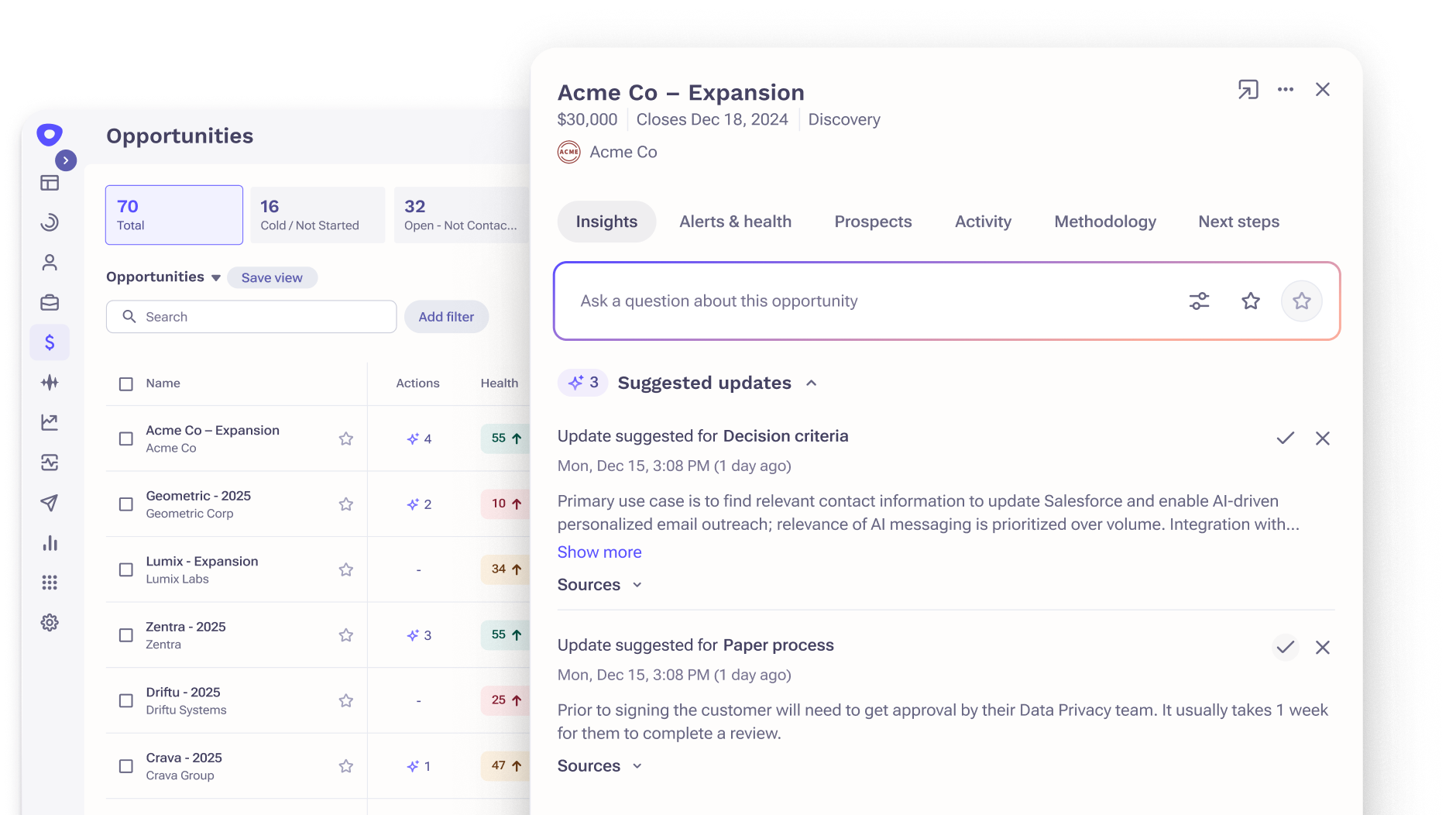
A few ways teams put this to work:
Whether your sales process uses MEDDPICC or a custom methodology, Deal Agent keeps your methodology fields consistent and accurate. And when things change, like your economic buyer leaves the company, Deal Agent tracks this shift and will automatically update the Economic Buyer field to reflect who currently holds budget authority.
This might be the most popular opportunity field. Every seller uses it to keep a running list of their next steps. With Deal Agent’s replace/prepend/append functionality, you can choose the prepend option and automatic updates will keep your next steps field formatted as a running list.
Any organization with a win/loss program looks to their closed-lost field for insight. When that field is left blank or is incorrect, it becomes harder to win your next deal. But with support for field types, Deal Agent can choose the right pick-list value that best matches the closed-lost reason rather than relying on a seller to select a lost reason from memory weeks after a deal closes.
For customer-facing teams, Deal Agent can watch for signals like if your buyer mentions layoffs or budget cuts and update a risk field before the account reaches a formal review.
While automatic field updates keep individual data points accurate, custom deal summaries give managers the full picture without having to dig through every recording and email thread. Deal Agent pulls from meetings, emails, and existing CRM data to generate a structured summary of a deal.
Instead of one generic summary for every deal, Deal Agent automatically displays the summary that matches the opportunity type. Summaries for open opportunities focus on where the deal stands, what risks exist, and what happens next. Closed-won summaries capture everything the post-sale team needs. Closed-lost summaries focus on why a deal was lost and what the learnings were so your team can spot patterns and improve win rates over time.
.png)
A few ways teams put this to work:
Every deal summary can be customized. You get a template, so you don’t start with a blank slate, but can fully customize the details within to match with your business needs.
The theory behind Deal Agent is that deal data stays accurate when it's captured at the source, not reconstructed from memory. The data backs that up. In the past 90 days, deal teams haven't just had Deal Agent running in the background — they've actively used it, checked it, and trusted it. These figures reflect internal usage by Outreach's own sales teams using Deal Agent in their day-to-day workflow.
That kind of adoption doesn't happen by accident. It happens because Deal Agent shows up where teams already work.
Deal Agent meets your sellers where they work via in-app notifications, Microsoft Teams, and Slack DMs and channels.
With Slack support, Deal Agent goes beyond just notifications. When an AI-recommendation requires approval from a seller, they can review/edit/accept the update directly from within their Slack instance.
Already using the Deal Agent? Catch up on the details from our most recent product enhancements, which make Deal Agent even more powerful for your teams.
Deal Agent analyzes your recorded conversations to extract deal signals. Every update links back to the exact moment in the recording where that information was mentioned—it doesn't guess.
You choose. Fields can be updated automatically or surfaced as recommendations that sellers accept/edit/reject. Full control stays with your team.
Yes. When Deal Agent updates an opportunity field, that update is synced back to your CRM.
Deal Agent requires call/meeting recordings to work. If you're already using Kaia (Outreach's conversation intelligence), you're all set. Otherwise, consider enabling recordings first.
Yes. Deal Agent monitors conversations for stakeholder changes—if an economic buyer leaves or a new champion emerges, it updates your fields automatically.
Manual updates rely on seller memory, which creates delays and errors. Deal Agent captures signals in real-time from conversations, creating an audit trail and eliminating the time gap between when something is said and when it's recorded.
How to improve sales performance across your revenue team
October 1, 2026
TL;DR: Quota attainment keeps slipping industry-wide, and most improvement programs respond by adding a new tactic, tool, or training program without first diagnosing what is broken. Find the real constraint behind the number, whether it is pipeline coverage, conversion, deal size, or churn, and match the fix to that specific constraint instead of layering on generic best practices.
Another quarter closes, and the number is short again. The team responds by adding a new sequence template, sending reps to a workshop, or swapping in a new sales methodology, and the next quarter looks almost the same. That cycle is familiar to most sales leaders, and it usually means the team is treating a symptom instead of the constraint underneath it.
The data backs up how common this is. Fewer than half of account executives hit quota in the most recent Bridge Group study. Its 2026 AE benchmark study put attainment at 48%, down from 51% in 2024. Ebsta and Pavilion's 2025 GTM Benchmarks tell the same story from a larger sample, with 78% of sellers missing quota in the prior year, up from 69%.
For CROs presenting those numbers to a board and CFOs funding the plan behind them, the useful question has shifted from "what should we try next" to "what is holding this back." RevOps leaders own the data behind that question, and adding another tactic rarely moves a number held back by a single constraint, so the work has to start with finding that constraint.
Sales performance is how well a sales organization turns the right selling activities and buyer conversations into profitable, predictable revenue from its pipeline. Teams measure it through quota attainment and closed-won revenue alongside pipeline health, sales-cycle efficiency, deal quality, retention, and expansion.
Strong performance means understanding the reason behind the number. The constraint could be market coverage, ideal customer profile (ICP) fit, messaging, qualification, sales skills, deal execution, pricing, process friction, or post-sale customer experience.
Each dimension points to a different owner and a different fix, and the diagnosis later in this article builds on this same breakdown.
Reps control activity directly and effectiveness partly. Efficiency and profitability depend as much on product quality and pricing as on selling skill. Retention also depends on marketing and post-sale delivery, so a strategy that accounts for those external factors through sales enablement and cross-functional handoffs produces steadier results.
Improving sales performance matters because forecast accuracy and cash planning both depend on it. Gartner reports that only 7% of sales teams forecast at 90% accuracy or better, with the median team landing between 70% and 79%. That shortfall makes it hard to plan spending and cash needs with confidence. Missed targets compound the problem. Each point of slippage raises the cost of every new dollar of revenue, since the same sales and marketing spend produces less annual recurring revenue (ARR).
Revenue concentration adds further risk. Ebsta and Pavilion found that 14% of sellers produce 80% of revenue, and losing even one of them can hit the number hard. Lifting the middle of the team, rather than relying on a few stars, produces steadier quarters and better retention. Reps who hit target tend to stay longer, protect the employer brand, and give marketing and product a clearer read on what buyers want and where deals stall.
Most improvement programs fail at the first step by choosing a new methodology or training vendor before locating the constraint. Match each weak metric to its likely causes before selecting an intervention.
Segment every metric by rep and sales motion before drawing conclusions, then examine each stage; a team-level win rate of 22% can hide one segment at 35 and another at 9.
Compare your top quartile against your median by segment, using segment-specific baselines. The difference between them is where coachable behavior lives.
When you inspect deals, pick them by signal (stalled stage, missing decision-maker, no next step), and record every review with an owner and due date for the agreed action. A structured pipeline review built that way surfaces the constraint within a cycle or two.
Key performance indicators (KPIs) vary by industry and motion, but a scorecard covering four groups gives almost any sales organization a complete read on health. Choose a handful of KPIs tied to strategic goals, and track the rest as supporting sales metrics.
Benchmarking internally comes first. Segment your own history by rep tenure, customer segment, sales motion, deal size, and territory, then compare each cell against its own top quartile. This comparison holds product and price constant within the same market, which no industry figure can do, and it points to the behaviors that separate your best sellers from your median.
Industry averages are useful for direction only, since definitions and populations vary from one report to the next; a team that measures itself against a single blended "B2B average" will misjudge every segment it does not match. If you do use external figures, match the source's segment and definition to yours, note the sample size, and treat the number only as a sanity check on your internal baseline.
Improving sales performance is a long-term process that starts with the diagnosis above and applies the strategies that match your constraints.
Pair every lagging KPI with two or three leading indicators that predict it, so the team gets an early read on whether the work is paying off instead of waiting for the quarter to confirm it. A goal to raise enterprise win rate from 21% to 26% by the end of Q2, for example, pairs naturally with leading measures like proposal-stage aging and manager-led call reviews on late-stage deals.
Bring reps into setting the goal, and let them push back in team meetings and one-on-ones. A team that helps set a stretch goal defends it instead of resenting it, and disagreements stay focused on strategy rather than whether the target is fair.
Revalidate your ICP every planning cycle using closed-won and churn data, covering firmographics, technographics, triggering events, use case, urgency, buying complexity, deal value, expansion potential, and churn risk. An ICP written eighteen months ago may describe a buyer who no longer exists.
Watch for buyer signals to sharpen timing, not just targeting. Gartner’s Sales Survey found 67% of buyers now prefer a rep-free experience, so the moment a rep gets involved matters as much as who they target.
Build your evidence base from won and lost notes, call transcripts, logged objections, and customer interviews rather than memory. Reps are not reliable narrators of their own losses, and usually give you a guess instead of a pattern.
Pair that evidence with a qualification framework such as the MEDDPICC framework for complex, multi-stakeholder deals, and require it in the CRM so a deal cannot progress on optimism alone. Treat getting the economic buyer involved early as a qualification gate, not a late-stage hope. A deal without the economic buyer in the room has usually already lost its best chance to close.
Pick a shared framework for running deals from discovery through close, and match it to your motion. Options include SPIN Selling to uncover latent pain, MEDDPICC to qualify complex deals, the Challenger sale for insight-led selling, or Sandler for early qualification. The specific choice matters less than whether the whole team adopts it.
Embed the methodology's fields and exit criteria in the CRM and deal scorecards, so following it is the easy path, not one more thing to remember. Organizations with high adoption post meaningfully higher quota attainment and win rates, mostly because a shared language lets managers coach the same way across the whole team instead of relearning each rep's personal process.
Align the seller's focus with the buyer's need at each stage, and use performance signals to find exactly where a stage breaks before deciding what to fix. Treating every stage with the same generic advice wastes effort on stages that are not broken.
Weak prospecting reply rates need tighter targeting and messaging. Poor discovery-to-evaluation conversion needs a discovery rubric and stakeholder mapping. Stalled evaluations need multi-threading and buyer-enablement content. Heavy discounting or aging proposals need tighter exit criteria and negotiation coaching.
Weak post-close retention needs a standardized handoff and assigned expansion ownership. Stage-specific evidence, not one blended conversion number, shows exactly where prospects fall off.
Pair pipeline coverage with stage conversion and actual qualification evidence, and diagnose whether a shortfall traces to lead flow, territory design, prospecting quality, or ICP fit before reaching for the easiest lever, which is usually adding headcount. A healthy-looking ratio can still hide a shortfall if the deals behind it are not real.
Cap the review agenda at six to eight deals picked by signal, not by whoever sits at the top of the pipeline view, with an owner and date on each, run the same way every week. That consistency is what catches problems early.
Agree with marketing on what counts as a qualified lead and how fast reps should follow up, and feed what reps learn in the field back to marketing so both teams work from the same picture of what is converting.
Document the sales-to-CS handoff and feed renewal-risk data back into qualification, so the team isn't caught off guard by churn it could have seen coming. RevOps owns the revenue operations that give sales, marketing, and CS the same account record.
Review pipeline and stage aging weekly, trigger coaching within 48 hours of a rep struggling at a specific stage, and revisit call quality on a regular cycle instead of only when something breaks. A consistent cadence beats a heroic one, and most organizations still skip it for more than half their reps every week because managers default to firefighting instead.
Watch the middle of the team too, since enablement tends to concentrate on new hires while the reps with the most room to move the number get the least attention. Conversation intelligence software lets that cadence scale past what fits on a manager's calendar, and helps managers see how top performers handle objections and where everyone else diverges.
Pair product and sales-technique training with a peer mentor and a 30/60/90 day ramp plan, and hand new hires call recordings, battlecards, and warm leads before cold outbound. A structured ramp like this gets reps productive faster than a deck and a login, and a new hire's first 90 days set the trajectory for the next two years.
Review a ramping rep's first discovery calls against a rubric, and apply that same routine to tenured reps, not just new ones, so drift gets caught before it compounds.
Tie compensation accelerators to priorities like retention and expansion, not just new logos, and keep the plan simple enough that a rep can calculate their own payout in seconds. Sales performance management, the planning work that sets quotas, designs territories, and administers incentive compensation, is where a team prices the behaviors it wants, and most comp plans reward the wrong thing out of habit.
Differentiate by role. Pay SDRs on qualified meetings, AEs on closed deals, and account managers on expansion, and review the plan quarterly instead of letting it go stale for a year. Run the capacity math before concluding a missed number belongs to one rep rather than an unrealistic territory.
Give your champion business case templates, ROI decks, and competitive comparisons they can use in a meeting you are not in. A deal rarely closes the moment your champion is convinced. It closes when your champion convinces everyone else in the room, and most of that conversation happens without a rep present.
A mutual action plan is a shared document mapping every step from evaluation to go-live, with an owner and date for each. It closes the gap between wanting the deal and closing it, and gives a manager an honest view of whether a deal is progressing or just aging.
First, automate account research, meeting prep, and CRM updates, the unglamorous work that eats a rep's week without ever showing up as a metric. This kind of agentic AI plans and carries out multi-step tasks inside a workflow, such as researching an account and drafting a follow-up before proposing a CRM update, giving that time back for time with a buyer instead.
Ground any agent in your CRM, conversation, and approved-content data, and keep a human in the loop for anything customer-facing. A well-built agent surfaces recommended updates for approval rather than writing to the record on its own, and you should audit its outputs regularly for hallucinated details or bias. Measure impact in seller time returned and win rate, not in how often the agent gets used.
Revenue orchestration is the category of technology that lets frontline revenue teams design, execute, capture, analyze, and improve buyer engagement in one place. Every strategy above depends on pipeline, engagement, conversation, and coaching data living in one record, which is why teams running four to six disconnected tools struggle to act on the diagnosis even when they get it right.
Outreach, the only agentic AI platform for revenue teams, brings prospecting, deal management, conversation intelligence, coaching, and forecasting into one platform.
Its Deal Agent surfaces recommended CRM updates and flags at-risk deals for human review, and Research Agent handles account research, so reps show up to calls prepared.
Organizations like Siemens use this unified data to trace performance problems back to their source instead of guessing.
For sales leaders, it means deal insights that trace a slipping forecast back to a specific process breakdown or the affected rep and stage. For reps, it means fewer tools to toggle between and more hours with customers.
Most teams get there fastest by diagnosing before acting, then working the constraint closest to revenue. For most, that is late-stage execution. Enforce exit criteria on deals already in evaluation and proposal, and get the decision-maker into every deal that lacks one.
Give reps back selling time and lift the middle of the team by running the plays your top performers already use.
Sales metrics are any quantifiable data point related to sales activity, while sales KPIs are the subset your organization identifies as the most important indicators of progress toward strategic goals. Total calls made is a metric, while a target of 50 qualified conversations per rep per week, set because your strategy depends on outbound pipeline generation, is a KPI.
Diagnose where the breakdown is happening before treating it as a performance problem. Does the rep have enough qualified opportunities to hit the number, or is this a lead-flow issue? Then examine conversion rates stage by stage, since a rep who books plenty of discovery calls but loses at proposal has a different problem than one who cannot get meetings. A sales performance improvement plan (PIP) is the written version of that coaching plan, specifying the behavior to change and how and when a manager will review progress.
The best sales performance benchmarking platform pulls pipeline, activity, conversation, and forecasting data into one system, so a team's own top-quartile performance becomes the benchmark instead of a generic industry average. Look for segment-level reporting by rep tenure, deal size, and motion, plus historical stage-conversion baselines to compare current deals against. Outreach, the only agentic AI platform for revenue teams, brings that data together in one place, so RevOps and sales leaders can benchmark performance internally by segment rather than relying on blended external averages that mix populations, definitions, and market conditions.
Reporting without context means stating a number, such as win rate or quota attainment, with nothing to compare it against. Pair every metric with its trend over the last two to four quarters, its segment-level benchmark by rep tenure, deal size, or motion, and the specific driver behind any change. A report that says win rate dropped to 22%, down from 27% last quarter and concentrated in one territory, gives a board something to act on. Outreach's unified pipeline, coaching, and forecasting data keep that segment-level context in the same report instead of a separate reconciliation exercise.

The real cost of a fragmented sales stack explained
September 30, 2026
TL;DR: The real cost of a fragmented sales stack goes far beyond software licenses. Disconnected sales tools create hidden costs across integration maintenance, data reconciliation, forecast accuracy, seller productivity, AI adoption, security governance, and employee turnover. Revenue and finance leaders can quantify these costs, build a business case for sales tech consolidation, and validate the impact through a phased pilot before scaling.
The average sales organization runs 10 sales technology tools and plans to add more, yet only 28.4 percent have integrated those applications with their CRM, according to Korn Ferry's March 2026 analysis. Those license invoices are the visible cost.
The rest sits in IT maintenance hours, revenue reconciliation in finance, forecast variance, seller time lost to app switching, and vendor risk reviews nobody books against the sales budget.
CFOs validating GTM spend and RevOps leaders who own the systems can quantify the real cost of a fragmented sales stack and build a consolidation case a board will accept.
A fragmented sales stack is a collection of point tools for sales prospecting, engagement, call recording, deal management, and revenue forecasting, each holding part of the customer record. Each tool carries its own data model, admin, login, and security posture, then connects to the CRM and every other tool through a separate integration.
Point-to-point integration between sales tools creates a management and scaling problem that AWS documents in its own architecture guidance. As the number of tools grows, the number of connections required to keep them in sync climbs sharply.
Bain & Company's 2025 survey of more than 1,200 senior commercial executives found 70 percent of companies fail to integrate their sales plays into CRM and revenue technology. Only about 20 percent have realized full value from those tools.
We go deeper on why this sprawl compounds — and where it intersects with the AI layer teams are now adding on top — in our guide, Build vs. Buy AI Agents: The Strategic Guide for Revenue Leaders. If you're already fielding "should we just build this ourselves" questions from your team, that's the companion read to this post.
These costs rarely show up as a single line item because they scatter across IT, finance, and sales operations budgets. Add them up, and a ten-tool stack costs far more than its license total.
McKinsey estimated in May 2025 that 10 to 20 percent of the technology budget meant for new products gets diverted to technical debt, and CIOs put that debt at 20 to 40 percent of the value of their entire technology estate.
Every custom sync between a sales tool and the CRM adds to that debt. When a sales tool changes its API or a field mapping breaks, the fix lands on the same IT team the CIO is trying to move toward strategic work, not reactive maintenance.
CIOs can benchmark the maintenance line. Forrester's October 2025 MuleSoft study, for example, reported a 70 percent reduction in ongoing integration management effort. Each retired sync removes one more connection to maintain, and with it a standing line in the IT maintenance budget.
Poor data quality costs organizations at least $12.9 million per year on average. Fragmentation feeds the problem directly. When customer data lives across multiple sales tools and the CRM, versions of the same record drift apart, and errors creep in from the moment records are created.
Finance absorbs the reconciliation work. The FP&A Trends Survey 2024 found 45 percent of FP&A time goes to data collection and validation rather than analysis.
Reps rarely have the time or patience to keep every system in sync by hand, so most CRM data ends up incomplete or stale.
One way to reduce the manual load is to let software draft the update while a person makes the final decision. AI-assisted workflows can also surface recommended CRM updates for human approval, so reps review and confirm changes instead of retyping them across systems.
Only 7 percent of sales teams achieve forecast accuracy of 90 percent or more, and median accuracy sits at 70 to 79 percent, according to Gartner. Company-level guidance fares no better, with most firms missing next-quarter revenue by wide margins and skewing consistently optimistic.
Fragmented systems can contribute to that bias. Salespeople commonly maintain separate CRM and personal records while remaining unrealistically optimistic about troubled deals, a pattern that produces overinflated forecasts. When buyer activity and stage data live in different tools, it becomes harder to check the rep's story against the buyer's actual behavior.
AE activity recorded in one system gives RevOps pipeline coverage to inspect, giving revenue and finance leadership a number they can defend in the board deck. For example, Omniplex Learning's CRO Tom Hammond replaced manual spreadsheet reviews with Outreach's AI Projection, tightening forecast accuracy to within 5 percent while saving hours on weekly calls.
McKinsey's productivity research found that non-selling activities consume two-thirds of the average sales team's time, and much of that goes to navigating between apps rather than talking to customers.
The overload has a quota cost. In Gartner's Seller Skills Survey, 70 percent of B2B sellers reported being overwhelmed by the technologies required to do their work, and overwhelmed sellers are meaningfully less likely to attain quota.
Managers also struggle to review a slipped deal, which often means opening the call recorder, the engagement tool, and the CRM to assemble a picture no single tool provides.
"Fragmented customer and revenue context across multiple tools is exactly what forces sellers into constant context-switching, and closing that gap is what lets agents connect the dots and deliver the right action inside a seller's actual flow of work." — Nithya Lakshmanan, Chief Product Officer at Outreach
Forrester traces this to sales organizations not using technologies they have already licensed. Adoption goes unfocused, capabilities lag, or reps simply do not know they have access to extended technologies already bundled into their CRM.
AI tooling layered on top inherits the same problem. Gartner found AI saves sellers an average of 4.8 hours per week, yet most sales organizations fail to reinvest that time in high-value selling. Adding an AI assistant to each of ten tools multiplies prompts without changing how the work moves between them.
Every sales tool with CRM access is a third party in your breach exposure, since connected systems add potential entry points through APIs and third-party services that raise the threat of cyberattacks.
Governance frameworks turn each vendor into a recurring obligation. Under NIST Cybersecurity Framework 2.0 subcategory GV.SC-07, third-party risks must be assessed and monitored throughout the relationship.
Ten sales vendors means ten of those lifecycles for the CIO's team to run, each with its own recurring security documentation and access review.
Gartner has found that a large majority of B2B sellers feel burned out, with more than 54 percent actively looking for a new job, with high-"drag" sellers far more likely to be job-seeking than their peers.
Peer-reviewed work reaffirms that techno-demands drive burnout, which in turn raises turnover intention. Each departure carries revenue out the door, and seller transitions lead to 13.2 to 17.6 percent losses in annual sales.
Refilling the seat costs more than the exit did. SHRM put the cost to replace an employee at 50 to 200 percent of annual salary depending on level, and the replacement then needs months before the territory produces at full rate. A stack that adds drag bills twice: once for the hire, and once for the months-long gap behind them.
Once the seven costs are on the table, the challenge shifts from naming them to proving them. The three steps below turn each cost category into a model finance will sign off on and a rollout the sales team will adopt.
Forrester's Total Economic Impact methodology evaluates a platform decision on four components: outcomes, costs, flexibility, and risk, with every estimate risk-adjusted to net present value.
Applied to the seven costs above, that structure typically surfaces 10 to 30 percent in recoverable software and maintenance spend.
Take the following actions:
McKinsey documented a 5,000-person sales change program that piloted in two markets, refined the approach, then expanded through regional managers. It produced more than $50 million in annual gross-profit growth.
To run the pilot and generate profit:
Agentic AI performs only as well as the data underneath it. Gartner's April 2026 research found organizations with the most mature AI-ready data achieve up to 65 percent greater business outcomes than peers still working from fragmented data.
Sequence the move by:
Outreach, the only agentic AI platform for revenue teams, brings engagement, Outreach Conversation Intelligence, deal management, and forecasting onto one data foundation. Rather than reconciling four separate systems after the fact, teams work from a single record that stays current as deals move.
Cisco consolidated more than 30 sales tools into Outreach for over 1,200 sellers, with high adopters generating 85 percent more activity, 9 percent more pipeline, and closing at a 5 percent higher rate than non-users.
Start with the seven costs of your fragmented sales stack. Total them, pilot the consolidation with one team, and bring those numbers to the board. You can now quantify the real cost of a fragmented sales stack and build a case for consolidation.
Start by checking whether anyone measures it. A February 2025 benchmark of 134 companies found only 53 percent of organizations track revenue technology adoption rates as an adoption metric. A tool with no workflow owner and no usage dashboard is a shelfware candidate.
Without a baseline usage number, license renewals default to autopilot, and the cost of underuse stays invisible to finance.
Forecast error is often the most consequential hidden cost because a miss ripples straight into guidance, hiring plans, and shareholder value. Consolidate buyer signals, rep activity, and stage data into one record so the forecast stops inheriting gaps between tools.
Then require managers to inspect pipeline against that shared record in weekly deal reviews, and hold reps to CRM updates confirmed from system-generated activity rather than memory.
The evidence from security tooling says yes. An IBM platformization study reported by CIO Dive found consolidation reduced incident identification time by 74 days and mitigation time by 84 days.
Fewer vendors also means fewer third-party risk reviews, access audits, and monitoring cycles for the CIO's team. Every retired vendor also removes an API connection and a set of standing credentials from the CRM's attack surface.
For the full vendor evaluation checklist — certifications, data residency, audit reports, explainability — see the governance chapter of our Build vs. Buy AI Agents guide.
Do you need both Gong and Outreach? Here’s how teams decide
September 30, 2026
TL;DR: If you already run Gong, adding Outreach is less a replacement question than a question of which parts of the revenue cycle each tool owns. For RevOps leaders sizing renewal spend, the decision comes down to which jobs are already covered, which are duplicated, and whether a measurable outcome justifies paying for both.
Your team already runs Gong for call recording and coaching, and now someone is asking whether a Gong–Outreach integration belongs in the stack, too. The honest answer depends less on which platform has more features and more on which job each tool owns in your revenue cycle. A side-by-side feature comparison will tell you that both platforms touch calls, deals, and forecasts. It will not tell you whether Outreach is solving a job Gong already covers, or one nobody in your stack is covering at all, which is the question that determines renewal spend.
Neither platform does one job. Both touch calls, deals, and forecasts, which is why the overlap looks larger from a distance than up close. Break the revenue cycle into the specific jobs each platform performs, and the actual division of labor gets much clearer.
This is Gong's original job and its deepest capability. At its core, Gong is a conversation intelligence platform. It records and transcribes calls in multiple languages, with AI Trackers detecting pricing discussions and objections, and coaches reps through scorecards, an AI Call Reviewer, skill-gap identification, and AI role-play.
Outreach Conversation Intelligence, powered by Outreach Kaia™, covers the same ground inside Outreach, with live content cards, real-time transcription across more than 20 languages, and Smart Coach Cards (Kaia) for coaching.
This is the one job where the two platforms genuinely compete rather than complement each other. Whichever platform already owns this job for you, switching costs more than adding a tool for something nobody else covers, so weigh it independently of the rest of the decision.
Outreach's core job is getting reps into a consistent outbound cadence. Sales engagement spans email, LinkedIn, SMS, and calls, with branching logic and Sequential Dialing, and responders are removed from a sequence as soon as they reply.
Gong covers this job through Gong Engage, a separately licensed add-on that runs multi-step outbound flows across email, calls, and LinkedIn. If your reps already live in Outreach sequences, Gong Engage is a second license for a job you already cover; if they don't, this is the clearest opening for Outreach.
Outreach ties customer relationship management (CRM) write-back, an editable deal grid, and a Deal Health Score with trends directly to deal pacing and coverage views. Managers can then work pipeline risk inside the same system reps use to sell.
Gong describes a comparable job through Deal Boards and an AI Deal Monitor for pipeline risk, plus an AI Deal Reviewer with prebuilt MEDDICC, BANT, and SPIN playbooks, all available on Forecast Essentials or Gong Forecast rather than Gong Foundation. Gong's deal likelihood is a percentile rank updated daily from hundreds of signals, while the Outreach Deal Health Score is activity-based. If both exports target the same Salesforce Next Step field, assign field authority before turning both on.
Both platforms treat forecasting as a job worth owning. Outreach’s AI-powered forecasting includes AI Projection, automated rollups, and a scenario planner with bull, bear, and most likely cases in Amplify Pro.
Gong Forecast, a separately licensed add-on, offers Configurable Forecast Boards and an AI Revenue Predictor. Under Gong's published packaging, this job sits outside Gong Foundation entirely, which matters if your Gong contract only covers recording and coaching today.
This is where Gong's answer looks thinnest, and it is usually the real reason a Gong Outreach integration conversation starts in the first place. Outreach, the only agentic AI platform for revenue teams, runs named agents such as Research Agent, Revenue Agent, and Meeting Prep Agent, all orchestrated through Agent Studio within admin-set guardrails.
Agentic AI means software that carries out multi-step work within limits an admin sets, then hands the result to a person for approval rather than acting on its own. Outreach AI agents surface recommended next steps rather than executing them unsupervised.
Gong describes an agent catalog included with Gong licenses, plus Custom Agents, but its agents work primarily from conversation data rather than the combined CRM, pipeline, and engagement signals Outreach agents draw on. If your evaluation keeps circling back to Outreach even though Gong covers your coaching job well, this is usually why.
Gartner placed Gong and Outreach together as Leaders in its December 2025 Magic Quadrant for Revenue Action Orchestration. Gartner defines the category around capturing revenue signals into one normalized data model and dispatching AI agents to execute work. Sitting in the same quadrant does not mean the two platforms do the same jobs, which is exactly the distinction that matters for your decision.
Most evaluations compare features instead of jobs, so any shared feature reads as duplication even when the two tools are doing different work. Three patterns drive that confusion.
Teams often treat adding Outreach as a signal to retire Gong, without first checking which workflows each tool serves. Mapping the specific job before picking a tool for it turns a vendor debate back into the more useful question: which job is currently understaffed.
Both tools touch calls, so it is easy to assume the platforms overlap everywhere. With a Gong Foundation deployment, agentic CRM actions, forecasting, pipeline execution, and sequencing all live on the Outreach side; only conversation intelligence and call coaching genuinely compete. Teams running Gong Engage might test migration scope rather than assume every sequence carries over.
Spec sheets reward the vendor with more rows, but feature rankings do not reveal which tool a rep opens to run a sequence. Mapping each role through its day-to-day work is a better test than tallying features.
Teams often select both tools on feature merit and discover afterward what syncs. Gong sends Outreach metadata into Gong, and Outreach imports Gong recordings, but neither connection syncs deal data, sequences, prospects, or email activity, so validate each required object and field before signing.
Knowing which job belongs to which platform is only half the decision. Renewal budgets get approved or cut on five specific answers, not a general sense that both tools are useful.
Data unification is the practice of bringing call insights and deal risk signals into a shared system with CRM data. Ask whether reps must cross-reference two tools to get a complete deal picture. A better tool can still be the wrong fit if it contributes no actionable data to the shared organizational database.
A Gong-to-Outreach recording import requires an Amplify package, runs a seven-day backfill, then ingests new recordings, and marks a recording as public when it cannot match the host to a recognized Outreach user.
Gong describes the Outreach-to-Gong telephony connection as syncing call disposition, purpose, and direction while excluding voicemails and short calls. Neither connection touches deal records, sequences, or email activity, so confirm the specific fields before you assume coverage.
Teams can name which group relies on each tool for each task. One common split assigns CRM adoption workflows, dialing, prospecting, and sequencing to Outreach, with call recording and coaching in Gong. The consolidation question is what breaks if you remove either tool.
Use login data to measure adoption, not intent. Check whether reps open Outreach daily and whether Gong supports a scheduled coaching cadence. A common failure mode is Gong recording every call without a manager coaching process behind it, which turns the recordings into compliance records nobody reviews. Treat the tool with the thinner active base as a consolidation candidate.
Name the need for two tools, then score it by its effect on win rates and resource use. According to Outreach's 2026 Agent Productivity Impact Report, reps saved 15 to 21 minutes per day on CRM updates and meeting summaries alone.
A use case needs to beat that number. Forrester cautions that reactive consolidation decisions driven by hype can outrun the signals teams have, so name an outcome on both sides of the decision, not just the side you are inclined to cut.
Missing any of these signals is how teams end up forcing a consolidation onto a workflow that was already working fine.
If most of these sound like your stack, treat the current setup as the baseline worth protecting, not the thing to renegotiate.
Ignoring these signals is usually how a second license quietly survives years of renewals it never earned.
If most of these sound like your stack instead, the stronger move is to pick one platform and build the discipline to enforce it.
Whether you keep both platforms or consolidate, the decision holds up only when it is grounded in the jobs each tool does, not a longer features list. Prioritizing by expected value rather than feature count gives sellers a clear place to execute and leadership dependable data.
A tested integration can preserve the jobs Gong already does well, while consolidation can remove the duplicate work of running two systems for the same job. Outreach supports either path by connecting agentic execution, coaching, deal execution, and forecasting in one platform, which is the specific question most Gong Outreach integration conversations are really about.
Yes. Gong and Outreach use separate one-way connections and have no shared data layer. One connection sends Outreach call metadata, including disposition, purpose, and direction, into Gong. Another imports Gong recordings into Outreach Conversation Intelligence for eligible Amplify packages, where teams can use Smart Meeting Assist summaries and Topics.
Outreach covers the jobs Gong Foundation does not. These include agentic AI execution across research, personalization, and deal updates, plus CRM write-back, pipeline execution, and sequencing, some of which may already sit inside separately licensed Gong Engage, Forecast Essentials, or Gong Forecast add-ons. The clearest overlap is conversation intelligence, since Outreach Conversation Intelligence covers much of the same ground Gong does today. Most teams keep Gong for its coaching cadence and add Outreach for the jobs nobody in the stack currently owns.
Yes, a team can use Outreach for governed AI agents, CRM workflows, deal management, forecasting, dialing, and sequencing while using Gong for recording, coaching, or training. This combination is most defensible when different groups depend on distinct capabilities and the integration moves the required information. Teams might define one system as the authority for CRM fields and activities, and if both tools create the same Tasks or Events or write to the same fields, administrators can disable overlapping exports.
Usually not, because Outreach Conversation Intelligence covers live recording, real-time transcription, content cards, AI summaries, Smart Coach Cards, auto-scoring, Topics, and call-data-driven deal insights. Outreach Kaia™ also provides live coaching during conversations. A separate tool may still make sense for a distinct requirement or adopted coaching workflow that cannot be replaced without measurable disruption. The decision depends on usage, integration quality, governance, and business outcomes.
Start with five questions: whether deal intelligence lives in one place or two, what objects and fields sync, which teams depend on each tool, which platform users open, and what measurable outcome requires both licenses. Then map seller execution through revenue operations visibility to executive and finance confidence. Integration is easier to justify when each question has an owner and a tested answer. Consolidation becomes more compelling when data is fragmented, capabilities overlap, adoption is thin, or the second platform lacks a defined use case.

How to automate competitive intelligence collection
September 30, 2026
TL;DR: Manual competitive intelligence collection costs deals the moment a sales organization outgrows tribal knowledge and Slack threads. Battlecards go stale, insights arrive after the deal is lost, and leadership loses visibility into competitive patterns. Automating capture from calls, CRM, and digital monitoring, then routing it into reps' existing workflows, fixes all three.
In most sales organizations, competitive intelligence collection runs on Slack threads, outdated battlecards, and whatever reps remember to share after calls. It is a system held together by goodwill and memory, and it breaks down the moment the sales organization grows past a certain size.
By the time insights reach leadership, they are weeks old and shaped by the loudest anecdotes rather than systematic patterns. The cost shows up in deals lost to competitors your team saw coming but could not respond to in time.
This guide explores which parts of CI collection you can automate across the revenue stack, how automation changes the speed and quality of your insights, and a practical approach to getting it running.
Competitive intelligence automation is the use of AI, integrations, and workflow triggers to continuously capture, structure, and distribute competitive signals across your revenue stack without relying on manual collection from reps.
For VP of Sales and RevOps leaders, a complete program pairs that automation layer with clear ownership, typically RevOps or product marketing, and a review cadence that keeps battlecards and talk tracks current.
Without automation, a rep hears a competitor mentioned on a call, maybe shares it in Slack, maybe logs it in CRM (probably not).
Product marketing stitches together anecdotes into quarterly slides, battlecards get sporadic updates, and insights arrive too late, biased by whoever speaks loudest, rather than rolling up into patterns by segment, product, or competitor.
The gap between what your team knows and what leadership can see is significant: data exists in recordings, notes, and emails, but none of it is aggregated or queryable.
Automated CI operates as a continuous collection pipeline. Conversation intelligence captures competitor mentions from calls and transcribes them in real time.
CRM triggers collect structured win and loss data the moment deals close. Monitoring tools crawl competitor websites, pricing pages, and review sites for changes. AI normalizes and tags everything by competitor, segment, and theme.
The result: your CI team spends time on sales pipeline analysis and strategy instead of manually hunting for signals that already exist somewhere in your stack.
Manual collection can work at a small scale, but it breaks down quickly as the sales organization grows. Processes that feel manageable at 10 reps become unreliable at 50, and by the time most teams notice, competitive blind spots have already cost deals.
Manual collection depends entirely on reps logging what they heard, when they remember to do it. By the time a competitive pattern surfaces (a new objection, a pricing shift, a feature claim gaining traction), multiple deals have already been affected.
Competitive intelligence creates the most value when it shows up inside live sales conversations, not weeks later in a quarterly review. That is why manual collection breaks down so quickly at scale.
Without structured, centralized data, you cannot answer basic strategic questions: Where are you losing to a specific competitor? Which objections are spiking this quarter? Which segments are under new competitive pressure?
When competitive positioning lives as tribal knowledge or scattered rep notes rather than queryable data, those questions stay unanswerable.
When competitive enablement depends on periodic manual refreshes, battlecards reflect last quarter's market. Reps ignore them because the information does not match what they are hearing this week. The trust breakdown compounds: if reps find outdated or inconsistent content once, they stop checking altogether.
Most teams start with the sources that already generate the clearest competitive signals: sales conversations, win and loss feedback, digital monitoring, and AI-powered categorization. Taken together, they give you a much more complete view than rep memory or ad hoc Slack threads ever can.
Conversation intelligence auto-transcribes calls, detects competitor mentions using NLP, and tags moments for review. More importantly, it aggregates this into trend data: which competitors appear most frequently, at which deal stages, with which objections, and how those patterns shift quarter over quarter.
The highest-signal CI data lives here. Your reps hear competitive positioning directly from buyers every day, and automation captures it systematically instead of relying on memory and Slack.
Automated workflows trigger short surveys when opportunities close, collecting structured competitive intel at scale while deals are still fresh. CRM workflows can require competitor field completion before deals advance to competitive stages, and validation rules can block closing opportunities as lost without documenting the reason.
Responses route to a central repository tagged by competitor, segment, and outcome. No manual stitching required.
CI platforms and monitoring tools crawl competitor assets (website changes, product updates, pricing shifts, review site activity) and send structured alerts when something changes. This replaces the manual checks your product marketing team runs quarterly with continuous, real-time monitoring.
AI extracts themes (pricing, product gaps, integrations, support quality) from call transcripts, surveys, and notes, then groups them by competitor, segment, and messaging theme.
Human analysts remain essential to validate AI outputs and provide strategic context. AI turns noise into structured datasets, and humans turn structured datasets into strategy.
Choosing competitive intelligence automation software comes down to how well a tool captures signals at the source and gets them back to reps inside their existing workflow, not how many dashboards it has.
These criteria separate tools that get used from tools that become another login nobody checks:
Teams evaluating point solutions for CI often end up managing a fifth tool with its own admin and budget line. Platforms that build conversation intelligence, CRM data, and distribution into one system remove that overhead.
These six steps turn ad hoc collection into a structured competitive intelligence program, whether you build the automation layer with separate tools or run it natively inside Outreach, the only agentic AI platform for revenue teams.
Ownership typically sits with RevOps or product marketing, with sales leadership setting priorities on which competitors and deal stages matter most. Teams often get better results when they start simple, prove the workflow, and expand from there.
Teams often start by listing internal sources (sales calls, email exchanges, CRM opportunity data, win and loss outcomes) and external sources (competitor websites, release notes, pricing pages, review sites, social media). Not everything needs automation on day one. Many teams prioritize three to five high-value channels, starting with sales calls and win and loss data, which are consistently the highest-signal sources.
For calls, configure conversation intelligence to auto-record, transcribe, and tag competitor mentions. For CRM and win/loss data, set up record-triggered flows that fire post-close surveys and pipe responses to a central repository. For digital sources, configure monitoring tools to crawl competitor assets and send structured alerts.
This is mostly configuration and integration work, not custom data science. Salesforce validation rules that block stage progression until the competitor field is completed are a practical way to improve source-data completeness.
Define how your tools connect. Conversation intelligence captures call-level signals and feeds them into your revenue workflows. A CI platform, or your existing BI tooling, centralizes external monitoring data, win-and-loss feedback, and enriched themes.
Your CRM is the deal-level layer where competitive context attaches to opportunities. Distribution tools (sales automation, Slack, email) push insights to reps in context.
Revenue operations teams generally choose between a CRM-centric setup, an event-driven setup with a data warehouse as the source of truth, or an integrated tech stack that consolidates natively, depending on existing infrastructure and the analytics flexibility the team needs.
Build a unified schema covering five dimensions:
AI can automatically tag intel to these dimensions, creating a single source of truth your revenue platform and enablement tools can read. Teams usually get better results when they define taxonomy before they automate. Normalizing your data model first helps prevent inconsistent tagging that makes trend analysis unreliable.
Push updated battlecards and talk tracks into CRM and process automation. Set up deal-level alerts when a competitor is detected on a call, with links to relevant positioning guidance. Outreach surfaces these alerts directly inside the seller's deal view, so intel appears inside reps' workflows instead of sitting in a wiki nobody checks.
Many CI programs underperform here: they invest more in collection than in distribution. Static Confluence pages and email digests are easy to publish, but they influence rep behavior less than guidance delivered inside the tools reps already use.
Track win rate versus top competitors pre- and post-automation. Measure deal cycle length and stage progression when reps use battlecards versus when they don't. Monitor rep adoption: battlecard views, alert clicks, usage patterns on competitive calls.
Tracking usage intensity can give the program owner an early read on whether adoption is gaining traction before the impact shows up in closed-won numbers. Build the measurement system alongside the CI automation itself, not as an afterthought.
Outreach Conversation Intelligence auto-detects competitor mentions on sales calls, transcribes and tags those moments, and links them to specific deals and opportunities.
It builds a queryable view of competitive dynamics: which competitors appear by segment, stage, and objection pattern, and how those patterns shift quarter over quarter, giving reps and managers a clearer way to review competitive moments in context instead of relying on memory or after-the-fact notes.
The Outcomes Report aggregates competitor mention data across the sales organization to surface stage-specific patterns, including whether discussing a specific competitor early in the sales cycle helps or hurts win rates, and how late-stage competitor mentions correlate with deal losses.
Research Agent adds competitive context at the account level by pulling insights from internal sources (past call transcripts, meeting summaries, emails) and external data (company websites, news, web content).
Those insights save directly to account fields where they are usable across filters, account plans, and sequences.
Together, these turn competitive signals that would otherwise stay buried in call recordings into structured, trendable data that feeds deal strategy, coaching, and leadership reporting, all within Outreach, the agentic AI platform for revenue teams.
Automation changes competitive intelligence three ways: continuous capture instead of periodic collection, structured, queryable data instead of scattered anecdotes, and guidance inside the tools reps already use instead of static wikis.
Manual cadences (quarterly win and loss reviews, ad hoc Slack threads) get replaced by continuous capture. The time from a competitor making a move to updated messaging reaching the field compresses from weeks to days. Gartner findings show closing deals is getting harder for many B2B teams, which makes preparation gaps more costly than before.
When competitive intel is tagged by competitor, segment, stage, and theme, leadership can run analyses that manual collection can't support: win rate by competitor, objection frequency trends, segment-level pressure shifts.
Competitive insights that live in reps' execution workflows get used more consistently than battlecards buried in a wiki. Automation pushes the right guidance to the right deal at the right time, rather than expecting reps to go searching for it.
Competitive intelligence automation turns a reactive, anecdote-driven collection process into a continuous signal that feeds deal strategy, coaching, and leadership decision-making across your revenue stack.
Organizations that do this well see competitive dynamics in real time, respond before deals are lost, and build positioning around data rather than conjecture.
Many teams start with call capture and win and loss automation, their two highest-signal collection sources, centralize and tag the data, then expand to external monitoring as the program matures. The measurement infrastructure goes in from day one, not as an afterthought.
CI automation typically involves conversation intelligence platforms for call capture, dedicated CI platforms for centralizing and distributing intel, CRM systems for deal-level competitive context, and integration tools that connect these systems. Most teams start with conversation intelligence and CRM triggers, since those generate the highest-signal data with the least setup work.
Outreach combines conversation intelligence and account-level research within Outreach, the only agentic AI platform for revenue teams, reducing the need to manage separate tools, logins, and data models that leadership must reconcile before seeing a unified competitive picture.
Automation improves win rates by getting the right competitive intelligence to reps at the right moment, while the deal is still in motion rather than after it closes. Deal-level alerts when a competitor is detected on a call, stage-specific positioning guidance, and easier access to relevant call context all help reps handle competitive situations more effectively. Reps who see current, deal-specific positioning tend to respond to objections with more precision than reps working from memory or a battlecard several quarters out of date, which shows up over time in win rate against named competitors.
Track competitive win rate (deals won against specific competitors before and after automation), deal cycle velocity (comparing deals where reps accessed CI content versus not), and rep adoption metrics (battlecard views, alert engagement, usage patterns). Establish a six- to twelve-month baseline before implementation, then segment results by competitor, product line, and rep adoption cohort. Internal baselines are more actionable than external benchmarks, which vary too widely to be reliable given how differently teams define and track competitive engagement across industries and deal sizes.
AI readiness assessment for revenue teams and workflows
September 29, 2026
TL;DR: Most teams treat AI adoption as a single yes-or-no data-quality gate, which either stalls the project indefinitely or launches it on top of a broken process. A scoped pilot can succeed on imperfect data if the fields, integrations, and workflow behind that one use case are consistent enough to trust.
Leadership wants AI in the revenue stack this planning cycle, and RevOps, technical governance, and finance leaders have to decide whether current operations can support it. That decision usually gets frozen into two bad options. Teams either wait until the data is spotless, or they buy on the strength of a demo and hope the pipes connect. An AI readiness assessment offers a third path. It shows which gaps would break a specific pilot and which ones a team can live with while it runs.
An AI readiness assessment for revenue teams evaluates whether the data, systems, processes, and people in a revenue tech stack can support an AI tool. What matters most is whether the output gives reps something they will trust and act on. For a GTM team, that comes down to four areas:
Together, these four areas show whether AI will strengthen the existing revenue workflow or inherit its structural problems.
Teams most often get this decision wrong because they frame the question poorly.
Teams ask whether they are ready and look for a clean yes. Readiness depends on the specific use case in front of you. A narrowly scoped deal-risk tool might only need a handful of reliable fields, while a forecasting model needs consistent history spanning months or years. So ask whether you are ready for this one pilot. That is a narrower, more answerable question than asking whether you are ready in general.
Waiting for perfect data before starting is a trap, because the cleanup never really finishes. Every audit turns up a new problem, fixing one field exposes inconsistencies in the next, and the ready date keeps moving.
Skip the cleanup entirely, though, and you risk the opposite problem: Gartner predicts organizations will abandon 60% of AI projects unsupported by AI-ready data through 2026. The way out is to scope down. Identify the specific fields a pilot depends on, clean only those, and let the pilot itself generate the feedback loop that improves the rest.
An AI tool amplifies whatever process feeds it, for better or worse. When reps use different stage definitions and different CRM habits, the AI tool inherits a mix of realities under one label, so its recommendations differ from rep to rep and feel less credible. The tool usually takes the blame, when the real problem was the inconsistent process underneath it.
Specific targets have to replace broad directions like "move faster" or "be more efficient." Without a named metric, a baseline measured before rollout, and a threshold that justifies the spend, you can't judge results at 90 days. A working tool can even get mislabeled as underperforming. The fix is to borrow a metric your team already tracks, since a preexisting number gives you a real baseline instead of a guess.
Teams often fall for a demo before checking whether the tool reads from and writes to the systems reps already use. An AI agent that cannot connect to those systems can only tell you things; it cannot do anything about them.
After purchase, a task sync might run in only one direction, a field mapping might silently drop a call disposition, or an authorization token might expire without warning. Each of those gaps shows up in the adoption report as rep resistance, when the real cause is structural friction.
Treat each factor below as a diagnostic question. None is a pass-or-fail test on its own.
Identify the fields your forecast math depends on, then track completion on those fields specifically, since new records matter more than old ones. Check for duplicates next. A duplicate account splits activity history in two and hands the model conflicting stories about the same buyer. AI-ready data means data whose gaps are stable and understood across the team, even when it is far from spotless.
Integration-ready means you can name the connectors between your CRM, sales engagement platform, dialer, and conversation intelligence tool, and state which direction each one syncs. Common checks include:
Together, these checks show whether the integration can support the workflow without hidden manual steps.
Agentic AI is an approach where AI agents work within context and configured boundaries to surface insights or execute defined revenue workflows. Outreach, the only agentic AI platform for revenue teams, brings engagement, conversation, deal, and forecast data into unified workflows, so teams can act on revenue signals without rebuilding the CRM first. Before you buy anything, ask which objects sync in each direction and where a failed record lands when a sync breaks.
A consistent process defines stages as observable buyer milestones with entry and exit criteria a manager can verify directly from the activity log. Validation rules enforce this, and call dispositions come from one shared picklist instead of five habits. Without that structure, Forrester finds fewer than 5% percent of sellers use all their CRM stages, so the CRM stops reflecting the real pipeline.
CRM adoption workarounds are the clearest warning sign. Deal information split between a spreadsheet and Slack, or activity logging that spikes every Friday afternoon, both mean reps do not trust the system. Manager reinforcement matters just as much as the tool itself, since a rep changes a habit faster when their manager visibly backs it. If a past tool became shelfware, find out why before adding another layer.
When conversation data matters, Outreach Conversation Intelligence captures meeting context automatically instead of relying on a rep's notes.
Name one workflow where a modest improvement would change this quarter's numbers, then avoid the "automatic capacity expansion fallacy," the assumption that hours saved automatically turn into revenue.
Sales conversion rate and forecast variance by rep both qualify as good targets, since they existed before the project and can move within a quarter. CRM completion rate works the same way.
Four things are worth writing down before day one:
Write these down before day one, then schedule an explicit 90-day decision point to stop, refine, or expand the pilot.
These conditions make successful adoption more likely.
Your data is consistent even where it is imperfect. Someone in revenue operations can pull a completion report on the fields the forecast uses, explain the gaps out loud, and defend the numbers to finance without flinching.
You can name the two or three integration points the pilot needs, confirm which direction each connector syncs, and trace how a single call outcome travels from the dialer to the CRM to the model.
Reps enter deals the same way because managers have documented and enforced the stage-exit criteria. Forecast categories mean the same thing across the team, and dispositions come from one shared picklist instead of five personal habits. That consistency gives AI a stable baseline to build on.
Reps work inside the CRM all week and do not wait until Friday to backfill it. They run the same sequences and log dispositions the same way, so an AI layer extends existing behavior instead of fighting it. Within Outreach sales engagement, for example, a responder automatically leaves a sequence the moment they reply, so the workflow stays aligned with how the buyer behaves.
You have a specific metric, a baseline measured before rollout, and a 90-day threshold that would justify the spend. "Be more efficient" fails this test. "Cut mid-market forecast variance from the current baseline within one quarter" passes.
Each of these signs is a temporary warning that AI adoption right now is more likely to create problems than deliver the outcome you want.
Completion is low on the fields the pilot would read, duplicate accounts split activity history and ownership, or Commit means different things to different reps. A model using that history can reflect rep optimism instead of buyer signal.
"There is probably a connector" sounds reassuring, but nobody has confirmed it. If no one can state which objects sync in which direction, or what happens when you hit the API limit, those gaps surface after purchase. They look exactly like adoption failure.
Ask five reps how a deal moves from discovery to proposal, and you get five answers. AI using that history reflects those inconsistencies, and reps become less likely to trust its recommendations.
The working pipeline lives in a spreadsheet, activity gets bulk-logged before the weekend, and managers let it slide. A team that treats the CRM as a reporting burden is less likely to act on AI recommendations embedded in it.
"We want to use AI" is a direction. It needs a metric, a baseline, and a 90-day threshold before it becomes a target you can hit.
Most revenue teams find mixed readiness. Strong data shows up in one area, shaky integration in another, an inconsistent process somewhere else. Focus the assessment on whatever gaps would block one specific pilot, and let fixes for everything else run in parallel.
Outreach's own AI agents are built around that same logic. A deal-risk pilot can start with the handful of fields a team can already defend. Outreach's Deal Agent surfaces recommended CRM updates for a rep to accept, reject, or edit, rather than changing the record on its own. A forecasting pilot takes more preparation when category definitions still drift.
Once they stabilize, Outreach's AI Projection adds another forecast view built on deal signals and history. Siemens applied that same discipline in its own forecasting transformation, standardizing forecasting across 4,000 sellers in 190 countries. That is proof the readiness work pays off once it is done.
Choose one pilot, name the fixes that can run alongside it, and set a 90-day point to stop, refine, or expand.
A readiness assessment is a structured evaluation of whether an organization's data, systems, processes, and team can support a new technology. For AI, it tests those conditions against a defined use case, and it evaluates readiness for each use case separately. Revenue teams typically review data consistency, integration paths, workflow adherence, user trust, governance, and measurable outcomes. The result identifies pilot-blocking gaps and parallel fixes, and it provides evidence for a scale decision.
AI readiness pillars are categories that organize adoption conditions, though frameworks disagree on whether there are three, four, six, or seven. For revenue teams, five factors provide a practical view: data quality, stack integration, process consistency, team trust, and a defined measurable outcome. Teams can group them into three broader pillars: technology and data, workflows and governance, and people and value. The labels matter less than testing each condition against a specific use case, owner, risk tolerance, and decision timeline.
The 30% rule in AI is an informal heuristic with no single authoritative definition. Gartner predicts that 30% of generative AI projects will be abandoned after proof of concept in one forecast, while McKinsey research uses the same figure in workforce analysis, and other discussions use it to describe a rough balance between technology, people and process. Because the meaning shifts by context, define the phrase before you use it. State whether 30% represents resource allocation, an approval threshold, expected adoption, or risk tolerance, then connect it to a metric and a decision owner.
Address data gaps before adoption when they change the meaning of inputs a specific AI use case requires. If Commit, stage, or next-step fields mean different things across teams, unreliable output can quickly erode trust. Imperfect but consistent data can still support a scoped pilot while broader cleanup continues in the background. Start by identifying the exact fields, history, and activity signals the pilot reads; measure completion and consistency on new records; assign an owner for exceptions; and monitor those inputs while the pilot runs.
AI tools can work with an imperfect tech stack when they have reliable access to the systems and data the intended workflow requires. Even a narrow integration surface can support a limited pilot, as long as the team can trace every input and output through defined, governed paths. Before adoption, confirm the required objects, sync direction, update frequency, conflict rules, API capacity, authorization process, and failure queue, and identify where human approval applies and who investigates exceptions.
Why revenue teams need AI that executes, not just observes
September 29, 2026
TL;DR: AI that only scores or recommends does not reduce administrative work, because someone still has to act on it and update the record. Execution-level AI takes over that work by completing bounded tasks and logging the outcome itself, while routing higher-risk changes to a human for approval.
Reps still spend time logging calls and retyping meeting notes into the customer relationship management (CRM) system. VPs of RevOps run into this every time they evaluate automation, and CROs and CFOs feel it too, since they own the productivity numbers.
Most AI tools available today stop at a dashboard, a score, or a recommendation. Someone still has to read it, decide what to do, and update the record themselves.
The space between watching the work and doing it is where most wasted hours live, and it is exactly where AI sales automation operates: capturing activity, updating records, and completing tasks within team-set limits.
Observation-only AI is software that reads revenue data and returns a dashboard, alert, score, or recommendation. Execution-level AI is software that writes a CRM field, creates a task, logs an activity, or sends a follow-up inside boundaries a human has set.
Agentic AI for sales is software that plans a sequence of steps, connects to the other systems a rep uses, and carries out sales tasks on its own within set limits. An assistant is different, since it depends on a person to read its output and decide what happens next. Plenty of tools marketed as agents are really just assistants with a new name.
For a revenue team, the difference shows up across four dimensions:
This shift is starting to show up at the platform level and inside individual tools. Salesforce is expanding its Headless architecture through the AgentExchange ecosystem, letting partner agents keep shared, real-time context across connected systems instead of relying on a single handoff between tools.
Outreach's Salesforce Headless integration coordinates bounded actions, such as updating a record or advancing a deal stage, across systems rather than stopping at a summary or a flagged risk inside one application.
A team evaluating a platform needs to know which changes wait for human approval and where each change is recorded.
Most of the time, it comes down to how the project got scoped, funded, and measured, not a decision anyone made on purpose. The same habits keep showing up in how teams scope, fund, and measure these projects.
A dashboard that flags deal risk feels like progress, so the project closes there. The rep still has to notice the alert, decide, act, and log the outcome. Teams buy automation to remove that last step, yet a risk score on a separate screen, disconnected from the rep's workflow, rarely converts into an action.
A demo can make reporting and forecasting tools visible to leadership. Forrester's 2024 Revenue Operations Survey found 46% of revenue operations respondents believe their processes are mostly manual and lack automation, the gap a reporting layer leaves open.
Teams layer insight tools onto inconsistent workflows, so a good recommendation lands on a rep with no standard next step. McKinsey has found that companies that connect automation to a defined sales process report consistent efficiency gains of 10% to 15% and free up time reps used to spend on back-office work like pipeline updates.
Teams count reporting activity and logins instead of hours of manual logging removed or actions completed without a rep. Forrester warns that treating login counts as the primary adoption metric creates distance between users and the technology the organization bought.
Nobody asks who is accountable for an automated update until leadership asks why a field changed with no rep touching it. Uniform governance rules applied the same way across every agent type are a common reason rollouts fail, per Gartner.
Skipping any one of these checks- data quality, system integration, process consistency, governance, or measurement- is usually why an execution-level rollout stalls or loses the team's trust.
Data is clean enough to act on when completion rates for stage and amount are high and close dates are reliably recorded. The account and contact duplicate rate should be low enough to quote from memory, and every rep should apply the same stage definitions.
A 2025 Validity survey found that 76 percent of organizations said less than half of their CRM data is accurate and complete, a problem most automation projects inherit before they ever start.
Duplicate data may lead an agent to act on a false premise without producing an error. Automation then applies the same errors faster, with less visibility into where each one came from.
Read access and write access are separate permissions. On Salesforce, an integration user with only Read permission can view records but cannot create or edit them, which rules out automated CRM updates.
Execution-ready integration for AI sales agents typically includes:
Sales workflow automation only removes work when these paths exist. Outreach, the only agentic AI platform for revenue teams, separates these responsibilities across connected capabilities rather than bundling data movement and agent action into one undifferentiated layer.
That kind of coordination is becoming a platform-level expectation. Outreach became the first transactable revenue orchestration platform on Salesforce's AgentExchange Go-to-Market App in September 2026. The AgentExchange launch announcement covers the unified billing and automated provisioning that shorten the path from evaluating a capability to putting it to work.
Which interface a rep happens to be looking at matters less than whether the agent carries the right context into it and stays inside the boundaries a team has set. A rep should not have to switch tools just to keep an agent's view of a deal current.
A team has that line when it documents which actions are safe to automate and routes any change to stage, amount, or close date through a review step. Without that agreement, AI just amplifies whatever process already exists, even one that lives in fragmented workflows, undocumented data, and ad hoc habits nobody wrote down. Stage exit criteria should use the buyer's confirmed state as their basis and exclude rep opinion.
Yes, guardrails exist: reps and managers can see what the AI changed and why, and higher-risk actions need approval. Whether past automation rollouts left a track record reps trust matters too, because a failed rollout sets the expectation the next system has to overcome. A workable set of guardrails covers four things: audit logs, signal-level explainability, human approval for sensitive changes, and configurable thresholds for what runs automatically.
You know it when you can name one task, such as hours spent logging activity or time from inbound lead follow-up, and measure it. Set a KPI (key performance indicator) before the project starts, then measure it again afterward against that starting baseline. A workable baseline records minutes per rep per week and defines both the reduction that counts as success and the judgment date.
Administrative time provides one possible baseline. According to the Outreach Insights Group's 2026 Agent Productivity Impact Report, active AI users saved 15 to 21 minutes per day on CRM updates and meeting summaries. A team can compare its baseline against the time saved after rollout without assuming another organization's results will transfer directly.
Each check below has two sides: what it looks like when a team is ready, and what it looks like when the team still needs to fix data or process first. Getting all five right creates a chain of impact. Reps spend less time on routine recording, RevOps gets cleaner workflow data, and revenue and finance leaders get a stronger basis for board reporting.
A ready team can report high completion rates for stage and amount, a low duplicate rate, and shared stage definitions across reps. An unready one has stage fields sitting blank across open opportunities, duplicate accounts turning up in every territory review, and two reps describing the same stage differently, so automation applies those errors at machine speed and makes each one harder to trace.
A ready team can name each action, identify its object and field, and confirm write-back. An unready one cannot say which systems or workflows AI would need to touch: "it should probably update the record somehow" does not identify an action, object, field, or sync direction, so the tool either sits in read-only mode or writes where nobody expected.
A ready team already has operations and sales management agreeing on which actions run directly and which require approval, with call logging running directly while stage or close date changes require rep approval. Without that line, execution-level AI does too little to matter or too much without anyone signing off, and sorting candidate actions by risk class before any of them run is what makes the line usable.
Reps and managers on a ready team already trust the CRM and engagement tools they use, because those tools help them close, and managers rely on that data in pipeline reviews. Teams that distrust or route around their tools face a steeper climb. Reps skip stages they see as pointless, and any AI that starts changing records on its own can feel like surveillance rather than help.
A ready team names the task, records its current duration, and sets a target reduction and review date. Without a defined task and a baseline, you can't tell whether execution-level AI reduced anyone's workload, and hours saved that nobody measures look like progress on a slide while the work stays the same.
Start with one bounded workflow and assign its owner. Define the approval and rollback paths before expanding access. A practical rollout order is accuracy, governance, safety, and autonomy, which gives teams a practical order for rollout decisions.
When the controls hold, widen the scope based on measured workload reduction and data quality. Outreach connects CRM data through Platform Services and captures conversation context through Outreach Conversation Intelligence. It also surfaces Deal Agent recommendations for human review. Controlled execution should earn more responsibility through visible results.
AI sales automation is technology that captures activity and updates CRM records. It also completes follow-up tasks without requiring a rep to perform every routine step manually. An insight tool might recommend contacting a buyer, while execution-level automation can create the approved task, place it in the rep's workflow, and record completion.
Yes, AI agents can capture calls, emails, and meetings in the CRM and take follow-up actions such as creating tasks or sending messages. Reliability depends on clean source data, write access, field mappings, and a clear exception path. Teams often begin with routine activity capture because they can verify the intended record, then test higher-impact workflows behind approval gates.
AI insight is an output that helps a person decide, such as a recommendation, score, summary, or alert. AI automation completes a defined workflow step. This may include logging a call or creating a task. It can also send an approved follow-up. The distinction matters when calculating ROI because insight still carries a human processing cost, including interpretation, system switching, action, and CRM updates.
Yes, human-in-the-loop AI works best with controls that match each action's risk. A team might allow routine call logging to run directly while requiring approval for stage, amount, close date, or externally visible messaging. Oversight also includes role-based access, automation thresholds, exception ownership, rollback procedures, and an audit trail showing what changed and why.
Readiness requires evidence. Revenue operations can document field completion and duplicate rates. IT can confirm permissions and auditability, while sales management approves thresholds for higher-risk changes. A strong first use case also has a named owner, a workload baseline, an exception path, and a review date, so the team can judge whether automation removed work without reducing data quality.
Building a systematic competitor-mention tracking program
September 28, 2026
TL;DR: Stale or lost competitive intelligence erodes rep trust and leaves teams relying on incomplete deal anecdotes. A systematic competitor mention tracking program captures competitor mentions and validates patterns. It then routes validated, company-specific competitive-intelligence guidance into battle cards that reps can use during live opportunities.
Competitor names surface on discovery calls and in opportunity notes, then resurface in win-loss interviews. Without an established way to collect, store, and capture that intelligence, valuable information from sources like these can get lost within days. Teams build competitive intelligence battle cards during a product launch or a painful loss, then move on to the next fire.
Well-designed, regularly updated battle cards give reps confidence in competitive conversations and protect the credibility of every card a team publishes. This article covers how to build the capture, review, and delivery process behind a battle card, from what to track and how to keep guidance current to the signs a program is ready to formalize.
Competitive intelligence battle cards are short internal reference documents, usually one to two pages, that help sales reps position against a named competitor.
Battle cards are created as part of a competitor mention tracking program, the repeatable process a revenue team uses to capture competitor mentions and turn them into data that creates, validates, and updates the cards. The validated data then feeds back into the battle cards on a set cadence. For revenue operations teams that own CRM schema, call tooling, and an enablement library, four factors shape whether the program succeeds, ending with rep trust in the battle card as the visible output:
Programs usually fail because teams get the card right and skip the process that keeps it accurate. The next section breaks down that shortcut.
Building a battle card that holds up under real deals starts with how the team captures mentions and ends with how it measures whether the card is working. Each step below builds on the last.
Most reps don't log competitor mentions the same way by default. Consistency requires the team to enforce one controlled list, log mentions during the call or deal rather than at quarter close, and use one source for both reps and managers. Salesforce Trailhead recommends requiring the competitor field only from the proposal stage onward, with a validation rule, because requiring it at qualification produces guesses.
Inconsistent or late data entry produces records where errors are hard to spot. For instance, reason codes entered weeks later during record cleanup are guesses too, and required guesses are harder to spot than blanks. Prioritize mentions that land in a form the team can aggregate; complete capture is unnecessary.
This is where a tool like Outreach Conversation Intelligence (Kaia) helps close the gap. Because it transcribes and tags topics on the call, it captures the mention in the moment instead of relying on a rep's memory at quarter close.
WithMe, an Outreach customer, used Kaia this way to drive 70 percent of its pipeline from cold calls, turning conversations reps used to forget by quarter close into a source reps and managers could actually track.
Tracking usually doesn't connect to where mentions happen unless competitor detection lives inside the call tool, feeds a structured CRM field, and lives alongside the battle cards. Conversation intelligence is the software that makes that detection possible, recording, transcribing, and analyzing sales calls for topics such as competitor names, pricing, and objections.
Outreach, the agentic AI platform for revenue teams, connects conversation signals with live seller guidance and revenue workflows. Kaia, Outreach’s AI-powered Conversation Intelligence assistant, uses configured competitor topics to surface Live Content Cards during calls. This allows AI to act on a revenue signal inside the rep's workflow by presenting relevant guidance when the competitor comes up.
Because Kaia sits on the same connected data layer as the rest of Outreach's platform, that same competitor mention can also automatically update a CRM field, instead of waiting for a rep to log it after the call.
Detection is only the first layer. Whether the tool writes the competitor to a structured CRM field, and which field it uses, decides whether call data meets rep-entered data in one report. Teams can also evaluate CRM sync and unified workflows through Outreach platform services.
Cards stay current only if a named owner reviews them at set intervals, since a battle card left to itself ages like a one-time project. Raw mentions also need a defined path to verified battle card updates.
The review path has five stages:
A tiered cadence for battle card updates keeps the load realistic, with more frequent reviews for tier one and tier two competitors and less frequent reviews for the rest. Validation protects rep trust, so the owner should attach a dated source and expiry to every material claim.
Reps don't open battle cards automatically, and they stop for good if they feel a card was built without their input. They have to earn back their skepticism one accurate call at a time, and they can lose it just as fast. A single wrong claim during a live buyer conversation does more damage than months of quiet, correct guidance ever earns back.
Ask whether managers reinforce battle card usage in coaching and deal reviews, and examine the last rollout. When a card surfaces automatically — like Kaia's Content Cards — the moment a competitor comes up, reps see it working in real time rather than having to remember to look for it, which helps earn that trust back. A launch-week usage spike followed by a flatline signals announcement-driven exposure. A rep who finds outdated guidance twice stops checking.
The program should move one number, most often competitive win rate against a named competitor, named before anything ships. Calculate it as closed-won competitive deals divided by closed-won plus closed-lost competitive deals. Exclude no-decision losses and unopposed wins. Holding one definition fixed before and after rollout makes the comparison meaningful.
Objection-handling consistency is the alternative. Conversation intelligence can measure the share of competitive calls where approved talk-track terms appear. A pre-rollout baseline using stage-gated fields keeps early-stage guessing out of the analysis. Teams often use their typical sales cycle length to set a readout interval of one or two quarters.
Poor framing and unclear ownership often derail a tracking program before tooling becomes relevant. A handful of recurring habits explain most of that failure, from how teams frame the work at the outset to how loosely they define what success even looks like.
Teams build a card during a launch or lost-deal review and then move on. Running on out-of-date content is one of the most common ways a tracking program fails. A card built once starts drifting the moment a competitor changes pricing or ships a new feature. Drift like this compounds fast, so a card built once is often stale within a quarter.
Waiting for a complete competitor profile sends reps into calls with nothing. A long, detailed profile is often out of date by the time it finishes. It makes more sense to act on the best available intelligence and revise it as new data appears. An eighty percent card covering competitors in live deals beats a perfect card still in draft.
When teams log mentions in a spreadsheet or wiki nobody opens, capture fails before analysis starts. Reps may skip battlecards when they are hard to reach, too long to remember, disconnected from what closes the deal, or out of date.
A 2026 Salesforce survey found that 42 percent of sales reps feel overwhelmed by too many tools. Sellers use an average of eight tools just to close a deal. A buried competitor field or a card living in yet another tool inherits that same overload.
Groups launch cards to "help reps win more" without defining a metric, such as objection handling or segmented win rate. Forrester's 2026 findings show just over one-third of surveyed organizations track win rates, while half produce sales battlecards.
Without a metric defined before launch, teams may blame the cards when nobody opened them, while a program that worked cannot prove it.
Organizations choose a battle card tool for its templates, then discover it does not connect to the call tool or CRM where mentions land. A card outside those systems creates another place reps must remember to check.
Readiness is only half the picture. The problems below explain why a program can look ready on paper and still fall apart the first time a rep tests it against a live buyer.
No single place holds the information, so reconstructing last quarter requires interviews. Create a canonical alias table that maps every spelling variant to one entry while preserving the original text.
The path from hearing a competitor name to publishing a battle card update remains vague or fully manual. Map the path from capture to notification on one page and identify the step with no owner.
Battle cards exist, but the team last touched them at launch. When a prospect corrects a rep's outdated claim mid-call, the rep stops trusting the battle card. Consider giving every battle card an owner and next review date, then retiring battle cards nobody claims.
A team that skips existing playbooks will likely skip a new battle card. Findability and freshness come first. Useful battle cards fit on one screen, take under ten seconds to find, and surface when a rep tags a competitor. Direct freshness notifications also work better than expecting reps to check for updates.
"We want better competitive intel" gives the team a direction rather than a use case. A baseline from existing closed lost data still works if the team flags those records as lower quality before measuring against them.
Start with one competitor and one revenue team, then measure whether reps use the guidance and whether the chosen outcome moves. Outreach connects conversation context and live guidance to opportunity workflows so teams can test that process where sellers already work.
Outreach Conversation Intelligence can surface approved guidance during calls, while Outreach deal management carries conversation context into opportunity workflows. A focused pilot gives revenue operations teams an adoption signal and gives revenue executives evidence for deciding whether to expand the program.
By separating who uses a card from who can edit it. Reps and managers get reliable access during call preparation and live opportunities, while editing rights stay with named owners and approvers.
By separating field observations from verified statements before anything reaches the card. Recorded calls, opportunity fields, closed-lost reason codes, and post-close buyer interviews show what buyers compare. External monitoring of pricing pages, releases, job postings, and public messaging adds market context. Product and legal stakeholders validate the claim before it becomes official positioning.
Teams should archive a card when nobody owns it, the competitor no longer appears in active deals, or the guidance no longer supports a measurable use case. A card should also leave active circulation if its material claims lack current sources or an owner cannot verify them during the next scheduled review.
By assigning an approver who can distinguish differences in buyer context from genuine contradictions. One buyer may describe a feature, price, or weakness differently because of segment, package, region, or deal stage. Preserving the original call language helps reviewers inspect that context before changing approved guidance.
It becomes useful once call volume grows, reps start missing manual entries, or teams need to connect detected mentions with opportunity-level reporting and live guidance. Specialized software remains optional for small programs that track one competitor and a manageable number of calls.

What is sales intelligence? Definition, tools & trends
September 28, 2026
TL;DR: Sales intelligence turns scattered prospect and account data into insights reps can act on, from firmographics and intent signals to real-time trigger events. Teams that build this into their process consistently outperform those still running on instinct and manual research, but only when the underlying data is accurate, compliant, and delivered inside the tools reps already use.
Reps who rely on gut instinct and manual research spend hours a week digging through LinkedIn, company websites, and news alerts just to find the handful of facts that make an email or call land. That gap separates teams closing on instinct from teams closing on data, and it widens every time deal volume grows.
The stakes are real whether you are an account executive sharpening your email prospecting, or a manager looking for ways to lift sales team productivity across the floor. The question underneath both seats is the same: what does your team know about a prospect before the first message goes out, and how much of that is real signal instead of guesswork?
Sales intelligence is the practice of collecting, consolidating, and analyzing data from multiple sources to generate actionable insights that improve performance and revenue. Typically, this requires sales intelligence tools that equip sales leaders, managers, and reps with relevant information about the people and organizations they engage with.
It may sound complex, but the main objective of sales intelligence is to help sales teams gain a full picture of workflows, prospects, and the entire revenue cycle.
In short, sales intelligence helps teams work smarter, not harder. The sections below explore the specific advantages of sales intelligence compared to more manual ways of gathering prospect and customer details.
Sales intelligence helps teams identify and prioritize high-value opportunities, focusing their efforts where they are most likely to pay off. By leveraging sales intelligence, reps can spend less time on low-potential leads and more time nurturing relationships with accounts that are most likely to convert into significant deals.
Personalizing outreach at scale is difficult once you have hundreds or thousands of prospects to reach. Sales intelligence solves this by giving reps the decision-maker details, buying signals, and pain points they need to craft a relevant message quickly instead of researching each account by hand.
By aggregating data from multiple sources, sales intelligence paints a fuller picture of each prospect, going beyond basic firmographics to include technographic information, social activity, and buying intent signals. Teams use that picture to tailor their approach and propose the most relevant solution for each account.
Your total addressable market (TAM) is the total revenue or number of companies your product could realistically win. Sales intelligence uncovers TAM by analyzing your existing customers for shared patterns, so your team can build buyer personas and find more businesses that match them, leading to better-defined budgets and more accurate growth forecasts.
Sales intelligence monitors trigger events, such as leadership changes, funding announcements, and mergers, that signal a prospect is ready to buy, and alerts sellers the moment one appears so they can reach out with timing a generic pitch cannot match. Outreach's Deal Agent applies the same logic to existing deals, flagging risk before it derails a close.
Manual research eats into time reps could spend selling. Sales intelligence aggregates real-time signals, company news, social activity, and past interactions into one place, so reps stay current without digging through five different tabs. Reps using AI-assisted research reclaim 7 to 8 hours a week that would otherwise go to manual prospecting.
Sales strategies need continual refinement, which requires visibility into rep performance, process gaps, and which messaging is landing. A modern sales intelligence platform surfaces those insights directly, so leaders can see what is working, what is not, and where to experiment next.
Sales intelligence serves as a vital feedback loop for product teams, offering insights into customer needs and pain points. This information helps companies refine their offerings and stay ahead of the market.
Sales intelligence platforms can improve your sales forecasting. These tools analyze historical data, current pipeline information, and external market factors to generate more reliable projections. By considering variables like deal velocity and win rates, you can anticipate potential roadblocks or opportunities more precisely.
Sales intelligence isn't just for closers; it is a powerful asset for many roles across a sales organization. From frontline reps to strategic decision-makers, the insights these tools provide can transform how teams operate and drive results.
The best sales intelligence software gives sales managers a high-level view of their team's performance and pipeline health. They can use these insights to identify coaching opportunities, allocate resources more effectively, and make data-driven decisions to optimize sales strategies.
For sales development teams, sales intelligence is a goldmine for identifying and prioritizing high-potential leads. It helps them personalize outreach with relevant insights, increase response rates and set more qualified meetings for account executives.
Sales intelligence improves lead generation efforts by providing data to build highly targeted prospect lists. These tools help identify companies that match ideal customer profiles and show buying intent, enhancing lead quality.
Revenue operations teams use sales intelligence to streamline processes and enhance cross-functional alignment. They use these tools to identify sales-process bottlenecks, optimize territory planning, and ensure all revenue-generating teams work with consistent, high-quality data.
Sales intelligence follows a consistent cycle from raw data to a decision a rep can act on.
Sales intelligence platforms pull from public records and company filings, such as websites, press releases, SEC filings, patent registrations, and job postings, alongside proprietary databases built and verified by dedicated research teams rather than automated scraping alone.
Website visitor tracking reveals which companies are actively researching your product, third-party data partnerships add specialized data like technographics, and your own CRM and internal systems contribute historical deal data and support tickets. Poor CRM data hygiene is one of the most common reasons sales intelligence initiatives stall before they deliver value.
Raw data alone is not useful until it is verified and prioritized. The best platforms enrich and verify raw records, cross-reference sources to catch stale or inaccurate information, and then score leads and accounts by fit and buying intent so reps know where to focus first.
Real-time data allows sales teams to stay ahead of market changes, respond quickly to customer needs, and make informed decisions at every stage of the sales process. With instant access to the latest information about a company and its employees, delivered inside the tools reps already use, sellers can tailor their approach on the spot instead of digging through a separate research tab.
The output is only valuable if it changes what happens next. Reps use the surfaced insight to prioritize a call, personalize a message, or flag a deal at risk, while managers use the same signals rolled up across the team to spot coaching opportunities and pipeline health.
Effective sales intelligence combines multiple data categories to build detailed prospect profiles. Understanding these data types helps teams prioritize which insights matter most for their sales motion.
Firmographic data describes the structural characteristics of target companies. This includes industry classification, company size, employee count, annual revenue, geographic locations, and growth stage. Sales teams use firmographics to segment their total addressable market and match prospects with reps who specialize in specific territories or verticals.
Contact data identifies the individuals within target accounts who influence or make purchasing decisions. Key data points include names, job titles, department, direct phone numbers, email addresses, and social media profiles. Accurate contact data lets reps reach decision-makers directly instead of navigating gatekeepers.
According to research from Marketing Sherpa, B2B contact data decays by about 2.1 percent per month, or roughly 22.5 percent annually. This rapid decay makes real-time data verification essential for maintaining effective outreach.
Technographic data reveals the technology stack a prospect's company uses, from their CRM and marketing automation platforms to their cloud infrastructure and security tools. This intelligence helps reps understand current workflows, identify integration opportunities, and position their solution against existing tools.
For example, knowing a prospect uses a competitor's product allows reps to prepare relevant battle cards and competitive positioning.
Intent data tracks online behaviors that signal buying interest. This includes content consumption patterns, product research activities, competitor comparisons, and engagement with industry publications. Intent signals help teams identify actively in-market accounts, enabling reps to prioritize outreach to prospects showing genuine buying behavior.
Combined with AI-powered prospecting tools, intent data lets teams engage prospects at the right moment in their buying journey.
Trigger events are company changes that create sales opportunities. These include leadership changes, funding announcements, mergers and acquisitions, office expansions, new product launches, and regulatory shifts. Monitoring trigger events allows reps to reach out with timely, contextually relevant messaging.
For instance, when a prospect company announces a new funding round, sales teams can position their solution as essential for scaling operations during the growth phase.
Behavioral data tracks how individual prospects interact with your company across touchpoints. This encompasses website visits, content downloads, email engagement, webinar attendance, and social media interactions. Behavioral insights reveal which topics resonate with specific prospects and indicate where they are in the buying journey.
Identifying and targeting your ideal customer is vital to a strong sales process, a shorter sales cycle, and higher revenue. Sales intelligence helps you get the information you need quickly and at scale by analyzing key characteristics of your most successful customers, including industry verticals, company size, technology stack, and buying behaviors.
An ideal customer profile (ICP) is an in-depth summary of your company's perfect buyer, covering firmographics, technology stack, business challenges, decision-making process, and growth stage. Sales intelligence keeps that profile current. Instead of defining your ICP once and leaving it static, ongoing data analysis lets you validate and refine it as your company grows and markets shift.
Sales intelligence and sales enablement often get bundled into the same conversation, but they answer different questions. Confusing the two means buying a tool that gathers data when your team needs one that helps reps act on it, or the other way around.
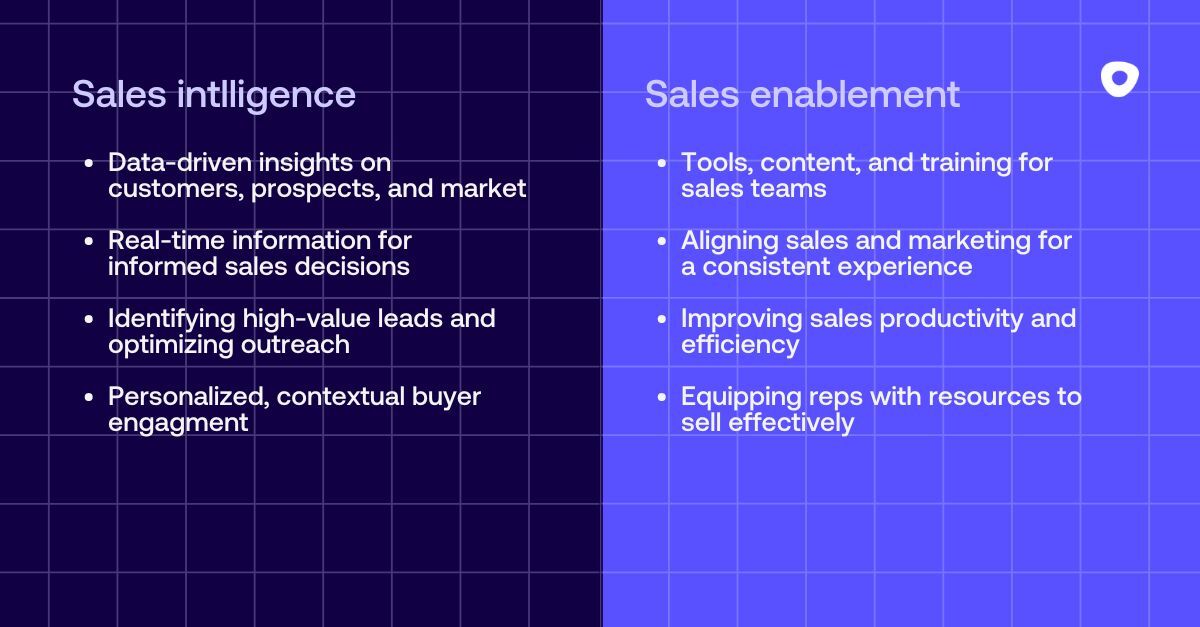
The two work best paired rather than chosen between. Feeding sales intelligence insights into your enablement content keeps pitch decks, battlecards, and talk tracks tied to what is happening in the market right now, instead of being built once and left to go stale.
A platform can be excellent at surfacing firmographic and intent data and still leave reps blind the moment a competitor enters the conversation. These are the specific capabilities worth checking if competitive insight is the job you need the platform to do.
A platform that only tags a competitor mention after the call cannot help the rep in that call, and by the time coaching happens, the deal has already moved on without the right response. Confirm detection happens live, during the conversation, not only in post-call analysis, since that is the difference between a rep who counters an objection in the room and one who reads about the missed opportunity a day later.
Walking into a call without knowing what the prospect already uses wastes the first several minutes on discovery that a good platform should have already answered, and a rep still guessing at the competitor rarely gets to real differentiation in time. When evaluating a platform, confirm its technographic coverage extends to the specific competitors you face most, not just broad categories like "uses a CRM."
A single blended win rate can hide that you are losing eight of every ten deals against one specific competitor while cleaning up against everyone else, and without that breakdown, leadership has no way to know where to invest in better battlecards, pricing flexibility, or rep training. Check whether the platform lets you filter results by named competitor, not just flag that a competitor was mentioned somewhere in the deal.
Standalone battle card libraries and static competitor spreadsheets go stale fast, and a rep mid-call will not stop to search a wiki for the right response. Platforms that surface competitive intelligence inside the call or email a rep already working in see far higher adoption, which matters because a capability nobody uses doesn't affect a single deal.
Outreach Conversation Intelligence reflects this shift, surfacing real-time battle cards based on what is said on a call, so reps get competitive context exactly when they need it instead of digging through a separate wiki mid-conversation.
Artificial intelligence has fundamentally changed what sales intelligence can deliver. Rather than simply aggregating data, AI-powered platforms now analyze patterns, predict outcomes, and recommend specific actions.
Traditional sales intelligence required reps to interpret raw data and decide how to act. AI shifts that burden to the platform. Machine learning algorithms process millions of signals to surface the insights that matter most, ranked by their likely impact on revenue.
According to Gartner research, by 2027, approximately 95 percent of seller research workflows will begin with AI, up from less than 20 percent in 2024. This shift reflects growing confidence in AI's ability to handle prospecting research and surface recommendations for reps to act on.
AI excels at identifying patterns that predict conversion likelihood. By analyzing historical wins and losses alongside prospect characteristics, AI models score leads more accurately than rules-based systems. This helps reps focus on accounts with the highest probability of closing.
Outreach's Revenue Agent automates research, identifies high-quality leads, and generates personalized outreach, transforming prospecting from a time-consuming chore into a streamlined workflow. In the Prospecting 2025 report, 100 percent of respondents reported saving time with AI, and 38 percent of reps specifically reported saving four to seven hours per week.
AI analyzes deal progression patterns to forecast outcomes and flag risks early. Rather than waiting for a deal to stall, AI-powered systems alert reps to warning signs and recommend corrective actions. This proactive guidance helps teams address problems before they derail opportunities.
AI-powered conversation intelligence analyzes sales calls and meetings to extract insights. These systems identify customer objections, competitive mentions, pricing discussions, and buying signals without requiring manual note-taking.
Beyond individual calls, conversation intelligence reveals patterns across your entire sales organization. Leaders can identify which talk tracks drive wins, where reps struggle with objections, and how top performers differentiate themselves.
Sales intelligence doesn't aim to replace human sellers with more data. AI handles repetitive research and data processing, freeing reps to focus on building relationships and solving customer problems, and the most successful organizations combine that capability with human judgment and empathy rather than choosing one over the other.
Outreach, the only agentic AI platform for revenue teams, helps every team member make smarter decisions, improve productivity, and achieve better outcomes across the entire customer lifecycle.
Business intelligence (BI) encompasses a wide range of data analytics across an entire organization, providing insights for strategic decision-making at all levels. Sales intelligence zeroes in on data specifically relevant to the sales process. While BI offers a broad view, sales intelligence delivers targeted, actionable insights that directly impact a sales team's performance.
CRM platforms manage existing customer relationships by storing interaction history, tracking deal stages, and organizing account records. Sales teams use CRMs to log activities and monitor pipeline progress. Sales intelligence platforms serve a different purpose. They continuously collect and surface external data to help reps discover new opportunities.
While a CRM tracks what has already happened with known contacts, sales intelligence reveals what could happen next by monitoring buying signals, company changes, and market trends across accounts you may not have engaged with yet. The most effective sales organizations use both together, with sales intelligence feeding qualified prospects into the CRM where reps manage relationships through the sales cycle.
Sales intelligence data should be refreshed as close to real-time as possible. The ideal frequency depends on the data type. Contact information may require less frequent updates than rapidly changing intent data or technographic details.
While sales intelligence significantly enhances prospecting, it does not entirely replace traditional methods. Instead, it complements and improves existing approaches. For instance, sales intelligence can help prioritize cold calls by identifying high-intent prospects.
GDPR and similar regulations like CCPA have significant implications for sales intelligence. These laws govern how personal data is collected, stored, and used, emphasizing consent and the right to be forgotten. Reputable sales intelligence platforms have adapted by implementing strict data compliance measures, obtaining proper consent, providing transparency about data usage, and offering data deletion options.
Implementing a sales intelligence strategy can present several challenges, but proper planning can address them effectively. Common challenges include data quality and accuracy, integration with existing tools, adoption and training, and cost considerations.
Sales intelligence software is a category of tools that help sales teams gather, analyze, and apply data to improve sales processes and outcomes. These platforms automate the collection and processing of relevant information, providing sales professionals with actionable insights as they prospect and manage accounts.
Core capabilities include lead generation and enrichment, company profiling, intent data tracking, predictive analytics, CRM integration, competitive intelligence, real-time alerts, and territory mapping. Together, these features help teams identify high-potential prospects, personalize outreach, and improve overall sales efficiency.
Outreach named a Leader in the Forrester Wave™ for revenue orchestration
September 24, 2026
The 2026 Forrester Wave™ shows how the revenue orchestration category is evolving. As the market changed, so did Outreach.
When we started this company, sales engagement was the problem in front of us. Sellers were drowning in manual outreach, so we built technology to help them work faster and smarter.
But the market didn't stand still, and neither did we. As I've talked with CROs and revenue leaders over the years, the conversation has shifted. It's no longer just about helping sellers send more emails or make more calls. It's about whether an entire revenue organization has visibility, consistency, and orchestration across the full revenue lifecycle, from the first touch to the forecast call.
We didn't just build a bigger platform. We listened to what revenue leaders actually needed, and we built for that reality.
That's why The Forrester Wave™: Revenue Orchestration Platforms for B2B, Q3 2026 matters to us. In that evaluation, Outreach was named a Leader, earning the highest possible score in 15 of 22 criteria, including Revenue Orchestration, Revenue Context & Continuity, Sales Forecasting, Conversation Intelligence, Innovation, Roadmap, and Adoption.
Forrester’s study notes:
"Outreach is best suited to organizations seeking industry-leading buyer engagement, conversation intelligence, and increasingly agentic workflows to improve seller productivity, pipeline quality, and forecast outcomes at scale."
That combination is the point. It's not depth in one narrow area. It's breadth across the things revenue teams actually need to run the business.
I’ll keep saying it: revenue execution doesn't happen in one part of the funnel. Prospecting affects pipeline, pipeline affects forecasting, coaching affects execution. All of it depends on having the right context at the right moment, connected rather than scattered across a dozen tools.
I've watched revenue teams spend years accumulating point solutions, each built to solve one narrow problem. Over time, those tools created their own drag: integration overhead, fragmented data, disconnected workflows. That wasn't bad decision-making. The category simply hadn't matured yet.
We believe Forrester's evaluation reflects a market direction we've built toward for years: the value of revenue technology isn't the number of features it has. It's how effectively those capabilities work together to support the workflows our customers rely on every day, in one unified solution. As AI capabilities converge, differentiation increasingly comes down to trusted revenue context, workflow orchestration, and governed execution at scale. That's the market we're building for.
AI agents are quickly becoming table stakes across revenue technology. But adding agents on top of fragmented context is not enough. The real advantage comes from giving agents trusted revenue context, clear guardrails, and governed access to the workflows where work actually happens.
That’s the foundation we’re building at Outreach: agent execution grounded in trusted revenue data and governed actions, so AI can move beyond simply generating recommendations to taking coordinated action with the right controls in place.
For us, Forrester’s profile of Outreach reinforces this direction. The study notes that,
“Outreach demonstrated strong autonomy controls, monitoring, usage management, and outcome reporting for revenue-focused AI agents in production.”
Vision is easy to talk about. It's much harder to build something customers actually adopt and depend on. But that’s the key to what separates a roadmap from a business.
The study states: “Customers show exceptionally strong evidence of adoption across both platform usage and business impact. They consistently describe large-scale deployments, expanding use cases, and increasing strategic dependence on the platform.”
In the Adoption criterion, we received the highest possible score, which we believe reflects our customers going deeper with Outreach and putting the platform to work across their revenue teams.
Forrester’s evaluation noted: “Outreach demonstrated strong customer adoption and a commercial model that supports broad deployment, while the roadmap provides a credible path toward human-plus-AI operating models.” Customers described large-scale deployments, expanding use cases, and growing strategic dependence on the platform.
Our scores in the Innovation and Roadmap criteria tell me we're not overselling a vision we can't deliver. Our score in the Adoption criterion tells me customers are already seeing the value today.
A Forrester Wave evaluation is a useful starting point.
But the real question is more direct: does this platform help your team create more pipeline, execute deals more effectively, forecast with greater confidence, and ramp new sellers faster?
If your priority is unifying pipeline, execution, and forecasting into one coordinated flow, revenue orchestration deserves a serious look. If you're solving one isolated problem, a point solution may still make sense, but be honest about the integration and workflow complexity of adding another system to the stack.
Consolidation is not a compromise.
Done well, it's the higher-performing choice. As revenue leaders build their FY28 strategies, look past feature checklists and ask harder questions about orchestration, adoption, governance, and where a platform is actually headed.
The future of revenue technology isn't about adding more tools. It's about making the whole revenue motion work better together, with AI that earns the trust to act on your behalf.
Forrester does not endorse any company, product, brand, or service included in its research publications and does not advise any person to select the products or services of any company or brand based on the ratings included in such publications. Information is based on the best available resources. Opinions reflect judgment at the time and are subject to change. This study is part of a broader collection of Forrester resources, including interactive models, frameworks, tools, data, and access to analyst guidance. For more information, read about Forrester’s objectivity here.
.jpg)
What is revenue orchestration? How AI agents change revenue work
September 22, 2026
Overview: Revenue orchestration brings together sales engagement, revenue intelligence, and CRM/Salesforce automation into a single category that sits on top of CRM to orchestrate the work revenue teams do to generate revenue. It spans core workflows including pipeline generation, deal management, account management, coaching, and forecasting across both new and existing customers. The category is emerging now because generative AI and agentic AI make orchestration executable, with AI agents taking on intensive work so sellers can spend more time engaging customers and building relationships.
Revenue orchestration is emerging as a distinct software category because revenue teams finally have something powerful enough to orchestrate at scale: AI agents. When you combine modern sales workflows with agentic AI that can execute work, you get a new layer that helps revenue organizations run end-to-end motions with more consistency, speed, and focus.
In a recent conversation with GeekWire, I talked about why revenue orchestration is emerging as a distinct software category and why AI agents are accelerating that shift. Revenue teams have long relied on separate systems for engagement, intelligence, and CRM. What’s changing now is the rise of AI agents that can execute work across those systems, not simply analyze it.
Revenue orchestration is the convergence of three previously distinct categories: sales engagement, revenue intelligence, and CRM/Salesforce automation. Together, they form a new software layer that sits on top of CRM and coordinates the workflows revenue teams rely on every day.
At its core, the goal is operational: help teams execute revenue work more effectively across the lifecycle, not simply track activity after the fact. In the interview, I noted that revenue orchestration is a layer that sits on top of CRM, helping to orchestrate the work that various revenue teams need to do in order to generate revenue for the company.
That orchestration matters because revenue work isn’t a single motion. It’s a set of connected motions — pipeline creation, deal progression, account expansion — where the handoffs and decisions determine outcomes. A system that coordinates those motions (and increasingly, the agents that execute pieces of them) becomes foundational.
Industry analysts have begun naming this category, which helps clarify that this is a newly recognized layer of the stack rather than a relabeling exercise:
Revenue orchestration is emerging now because generative AI has accelerated the rise of AI agents, and agents are naturally suited to execution and coordination. Orchestration software becomes significantly more powerful when it can delegate real work to agents alongside humans.
Agentic AI is best suited to “get work done” — to take an objective, operate across systems and data, and move a workflow forward with human oversight. That is a direct match for what revenue orchestration is designed to enable: coordinated execution across revenue motions.
A common misunderstanding is that orchestration only applies to top-of-funnel prospecting. In reality, revenue orchestration spans the operating system of the revenue organization.
Key workflows include:
These workflows are interconnected, and they depend on each other. Sales engagement supports the actual interactions. Revenue intelligence helps teams understand what’s being said, what’s changing, and what’s working. CRM automation supports the operational mechanics of deal progression and forecasting. As I told GeekWire, “There’s not really one part which you can say, ‘hey, let me just do this one and forget about the rest.’ It doesn’t work. It just falls apart.” Revenue orchestration only works when engagement, intelligence, and automation reinforce one another rather than operating as disconnected systems.
The misconception I still see, especially early in adoption, is that you can simply “add AI” to a broken or fragmented system and expect impact: “If I just sprinkle an AI tool on top… I will magically see some results.”
That’s not going to happen.
Revenue outcomes don’t improve because AI exists somewhere in the stack. They improve when the fundamentals are in place: clean and usable data, consistent processes, and a platform approach that connects workflows rather than scattering them across tools that don’t work well together.
You still have to orchestrate:
Otherwise, teams end up right back where they started: disconnected data, inconsistent execution, and AI that can’t reliably operate across the system.
The most productive way to think about AI agents is not as replacements for revenue professionals, but as force multipliers. The aim is to take the most intensive, repeatable, and time-consuming work and let agents handle it, so humans can do more of the work that requires judgment, trust, and relationship-building.
Consider the tasks sellers and revenue teams spend enormous time on today:
When AI agents can do meaningful portions of that work continuously, the seller’s job becomes more centered on what humans do best: spending time with customers, building relationships, and selling value.
That’s the philosophy behind how I think about agentic AI in revenue workflows: When you hire AI agents from Outreach, you’re essentially augmenting your people, giving them superpowers because these agents are helping them become more successful.
Over the next few years, the model evolves from agents that execute tasks to agents that improve with experience and collaborate more actively. The future I see is humans and agents working side by side as teammates: humans remain in control, but agents contribute more than execution.
In that world, agents don’t only follow instructions; they observe what is working across the organization and return with proactive recommendations: how to time outreach, how to adjust motions, and which approaches are producing better results, all with human oversight.
Revenue orchestration is a software category that merges sales engagement, revenue intelligence, and CRM/Salesforce automation into a single layer that sits on top of CRM to orchestrate revenue work.
RevOps is an operating discipline; how organizations align people, process, and data across revenue functions. Revenue orchestration is the software layer designed to help execute that aligned work across workflows like pipeline generation, deal management, account management, coaching, and forecasting.
They describe closely related views of an emerging revenue technology category, although the analyst terminology and definitions differ. Gartner uses Revenue Action Orchestration (RAO) for platforms that use AI and revenue signals to guide and execute seller actions across workflows such as acquisition, account growth, pipeline management, forecasting, and coaching. Forrester uses Revenue Orchestration Platforms (ROP) for technology that brings capabilities such as sales engagement, conversation intelligence, and revenue operations together in a unified platform.
For a deeper look at how Outreach defines a revenue orchestration platform and the capabilities it brings together, see our full guide.
AI agents are most valuable when they augment revenue professionals, handling intensive work like research, personalization, meeting preparation, and record updates so sellers can focus more on customer relationships and value-based selling.
Because generative AI and agentic AI make orchestration executable. Agents are designed to get work done, which is a strong match for a platform intended to orchestrate workflows across the revenue lifecycle.
No. Revenue orchestration is designed to sit on top of CRM, not replace it. CRM remains the system of record, while revenue orchestration coordinates the workflows, intelligence, and actions that happen around it across sales engagement, deal management, forecasting, and other revenue processes.
Outreach is a Leader in IDC MarketScape for Unified Revenue Orchestration Platforms — here's why
September 22, 2026
Revenue teams don't need another dashboard telling them what already happened. They need a system that can act on it. That's the shift International Data Corporation (IDC) is tracking in its newly released IDC MarketScape: Worldwide Unified Revenue Orchestration Platforms 2026 Vendor Assessment (Doc#US54121526, September 2026). And that’s the category Outreach has been building toward for years.
So, we’re beyond excited to share that Outreach has been named a Leader in this inaugural assessment!
"Unified revenue orchestration" is a new name for a problem old as time: revenue data and workflows scattered across marketing, sales, customer success, and finance, with no single system connecting them into action. IDC defines the category as a single, AI-enabled platform that unifies data and workflows across these teams to coordinate every buyer and customer interaction.
What's really changed in 2026 is the bar for evaluation. Buyers are moving past counting AI features and are now asking a harder question: can this platform actually trigger cross-functional work, not just surface an insight and wait for someone to act on it?
The IDC MarketScape noted:
Consider Outreach when your revenue organization wants a mature, full-cycle revenue execution and orchestration platform that turns trusted data and context into governed action across prospecting, account management, conversation intelligence, coaching, deal and pipeline management, forecasting, retention, and expansion.
What we believe differentiates Outreach apart in the Unified Revenue Orchestration category is our platform's ability to handle the entire revenue lifecycle—from initial prospecting and deal management all the way through renewal and expansion. Rather than requiring separate best-of-breed tools for each stage, Outreach unifies these workflows on a single data foundation, a revenue context layer that persists and evolves, enabling precise, coordinated action across every revenue function.
The IDC MarketScape noted:
Broad real-time triggering, multisystem coordination, and AI-driven next best action reflect the shift toward agentic, governed execution rather than simple automation.
That distinction, between AI that advises and AI that acts, is central to how we've built the platform. Purpose-built agents work inside revenue workflows on a shared data and context layer, with the permissions, guardrails, and observability revenue leaders need to trust what's happening without watching every step.
"Revenue teams don't need more AI that only analyzes work; they need AI that helps move the work forward," said Nithya Lakshmanan, Chief Product Officer at Outreach. "Our AI agents take work off sellers' plates, guide them in the moments that matter, and help leaders act with greater confidence. Being named a Leader reinforces the direction we've taken: AI that acts, not just advises."
In the last few quarters, we've moved fast to back that up. We shipped Outreach Omni, a universal conversational agent that lets sellers and leaders ask questions and take action across accounts, opportunities, prospects, and meetings, as well as Agent Studio, a visual canvas that lets admins build custom agentic workflows without pulling in engineering.
We also rolled out a full Model Context Protocol (MCP) suite— starting with Outreach MCP Client, which brings context from tools like Amplitude, Seismic, and ZoomInfo directly into Outreach workflows, and extending to Outreach MCP server, which allows teams to securely bring Outreach insights and actions into the AI tools they use everyday.
And we’re backing it up with how we run our organization and what our people do. Our Customer Success organization evolved this quarter into GTM AI Advisors, with a mandate built specifically around closing the gap between buying AI and actually running on it. We understand our customers are on an evolving journey with their AI maturity, and we worked this year to create a plan to support them wherever they are in their AI journey.
Unified revenue orchestration is a single, AI-enabled platform that consolidates data and workflows across all revenue functions—sales, marketing, customer success, and finance. Rather than managing separate point solutions for prospecting, deal management, forecasting, and customer engagement, a unified revenue orchestration platform connects all these activities on a shared data foundation, enabling coordinated action across your entire revenue organization. This eliminates data silos and lets teams act on insights in real time.
Outreach's core differentiator is its unified approach. Rather than consolidating multiple point solutions, Outreach was built from the ground up as a unified platform with a shared data cloud, unified orchestration engine, and AI agents that work across the entire revenue cycle. This means your data doesn't live in silos across different tools—it's centralized, enabling better AI training and more coordinated workflows. Additionally,Outreach distinguishes itself through agentic execution: AI agents take action on behalf of revenue teams (handling prospecting research, scheduling follow-ups, surfacing deal insights) rather than just providing recommendations that require manual intervention.
Advisory AI analyzes data and provides recommendations—it helps revenue teams understand what's happening and what they should do next, but humans must act on those insights. Agentic AI goes further by taking action on behalf of your team. Outreach's AI agents automatically handle routine tasks(like prospecting research, account planning, and next-best-action recommendations), surface insights in real-time moments that matter, and coordinate workflows across your entire tech stack—all with appropriate guardrails, permissions, and oversight to maintain governance. This frees sellers from administrative work and lets them focus on high-value relationship building. See how SailPoint is using agentic AI to scale their pipeline and drive real business impact.
That depends on your current setup and priorities. If you're managing 4-6 disconnected point solutions and experiencing data silos, inefficient workflows, and high maintenance overhead, consolidating to a unified platform like Outreach can eliminate that complexity. However, the decision should be based on your specific needs and current tools. What's important is evaluating whether a platform can deliver orchestration depth(triggering action across your tech stack), agentic AI capabilities with proper governance, and proof of outcomes rather than just features.
Many organizations move to Outreach precisely because they want a single system that can coordinate work across all their revenue teams without maintaining separate specialized tools. Check out our pricing page to learn more about how Outreach can fit your organization's needs, and review our customer stories to see how other teams have used Outreach to drive real results.

The RevOps leader's guide to AI-powered sales forecasting
September 18, 2026
TL;DR: Inaccurate forecasts undermine board confidence in planning and capital allocation. AI-powered sales forecasting uses unified deal records enriched with activity and conversation data to produce evidence-based projections while preserving human oversight. Teams can compare model outputs with actual results before changing forecast authority.
Across many organizations, board forecasts become hard to defend when stale pipeline data and subjective, error-prone spreadsheet inputs obscure likely revenue. For RevOps leaders responsible for board forecasting, that uncertainty affects every plan finance builds against.
For context, Gartner reports that only 7% of sales teams achieve 90% or higher forecast accuracy.
Meanwhile, Deloitte's global survey found 30% of organizations still use spreadsheets as their main budgeting and forecasting tool, unchanged from 2014. The survey also found that 94% do not use algorithmic forecasting.
The pattern is hard to miss. Most teams still forecast the way they did a decade ago, and accuracy has not kept pace with what boards now expect. AI-powered forecasting is the alternative that closes that gap, so it helps to start with what it is.
AI-powered sales forecasting uses machine learning and AI models to analyze historical data, real-time pipeline activity, and market trends to predict future revenue with high precision.
Unlike a spreadsheet that freezes a single snapshot, these models read the signals a deal gives off as it moves: email and call activity, engagement trends, stage changes, and win rates for similar past deals.
They update as the pipeline changes, not at the end of a cycle. The result is an evidence-based projection, with human oversight kept in place rather than removed.
Spreadsheet forecasts combine slow consolidation, subjective inputs, incomplete records, and mechanical errors. Each weakness makes the final number harder to explain and defend.
Annual plans can take months to build, and each forecast cycle often takes weeks. The updated version can therefore land in the rearview mirror as soon as the team completes it. Manual consolidation stretches that delay further.
Each region exports its numbers for analyst reconciliation, so the total arrives days after the pipeline has changed.
The sheet itself adds mechanical risk. An audit of 50 operational spreadsheets found errors in 94%, with an average cell error rate of 1.79%. At the size of a quarterly roll-up, one mistyped formula in a rarely opened tab can move the commit.
An analysis of more than 60,000 forecasts across four supply-chain companies found that people adjusted most forecasts, more than 90% in one company. Those adjustments improved overall accuracy in three of four companies, but upward adjustments moved in the wrong direction more often than downward ones.
Incentives distort inputs in both directions, with sellers often sitting at the optimistic end of the range. HBR reports that "salespeople often exploit incentive programs to maximize their gain through various schemes, with damaging effects on company performance. Common cheating tactics include sandbagging."
The records feeding the sheet are often too thin for a model to use. Forrester traces the cause to the pipeline itself, where inconsistent opportunity updates and mismatched stage definitions undercut data accuracy. Bain's survey of technology companies found that 59% do not record a reason when a lead is lost, and 68% do not log touchpoint history.
Both gaps remove fields that a model could use. Without a loss reason, the record shows that a deal died but not whether pricing killed it, a competitor pressured it, or the buyer froze its budget. Without touchpoint history, engagement decay becomes invisible.
The drop from weekly meetings with four stakeholders to one unanswered email leaves no trace. The seller controls the remaining stage field and close date.
A staged migration gives teams time to improve the underlying process, compare results, and build trust before changing forecast authority. Here’s how the process looks.
Automating an inconsistent process produces inconsistent outputs faster.
Start by agreeing on what each stage means and what evidence a deal needs to enter it. When one rep marks a deal committed on a verbal yes and another waits for a signed order form, the same label hides two different realities, and any model trained on that data inherits the confusion.
Write exit criteria for every stage in plain terms, tied to something observable: a signed mutual action plan, a completed technical review, a named procurement contact. Then clean the historical records so past deals reflect the new definitions, or the model learns from a moving target.
This is unglamorous work, and it is the step teams most want to skip. It is also the step that decides whether the model has anything solid to learn from. Standardized stages separate a forecast the board can question from one it can trust.
Before the model goes live, teams often freeze each forecast version at its issue date and create a scorecard.
A practical scorecard includes:
These measures show the direction and size of forecast error. A frozen version provides a dated snapshot of the submitted number, the commit, the best case, and the supporting deal list. Later edits cannot change it.
The AI model then runs in parallel with the existing forecast across at least one full closed period. Teams score both against the same actuals and inspect performance by segment.
A model that beats the seller roll-up in enterprise can still lose in transactional deals with short cycles. The shadow run turns "trust the model" into an evidence-based decision about where the model earns primary authority.
People trust a model more when they can adjust it. Wharton researchers found that letting someone modify a model's output, even slightly, lifted adoption from 32% to 73%, and that tight limits on that adjustment produced better long-run results than free rein. The lesson is to allow a narrow, bounded adjustment.
Direction matters as much as size. In one supply-chain study, downward revisions cut mean percentage error from 48.71 to 30.12, while upward revisions pushed it from 30.98 to 40.56. Trimming a number when a deal weakened helped. Talking it up did not.
Options worth considering include overrides within a band, required reason codes, preserved model outputs, and quarterly reviews of override accuracy. In the CRM, keep the model's number beside the submitted number. Add a reason picklist for changes, with values such as legal in redline or budget pulled.
Preserving the original model output makes the quarterly review possible. Downward adjustments supported by deal-level intelligence can add value, while optimistic upward adjustments rarely do.
Once finance signs a board number that a model helped produce, the forecast becomes an auditable process. NIST's AI framework requires teams, under MEASURE 2.9, to explain, validate, and document an AI model.
Under MANAGE 4.1, it asks teams to include mechanisms for appeal and override, incident response, change management, and ongoing monitoring. Article 14 of the EU AI Act sets the oversight standard for high-risk systems.
Supervisors must "remain aware of the possible tendency of automatically relying on the output produced by the high-risk AI system (automation bias)." They must also be able to disregard, override, or reverse that output.
Most of this work involves record-keeping. Version and timestamp every forecast, and retain the model's original number beside any human override. Record which inputs drove each projection. A team that cannot reconstruct last quarter's projection will find the model harder to defend than the spreadsheet it replaced.
In the same engagement that standardized stages, weekly pipeline calls treated the CRM dashboard as the sole source of truth. The team discussed only what appeared on the dashboard.
The call's purpose shifted from collecting numbers to managing exceptions. Discussion focused on deals the model flags as at risk and areas where overrides cluster. The team also reviewed segments pacing off plan.
That shift changes who does the talking. Instead of each rep reading their commit aloud, the manager walks through the exceptions the model surfaced and asks what the team knows that the data doesn't. A deal flagged as slipping gets a real diagnosis, not a status update.
It also shortens the call. When the dashboard is the single source of truth, nobody spends twenty minutes reconciling two versions of the same number. That time goes to the few deals where judgment moves the forecast, and the model handles the rest.
A forecasting rollout that gives sellers a second place to update deals creates friction on day one. A seller who already logs a deal in the CRM has little reason to log it elsewhere. Rollouts that stick remove work, and automatic capture often delivers that value first.
Reps saved 15 to 21 minutes a day on CRM updates and meeting summaries, according to the Outreach Insights Group's 2026 Agent Productivity Impact Report.
Frame the rollout around that saved time, not the board-level accuracy it eventually enables. A seller adopts a tool that hands back fifteen minutes a day long before they care about the forecast it feeds. Automatic capture of activity and meeting notes is usually the fastest way to show that value.
From there, sequence the change. Start with one segment, prove the model against real outcomes, and let early adopters carry the story to the rest of the team. A rollout that removes work and shows its math earns the trust that a mandate never does.
The forecast a revenue organization takes to its board is only as reliable as the data feeding it. Fix the foundation, and the projection holds up under scrutiny. Leave it fragmented across spreadsheets and disconnected tools, and no model layered on top can close the gap.
Omniplex Learning felt this shift directly. Tom Hammond, CRO of Omniplex Learning, put it plainly: "Our forecast accuracy is now within 5%, compared to being off by 10, 15, even 20% before. That's a game changer at the board level."
That kind of confidence comes from a data foundation solid enough that the numbers hold up under scrutiny, whether the audience is a single rep or a room full of investors.
Outreach, the only agentic AI platform for revenue teams, builds its analytics and forecasting on exactly this kind of unified foundation. Rather than copying numbers between tools after the fact, it connects the workflow layer where revenue data is created and acted on, so the forecast the board sees stays current instead of adding another dashboard on top of the same fragmented data.
Agentic AI in sales forecasting refers to AI-powered agents that go beyond a single prediction to monitor revenue signals, flag changes, and surface recommended actions for approval. In practice, these AI-powered agents score deals, flag risk, recommend next steps, and surface CRM updates for review, all within human-controlled workflows. A team can define permissions by role, preserve the model's original projection, and require approval before any record changes.
AI-powered forecasting accuracy depends on data quality, process consistency, segment, sales-cycle length, and forecast horizon. The useful benchmark is measurable improvement over the current method at a defined point in the quarter. Teams can freeze each forecast at submission and compare model and human projections against the same actuals. They can then review error by segment. Confidence should come from repeated closed periods, stable inputs and transparent exceptions.
AI predictions complement human judgment. Models process historical patterns and activity signals, while people interpret new context such as legal delays and leadership changes. Human judgment adds the most value when it contributes fresh deal evidence within governed override controls. Teams can retain both the model projection and submitted number while requiring a reason code. They can review override performance after the quarter closes. That record shows whether adjustments improved the forecast or introduced optimism.
A staged migration usually includes process standardization, data preparation, a parallel test through at least one full closed period, and governance review. The timeline depends on data readiness, sales-cycle length, integrations, and team adoption. A business with standardized stages and complete activity capture may move faster than one still reconciling fields across separate tools. Pilot scope matters too: starting with one segment limits disruption and creates a clear comparison against actual outcomes.

Building a revenue data architecture for sales analytics
September 17, 2026
TL;DR: Most sales analytics initiatives fail because the underlying data is scattered across disconnected tools, not because the dashboard or model is flawed. A unified revenue data architecture, one that connects engagement signals, CRM records, warehouse data, and third-party intelligence, is what makes accurate analytics and AI-powered forecasting possible.
Most sales analytics initiatives fail for a mundane reason. The dashboard is fine. The forecasting model is fine. The data feeding both of them is scattered across a dozen systems that were never designed to agree with each other.
For CROs, CFOs, and revenue operations leaders deciding where the next infrastructure dollar goes, this is a familiar and expensive problem. Most teams patch it with another integration or another reporting layer, the same instinct that let revenue tech stacks grow into loose collections of point tools in the first place.
The fix has to start further upstream, with the architecture the analytics sit on, rather than the analytics themselves.
Revenue data architecture is the underlying structure that connects, standardizes, and stores the data a revenue organization generates, spanning engagement activity, CRM records, financial systems, and third-party intelligence, so that every application built on top of it draws from the same source of truth.
This same principle underpins how AI agents earn enterprise trust — check out our recent post on Outreach's revenue architecture: A framework for trusted AI agents and how a unified data foundation supports not just dashboards, but autonomous agent execution.
Most content published under the sales analytics banner describes the visible layer sitting on top of that structure: the dashboards, forecasts, and win-loss reports built from the data, the charts pulled up before a leadership review, and the model that predicts which deals will close. Revenue data architecture sits beneath it all.
A dashboard can be well designed and still mislead a room full of decision makers. When a forecast misses, or multiple departments arrive at the same meeting with different pipeline totals, the fault usually traces back to the architecture underneath, the connections and shared definitions the analytics depend on, rather than the visualization layer itself.
Three reasons show up again and again when a sales analytics initiative stalls before it delivers value. Each traces back to the architecture underneath the dashboard, not the dashboard itself.
Imagine engagement data living in the sales engagement platform, deal data living in the CRM, and call and meeting data living in whatever conversation intelligence tool the team adopted. Billing and revenue recognition might be living somewhere else entirely, usually in finance's own system with its own definitions.
Each of these tools does its own job well. The problem is that none of them was designed with the others in mind, so the data accumulates in silos that grow wider every time a team adds a new point tool to solve a narrow problem.
Breaking down data silos starts with recognizing how many separate sources any single analytics question touches. A simple win rate calculation might need engagement history from one system, stage data from another, and revenue figures from a third, and analytics can only be as good as the weakest connection between them.
Even when the data physically lives in one place, teams can frequently disagree on what it means. A deal marked "committed" in one region's pipeline might mean something different in another. A rep logging a "meeting" might count a five-minute call the same way a colleague counts a full discovery session.
These definitional gaps rarely show up until someone compares numbers across teams or time periods, at which point the analytics quietly become unreliable. Sales methodologies built around consistent deal criteria, like the MEDDPICC framework, exist precisely because unstructured definitions of stage and qualification produce forecasts nobody can trust.
Without a shared definition enforced at the data layer, every rollup report is just an aggregation of several different, incompatible datasets that happen to share column names.
Faced with disconnected tools and mismatched definitions, most revenue operations teams respond the same way. Someone builds a spreadsheet that pulls numbers from each system and manually reconciles them before every leadership review. It works, but just for a while.
Over time, the reconciliation spreadsheet becomes its own fragile system, dependent on one person's manual judgment calls about which source to trust for which field. When that person is out, or the underlying systems change their export format, the whole process breaks quietly, and nobody notices until the numbers stop matching what leadership remembers.
Poor CRM adoption compounds the problem, because reps who don't trust the system stop entering data consistently, leaving the person doing manual reconciliation with even less to work with.
The three reasons above explain why analytics initiatives stall. The signs below are how that failure actually shows up for a leader deciding whether this is worth fixing now:
Recognizing these indicators is the first step toward moving from reactive maintenance to strategic infrastructure development.
Four steps show up consistently when building a revenue data architecture that can support AI-powered analytics. Outreach'sRevenue Layer Data is the unified foundation that brings all four together, training its AI on billions of engagement signals across the platform rather than a narrow slice of any single tool.
Start by pulling every call, email, meeting, and touchpoint a rep or buyer generates into a single layer, instead of leaving it trapped inside whichever individual point tool logged it.
Once activity across channels lands in one place as it happens, downstream reports and models see a complete history instead of a partial view scoped to a single tool. A model trained on half the engagement history will confidently produce a prediction; it just won't be a good one.
Make sure information flows in both directions with the CRM, rather than requiring reps to update it manually after every conversation. A sync that only pulls data out misses the corrections and edge cases that happen inside deal reviews and daily rep workflows.
Outreach enables robust bidirectional CRM sync, including support for custom objects, reconciling changes made across the platform with the CRM record instead of leaving reps to update the same fields twice.
According to the Outreach Insights Group's 2026 Agent Productivity Impact Report, reps save 15 to 21 minutes a day on CRM updates and meeting summaries once that reconciliation runs in the background, time that would otherwise go into data entry rather than selling.
Feed the synced engagement and CRM layer into a broader data warehouse alongside finance, product, and marketing data, since no single application supports the kind of blended analysis a revenue org eventually needs.
One-off exports or scheduled batch jobs create their own staleness problem, with the warehouse copy several days behind the source system by the time anyone queries it.
Outreach automatically enriches its records with first-party data pulled from your data warehouses like Snowflake, such as product usage and renewal history, so that context lives alongside engagement and CRM data instead of sitting in a separate system nobody joins.
That same platform layer carries the governance controls that keep access and retention rules consistent as the data moves.
Layer in what internal engagement and CRM data can't tell you on their own, when an account raises a funding round, adopts a competing product, or shows buying intent somewhere outside your own systems.
With Outreach's Smart Data Enrichment, you can add this outside context through pre-built connectors to third-party data providers, appending firmographic and intent signals directly to the account and contact records already in your architecture.
Two reasons make this gap especially costly once AI models enter the picture, on top of everything a fragmented architecture already costs a dashboard.
A person looking at a dashboard brings judgment. A manager who knows an account personally will notice when a number looks off and mentally correct for it before making a decision. That human context absorbs small data errors without anyone having to fix the underlying system.
A predictive model doesn't have that context. It learns patterns from thousands of historical rows, and if a field has been unreliable across a meaningful share of those rows, the model doesn't average out the noise. It treats the unreliable pattern as signal and applies it at scale.
This means one systematic data problem, like inconsistent close-date logging, can quietly bias an entire forecast rather than producing one visibly wrong number a person can catch.
A model trained on years of pipeline history repeats whatever patterns exist in that history, including the bad ones. If deal stages have been recorded inconsistently for two years, the model treats that inconsistency as real behavior to learn from rather than noise to correct.
Also, its confidence in the resulting pattern often looks stronger than a human's confidence would. Whichever forecasting methods a team layers on top, from regression to weighted pipeline models, none of them can separate real signal from historical noise on their own.
The dashboards, forecasts, and AI models a revenue organization depends on are only as reliable as the architecture feeding them. Fix the plumbing, and every report built on top of it becomes trustworthy by default. Leave it fragmented, and no amount of spending on analytics or AI closes the gap.
Omniplex Learning felt this shift directly. Tom Hammond, CRO of Omniplex Learning, put it plainly: "Our forecast accuracy is now within 5% — compared to being off by 10, 15, even 20% before. That's a game changer at the board level."
That kind of confidence comes from a data foundation solid enough that the numbers hold up under scrutiny, whether the audience is a single rep or a room full of investors.
Outreach, the agentic AI platform for revenue teams, builds AI-powered analytics and forecasting on exactly this kind of unified foundation, rather than adding another dashboard on top of the same fragmented data most teams already have.
A data warehouse is one storage and compute layer inside a broader architecture. Revenue data architecture also includes how engagement tools, the CRM, and third-party sources connect to that warehouse, plus the shared definitions and sync logic that keep the data consistent across every system that touches it, inside the warehouse and beyond it.
Data observability monitors data that already exists inside a connected system, watching for freshness, volume, or schema problems after the fact. Revenue data architecture is the design decision that determines what gets connected, synced, and standardized in the first place. Observability catches breaks in a foundation; architecture is what that foundation is built from.
Most teams see the biggest gains from sequencing the work in phases rather than attempting everything at once. Engagement data consolidation and CRM sync typically show results within a quarter. Warehouse connections and third-party enrichment usually bring the architecture to full maturity within twelve to eighteen months, depending on how many legacy systems need to be untangled first.
Both, at different layers. Revenue operations typically owns the business definitions, deal stages, activity types, and what counts as qualified, since those decisions require sales context. IT and data engineering typically own the pipes, security, and governance controls that keep the architecture reliable. Neither team can build a trustworthy architecture without the other.
They will still produce dashboards and reports, but the numbers behind them stay only as reliable as the fragmented data feeding them. A new visualization layer or a switch to a different analytics tool doesn't resolve mismatched deal definitions or manual reconciliation. You have to solve those problems at the data layer before you can trust any analytics tool.
Unifying sales analytics for better revenue intelligence
September 17, 2026
TL;DR: A forecast built on sales pipeline data alone leaves renewal risk and expansion signals sitting in a separate system nobody on the sales side checks. An account with an open support escalation looks identical to a healthy one until someone manually cross-references two systems, often after the moment to act has passed. This guide explains why analyzing sales, CS, and renewal data separately creates that blind spot, what changes when the data is unified, and how that unification happens.
A forecast built on sales pipeline data usually leaves renewal risk and expansion signals sitting in a separate customer success platform that nobody on the sales side checks.
For the CRO or CFO presenting that forecast to the board, an account showing early churn signals looks identical to a healthy one until someone manually cross-references two systems, and by then the moment to act on it has often passed.
This guide covers why analyzing sales, CS, and renewal data separately creates that blind spot, what changes when the data is unified, and how that unification happens.
Unified revenue data is a single, shared view of an account that combines sales pipeline activity, customer success health signals, and renewal or expansion status, instead of tracking each in a separate system that only its own team checks.
A rep, a CS manager, and whoever builds the board forecast are looking at the same underlying record rather than three exports that have to be reconciled by hand. This is different from simply having more revenue intelligence software, since a company can run separate sales, CS, and billing systems for years and produce plenty of dashboards without ever unifying what they show into one number anyone can act on.
A handful of specific failure modes show up when this data stays siloed, each one costing a different part of the revenue organization something real.
A rep with an expansion call already on the calendar has no way to see an open support escalation sitting in the CS platform. The call goes ahead as planned, the pitch lands in an account that is actively frustrated, and the rep finds out only after the prospect brings it up, or worse, does not bring it up at all and simply goes quiet.
According to ChurnZero's 6th Annual Customer Revenue Leadership Study, 74 percent of revenue comes from existing customers. When expansion and renewal revenue sit in a CS tool the forecast never touches, the number presented to the board reflects only new-logo pipeline, understating the majority of the business by definition.
Without sales history visible on the account management record, a CS manager walks into a renewal call unable to reference what the account was sold on, what objections came up during the sales cycle, or what the original business case was. The conversation restarts discovery that already happened once, and the customer notices.
A usage spike or a feature-adoption milestone that signals expansion readiness lives inside the CS platform, visible to the CS manager and nobody else. Nothing routes that signal to a rep, so it never becomes a logged opportunity. The deal never existed from a sales perspective, so no rep missed it; it simply never reached them.
Building one account view across three systems means pulling three exports, matching records by hand, and resolving the inevitable mismatches before anyone can trust the result. That time comes out of the hours RevOps could otherwise spend on revenue operations analysis instead.
Each failure mode above has a direct inverse once the data lives in one place instead of three. None of these outcomes requires a new capability so much as removing the separation that caused the problem in the first place.
A rep sees CS health signals before an expansion call goes on the calendar, so outreach timing reflects whether the account is in a good position for that conversation rather than relying on the contract date alone.
Expansion and renewal revenue shows up in the same forecast as net-new pipeline, giving the board one number that reflects where the 74 percent of revenue ChurnZero identified is actually sitting, instead of a new-logo number that quietly excludes most of the business.
A CS manager opens a renewal call already knowing what the account bought, why, and what came up during the sales cycle, so the conversation picks up from where the relationship actually stands instead of restarting discovery. Better CRM adoption across both teams follows naturally once they are both updating the same record.
A usage spike or adoption milestone routes to a rep as a logged opportunity instead of staying visible only inside the CS platform, closing the pipeline-creation gap rather than just making the existing pipeline easier to see.
The hours that went into manually matching three exports go into interpreting what a genuinely integrated tech stack actually shows instead, which is the work RevOps was trying to get to in the first place.
Unifying sales, CS, and renewal data does not require replacing every system at once. A sequence of steps separates a rollout that stalls from one that produces a number you can trust.
Pick the single most valuable connection first, syncing renewal dates and CS health scores for the accounts closing in the next two quarters, rather than attempting to unify every field across every system on day one.
Build a short list of those accounts and confirm the synced data matches what each system shows independently before expanding further. RevOps owns this list, and it is working when a rep can pull an account's renewal date and CS health score from one place without asking CS for an export.
Stand up the sync between the CRM and the CS platform, run it through one full forecast cycle, and confirm it stays accurate before connecting a third system. A rollout that tries to unify sales, CS, and billing data at once has three places to fail. RevOps and IT co-own this step, and it succeeds when that single connection holds up through a full quarter without manual correction.
Run the previous, manually-built forecast alongside the new unified number for one full quarter rather than replacing the old process outright. Whoever owns forecast accuracy should compare the two sales metrics, account for any gap and present the unified number to the board as the official one. This step is complete when the two numbers converge within an acceptable range, and any gap is explained rather than left unexplained.
Outreach, the only agentic AI platform for revenue teams, treats sales, CS, and renewal data as one connected record rather than three exports to reconcile by hand. That works because the data is unified at the source, not through a single feature layered on top afterward.
The Outreach Data Cloud is built as four layers rather than one. CRM data sync carries the sales side, prospect, account, deal, and pipeline records, while a separate enterprise data warehouse layer pulls in product usage, customer health scores, support ticket history, and billing information.
Both layers update the same record, connected through Outreach's MCP Server and MCP Client — the infrastructure that lets AI agents pull live signals from enrichment providers, cross-reference usage data with pipeline, and act across the revenue stack rather than inside one tool at a time. Sales activity, CS platform data, and renewal status update together instead of sitting in three separate systems that drift apart between exports.
Because CRM data synchronization is one of the four layers, opportunity records, deal stage history, and the original sales activity sync directly into the same account record a CS manager already has open, rather than living in a system only the sales team can query.
AI Projection pulls from both the CRM synchronization layer and the data warehouse layer to compute the rollup, so a renewal or expansion signal sitting in CS data feeds the same number as net-new pipeline instead of requiring someone to add it in manually. Automated forecast rollups built this way cut forecast prep time by 44 percent.
Deal Health Score reads signals from across the unified record instead of sales-stage activity alone, and surfaces that health status directly on the account before a rep schedules an expansion call. Timing outreach off a live health signal, rather than a contract renewal date, is possible because the score pulls from CS and support data that used to sit outside the sales view entirely.
Revenue Agent can be configured to treat a usage-adoption milestone from the data warehouse layer as a targeting rule, generating a recommended opportunity for a rep to review rather than requiring someone to notice the signal manually and create the record themselves.
Outreach, the only agentic AI platform for revenue teams, gives revenue teams a single record to build that number from instead of three systems to reconcile first. Pipeline inspection and forecast accuracy both improve for the same reason.
Increasingly, that record doesn't stop at the forecast either. Reps and CS managers can ask Outreach Omni about an account's renewal risk or expansion readiness directly, in plain language, instead of opening a new dashboard for every question. The answer only holds up because the data behind it was already unified, making Omni a faster way to ask, not a new source of truth.
A forecast built on unified sales, CS, and renewal data holds up under the kind of scrutiny a board conversation brings, because the number was never assembled from disconnected exports in the first place.
More reports still come from separate systems that have to be manually cross-referenced to build one picture of an account. Unified revenue data means sales, CS, and renewal information update the same record automatically, so the report reflects one source instead of requiring someone to reconcile three of them first.
A forecast built on sales pipeline alone excludes expansion and renewal revenue sitting in a separate CS system, understating a number that, per ChurnZero's research, represents 74 percent of total revenue for most companies. Unifying that data means the forecast accounts for existing-customer revenue alongside new pipeline, rather than treating it as invisible until a renewal or churn event forces someone to notice it.
No. Unification depends on the systems syncing to a shared record, not on every team using identical software. A CRM and a CS platform can stay separate as long as the data between them updates the same underlying account view, which is what a bidirectional sync accomplishes without requiring either team to change how they work day-to-day.
How AI for customer success moves teams from reactive to proactive
September 17, 2026
TL;DR: A CSM typically learns about churn risk in the cancellation conversation itself, not before it. Expansion opportunities sit unnoticed in usage data nobody reviews systematically until a renewal is already on the calendar. This is a structural problem at scale, not a training gap, and closing it is worth a measurable swing in net revenue retention, the kind that shows up in how the business gets valued.
A customer success manager (CSM) managing dozens of accounts typically learns about churn risk the same way everyone else does, in the cancellation conversation itself. For the CRO or CFO reviewing net revenue retention each quarter, that timing problem is structural.
Expansion opportunities sit unnoticed in usage data nobody reviews systematically, and by the time a renewal call surfaces a problem, the account has often already decided.
AI in customer success closes that timing problem, turning a signal that would otherwise surface in a cancellation call into one a CSM can act on weeks earlier.
AI in customer success is the use of machine learning and workflow automation to surface account risk, usage patterns, and engagement signals before a CSM would otherwise notice them manually.
The agentic AI layer takes this further by turning a flagged signal into a recommended next step for a CSM to review, rather than just a dashboard number. Applied well, it shifts customer success from a reactive function, responding to problems once a customer raises them, to a proactive one that acts on signals as they emerge.
The distinction matters because reactive and proactive customer success are not the same work done faster; they are different points at which the same information reaches a human.
The difference between the two models shows up less in what gets done and more in when it happens.
Each row above maps to a specific point later in this guide, starting with why the shift matters enough to prioritize in 2026.
The case for AI in customer success comes down to two numbers most revenue leaders already track and one pattern that compounds if left unaddressed.
Many revenue organizations have added CS headcount over the past several years without retention becoming the growth lever it should be. Bain's research on the customer success function points to a specific reason.
CSMs spend roughly 65% of their time on tasks that could be automated: manual health checks, status updates, and administrative follow-up, rather than the judgment calls that actually influence whether an account stays or grows.
Adding headcount to a role that spends two-thirds of its time on automatable work produces more capacity for the same low-impact tasks, without necessarily improving retention.
According to ChurnZero's 6th Annual Customer Revenue Leadership Study, customer success teams with strong enablement see 99% net revenue retention compared with 94% without it. A five-point gap at the NRR line is hard to explain with anything other than whether risk and expansion signals reach a CSM before the renewal call or during it.
The five-point spread gets board-level attention because it affects valuation. McKinsey's study of 98 B2B SaaS companies found that top-quartile-valued companies run 113% net revenue retention with a median enterprise-value-to-revenue multiple of 24x, compared with 98% NRR and 5x for the bottom quartile. A 15-point difference in retention corresponds to nearly a fivefold difference in multiple.
A churn signal missed this quarter doesn't just cost that one account; it delays the point at which the team builds the habit of acting on signals early. Teams that stay reactive one more quarter are not standing still relative to teams that have already made the shift; they are falling further behind on the muscle memory that makes proactive CS work.
A handful of real obstacles show up across most teams, and naming them plainly is more useful than assuming AI adoption will happen on its own.
A health score is only as good as the data feeding it, and product usage, support tickets, and CRM activity typically sit in three different systems that were never built to talk to each other. Teams that try to build a signal on top of fragmented data usually get a noisy one, which undermines trust in the tool faster than having no signal at all.
Product usage data, support tickets, and CRM records are often governed by the same customer contracts that make the account worth retaining, and combining them into a single AI-readable signal usually triggers a security and legal review before a single account gets flagged.
According to a 2026 Okta-commissioned survey of IT and security decision-makers, 69% say security concerns are slowing their organization's adoption of AI agents, citing data exfiltration risk and over-privileged access as the leading reasons.
A tool that cannot clear that review, because it trains on customer data, lacks a data residency guarantee, or has no signed DPA in place, stalls in procurement regardless of how good the underlying model is.
A risk score with no explanation behind it asks a CSM to trust a number without knowing what drove it. Teams adopt AI signals faster when the tool shows the specific activity behind a flag, a usage drop, a support ticket pattern, rather than a score alone.
An account flagged as at risk with nobody assigned to act on it produces the appearance of proactive coverage without the substance. Adoption stalls when flagging is treated as the finish line instead of the trigger for a specific, assigned action.
Volume erodes trust faster than inaccuracy does. In healthcare, physicians override 90% to 96% of clinical alerts, a pattern documented in the Journal of Medical Internet Research, and a CSM's inbox faces the same risk after enough unfounded flags.
Precision matters as much as coverage, and getting proactive outreach wrong can backfire outright. A field experiment found that a poorly targeted proactive retention offer raised churn from 6% to 10%, since the outreach reminded customers to consider switching rather than reinforcing why they should stay.
Rolling out AI in customer success without agreeing in advance on what success looks like, fewer accounts reaching a cancellation conversation, faster time to flag, makes it impossible to tell three months later whether the investment paid off or just added a new dashboard nobody checks.
Each addresses a specific point in the customer lifecycle where a signal currently reaches a CSM too late to act on, or doesn't reach them at all.
Health scoring models read usage frequency, support ticket volume, and engagement trends to flag accounts trending toward churn weeks before a renewal call would surface the same problem.
A score that updates continuously catches a slow decline that a quarterly check-in would miss entirely, surfacing a recommended re-engagement action before a CSM would otherwise go looking for one. Getting ahead of the signal this way feeds the same churn reduction motion a CSM already runs, just weeks earlier.
A usage spike or a new feature adopted by power users often signals expansion readiness well before a customer raises it themselves. Reading that signal requires pulling from product usage data most CS teams don't review account by account, then routing what qualifies as a genuine buying signal to the account owner rather than leaving it in a dashboard nobody checks.
New customers who hit early product milestones on schedule renew at meaningfully higher rates than those who stall. Automated milestone tracking flags a stalled onboarding in week two instead of week ten, giving a CSM time to intervene while the account is still early in its customer journey rather than after the customer has already disengaged.
Manual note-taking during a customer call means a CSM is either fully present in the conversation or accurately capturing what was said, rarely both. Automated transcription and action-item detection remove that tradeoff, so commitments made on the call get tracked without competing for the CSM's attention.
According to the Outreach Insights Group's 2026 Agent Productivity Impact Report, reps save 15 to 21 minutes per day on CRM updates and meeting summaries alone, time a CSM juggling dozens of accounts cannot easily find elsewhere in the day.
A CSM covering 150 accounts cannot review each one daily. Prioritization models, like those in most customer intelligence platforms, rank accounts by a mix of risk and opportunity signals, so the CSM's limited time each morning goes to the handful of accounts where it will actually change an outcome, rather than the accounts that happen to be next on a rotating schedule.
A CSM writing individually tailored check-ins for 150 accounts either spends hours doing it or defaults to a generic template for most of them. Automated sequencing pulls account-specific context into outreach without a person assembling each message by hand, so tailored engagement does not depend on how much time a CSM has left in the day.
A pattern of shorter replies, delayed responses, or a shift in who from the customer side is engaging often precedes a churn conversation by weeks. Sentiment and engagement-pattern analysis applied to support tickets and email surfaces that shift as a signal in its own right, rather than as context noticed in hindsight after the account is already at risk.
A renewal conversation goes better with the same real-time support a sales call gets, relevant account history and suggested talking points surfaced live rather than recalled from memory under pressure. Real-time conversation intelligence applied to a renewal call means the conversation draws on the full account record live, instead of whatever the CSM remembers walking in or has time to look up mid-call.
Three of the use cases above map directly to capabilities already built into Outreach, the only agentic AI platform for revenue teams.
Outreach's Revenue Agent monitors account health directly on the record and surfaces a recommended re-engagement action when a risk signal appears, so a CSM sees it before scheduling the next touchpoint, not during it.
Outreach's Smart Data Enrichment surfaces buying signals like usage spikes and feature adoption directly on the account. Workato saw a 68% increase in expansion opportunity identification using this to surface exactly these signals, rather than relying on a CSM to notice them manually.
Kaia™, Outreach's Conversation Intelligence, provides real-time insight during renewal calls, pulling from the account's full engagement history so the conversation draws on that record live instead of whatever the CSM remembers walking in.
Adopting the practices above responsibly means deciding upfront how much of the work AI does versus recommends, and being direct with customers about which is which.
Treat an AI-flagged risk or opportunity as a recommendation a CSM reviews and approves, not an action that executes on its own. Outreach's own AI agents already work this way, surfacing recommended next steps for human approval rather than acting autonomously, and the same principle protects a customer relationship from an automated response nobody reviewed first.
An AI-drafted check-in or a health score that triggers outreach does not need to be hidden from the customer, and pretending otherwise creates a bigger trust problem than the automation itself would. Teams that are direct about where AI supports the relationship, without overstating it as replacing the CSM, keep the relationship-building part of the job intact.
Building a unified account signal means product usage, support tickets, and CRM data start flowing into the same system. Confirm what data each AI capability actually needs before granting broad access, rather than connecting every available data source by default.
The five-point NRR gap between strong and weak CS enablement traces back to timing, whether a risk or expansion signal reaches a CSM before the renewal call or during it. Closing it does not require more headcount or more dashboards.
Most teams already have the underlying signals somewhere in their stack, usage data, support tickets, deal history, just not in a form that reaches a CSM automatically, before they have to go looking for it.
Outreach treats account health, usage signals, and renewal timing as one connected record instead of three separate systems a CSM checks independently, which is exactly the infrastructure this timing problem requires.
AI shifts what a CSM spends time on rather than removing the role. AI automates tasks like manually reviewing usage dashboards, drafting individual check-in emails, and taking notes during calls, while judgment calls, relationship building, and complex negotiations still require a person. Teams that adopt AI in customer success typically need CSMs to cover more accounts each, not fewer CSMs overall, since the constraint was always attention, not headcount alone.
Agentic AI can act on a signal rather than simply reporting it, surfacing a recommended next step for a CSM to approve instead of leaving the CSM to notice the signal, interpret it, and decide what to do entirely unassisted. That difference matters at scale: a CSM covering 150 accounts cannot manually review every signal every day, but can review and approve recommendations that already point to the accounts that matter.
Most teams start with one signal already sitting in their data- usage frequency, support ticket volume, or time-to-first-value- and connect it to an alert a CSM reviews rather than a report someone has to remember to check. From there, the common starting points are health scoring for churn risk, usage-pattern analysis for expansion signals, and automated meeting notes to remove manual admin. The teams that get the most value pick one use case, prove it works, and expand from there rather than trying to automate the entire CS motion at once.

Platform consolidation: 10 best practices to streamline your tech stack
September 17, 2026
Most revenue teams inherit their tech stacks rather than design them. You picked a CRM years ago, added a conversation tool for coaching, then a research tool, then a forecasting tool. Each one solved a real problem at the time. Now you're managing six systems that don't talk to each other, and nobody's entirely sure which one is telling the truth about your pipeline.
Consolidation might sound like a cost-cutting exercise. It's not. It's about building a foundation where your data lives in one place, workflows actually work end-to-end, and AI agents can reason about your complete customer picture instead of partial slices.
A year ago, adding AI to your stack was optional. It isn't anymore. Gartner predicts AI agents will outnumber human sellers 10 to 1 by 2028, and organizations giving sellers AI-enabled next best actions are already 2.6 times more likely to achieve commercial growth. That pace of adoption changes what consolidation is for. It's not about cutting tool sprawl, but rather building the data foundation AI needs to work at all.
That foundation is harder to come by than most teams assume. McKinsey found nearly two-thirds of organizations haven't scaled AI beyond a handful of pilots, and no more than 1 in 10 report AI agent usage making it past the pilot stage within a given business function. The bottleneck isn't ambition or budget — it's whether the data and workflows underneath are unified enough for AI to act on with confidence. That's exactly what the ten principles below are designed to fix.
Outreach's own AI Revenue Maturity Model maps this journey across four stages: Traditional Sales Operations, Connected RevOps, Consolidated RevOps, and AI Efficient GTM. Most organizations sit stuck in the middle two. They've connected their tools, or even started consolidating them, but haven't gone far enough to actually unlock what AI can do. The ten principles below are what moves you from wherever you are today toward that last stage.
Build a complete inventory: every tool, its cost (including hidden integration and maintenance), who uses it, and what workflows depend on it. But the real insight comes from mapping your GTM workflows end-to-end. Where does data get duplicated? Where do handoffs fail? You might discover three systems scoring leads, or AEs manually copying opportunity data because two platforms don't sync.
Before you start shopping, get clear on your business outcomes. What's forecast accuracy within 5% early in the quarter worth to you? How much revenue are you leaving on the table? Those outcomes become your evaluation criteria, not feature checklists.
Map overlaps and gaps explicitly. Some overlaps are intentional. Others are waste. This audit becomes your business case for consolidation and your roadmap for what comes next.
If you want a faster gut-check before committing to a full internal audit, Outreach's AI Revenue Maturity Assessment scores your organization across five core workflows (prospecting, deal management, retention and expansion, coaching, and forecasting) in about 10 minutes, and tells you which stage you're in and where your biggest gap is.
Scattered data across multiple systems isn't just an IT problem: it's a revenue problem. When your CRM has one version of pipeline, your engagement platform has another, and your forecasting tool has a third, nobody trusts any of them. Gartner predicts that by 2028, 80% of GenAI business applications will be built on organizations' existing data management platforms rather than bespoke infrastructure. The platform your data already lives in matters more than ever before as you think about deploying AI workflows.
Look for platforms that integrate natively with your CRM and capture data across the entire customer lifecycle. Multi-workflow capabilities matter more than best-of-breed features. An Agentic AI Platform that handles prospecting, deal execution, and expansion with consistent data beats three specialized tools that require constant reconciliation. This means recognizing that data quality and completeness unlock better AI than fragmented "advanced" features ever will.
The architecture question worth asking of any platform: does it bring engagement data, CRM sync, your data warehouse, and third-party intelligence together natively, or does it require your team to stitch those layers together after the fact? Outreach's Data Cloud, for example, brings all four together as one architecture, with a Smart Data Enrichment Service that keeps it current automatically through pre-built connectors. It also extends natively to your actual data model — full custom object support, plus bidirectional MCP connections to your broader AI and revenue stack — so agents work from your real data instead of a flattened, standard-objects-only version of it.
Once you've mapped your current state, sort every tool into three buckets: keep, consolidate, or sunset. This should be based on usage data and business outcomes.
Start with adoption signals as your first filter:
Tools get to stay if they deliver unique, high-value capabilities, strong user advocacy, and measurable business impact. Everything else should be considered for consolidation into your unified platform or retired entirely. If a tool does not demonstrate clear value across most of these dimensions, it may be a candidate for consolidation.
This classification becomes your migration roadmap. Sunset low-value tools first to build momentum and reduce complexity. Tackle high-value consolidations next when you've proven the approach works.
Big-bang migrations fail. Companies that succeed with consolidation often start with a pilot group in a less critical application before rolling out broadly. We recommend a phased approach: test and refine with representative, non-mission-critical teams first.
Run legacy and new systems in parallel for 2-3 months during the pilot. This isn't wasted effort, it's insurance. You need time to validate that data migrates cleanly, workflows function correctly under real conditions, and your team can actually get work done.
Continuous automated reconciliation between old and new platforms catches discrepancies before they become crises. This parallel operation period allows for comprehensive testing under real-world conditions, including quarter-end processing, forecast cycles, and pipeline reviews, critical for revenue-critical B2B sales platforms.
Most successful teams create explicit rollback procedures before they flip the switch. Define clear triggers: system-breaking bugs affecting core sales workflows, performance degradation beyond specific thresholds, or failure to meet predefined success metrics. CTOx research shows the best rollback approaches are hybrid, combining automation for speed with expert oversight for complex decisions. For revenue-critical platforms, you can't afford to wing it.
Phased rollouts reduce risk and give you time to course-correct. Each wave validates that your approach works before you expand it. By the time you're rolling out to your entire sales organization, you've already solved the hard problems and built internal champions who can help the next group succeed.
Technology consolidation often fails because of people issues, not technical ones. Role-based training consistently outperforms generic training. Your AEs need strategic skills on account planning, your SDRs need process-driven training on cadence and data quality, and your Sales Managers need to understand how to coach using unified dashboards. One-size-fits-all training wastes everyone's time.
Consider building a champion network of 15-20% of your sales force. These influential early adopters become internal advocates who translate technical value into seller language, provide feedback, and recruit additional users. Incentivize them with recognition and early feature access.
But champions alone won't overcome resistance. When you encounter pushback, respond with transparent answers to four critical questions:
Resistance often stems from legitimate concerns – people who succeeded using different tools fear losing control or hitting learning curves. Treat resistance as a legitimate concern requiring real answers, not obstacles to overcome.
Lift-and-shift migrations (moving existing processes to new platforms without redesign) just scale your current dysfunction. Map current workflows first, then design unified future-state processes that incorporate best practices from each variant. When you're consolidating three prospecting tools into one platform, don't just pick one team's cadence and force everyone to use it. Identify what actually works across all three approaches and build that into your unified workflow.
Workflow consolidation delivers four key improvements:
Unified views and dashboards are where adoption actually happens. When AEs have conversation insights, next-best actions, and deal intelligence in their workflow instead of separate logins, they'll adopt it.
SailPoint's sales team put this into practice when aggressive growth targets outpaced their headcount plan. Rather than hire, they leaned on agents and KaiaTM to eliminate manual research and deliver more consistent, personalized outreach across every rep — rolling the motion out to seven languages for their global team and seeing open rates run more than 50% above benchmark.
Tech stack sprawl is a recurring problem without governance. Most successful teams structure it like this:
Create canonical data models and standardized definitions. When "qualified lead" means different things across sales, marketing, and customer success, your analytics are worthless. Set standards: email deliverability above 98%, contact completeness with name/email/company, accuracy exceeding 95% for fields feeding AI.
Approval processes prevent shadow IT sprawl. Any new tool requires demonstrating unique value and proving it won't duplicate existing capabilities. Revenue Council governance keeps your stack aligned with business strategy.
Daily active users tell you people are logging in. They don't tell you if consolidation actually improved your business. Focus on outcome metrics that matter:
These business outcome KPIs (not adoption metrics) represent the true measure of consolidation success.
Corpay measured the same way across a far more complex business. The result was 2-3x growth in SDR opportunity creation over two years, plus faster rep ramp time once coaching moved onto call recordings and coaching cards instead of a manager's bandwidth.
Track ramp time for new hires, win rates by segment, and pipeline velocity by stage to quantify where consolidated workflows eliminate friction.
Migrating dirty data to a clean platform just gives you a clean platform full of dirty data. Data quality work happens before migration, not after. EY research shows you need accuracy exceeding 95% at the field level for AI models to work effectively.
Start with the basics: standardize how names, emails, and phone numbers are formatted. Ensure opportunity values match deal stages, and that contact roles align with account relationships. Then deduplicate, when you have the same person in your database under slight variations, merge them intelligently (keep the most recent or most complete record, not both).
Set clear rules for conflicts: most recent data wins, or most complete record wins, depending on what makes sense for your business. Make sure you preserve all historical activity when you merge records.
Industry estimates suggest data decays at roughly 30% annually without ongoing maintenance,
Consolidation isn't the end goal; it's the foundation that makes advanced AI possible. Once you have unified, high-quality data, you unlock capabilities that fragmented systems can't support.
This is also where teams tend to overestimate the lift. Adopting AI on top of a consolidated platform is an activation decision. You don't need a new vendor, a new integration, or another change-management cycle. You need to turn on the layer that reads the data and workflows you already unified. Outreach Amplify sits directly on top of the instance you're already running, turning existing conversations, deals, and workflows into AI-driven insight and action without asking your team to change how or where they work.
Point solutions can't do this because they don't have access to the complete dataset spanning engagement, conversation, deal, and outcome data. Unified data platforms train AI on your actual patterns, not generic training data. This becomes your competitive moat – while competitors struggle with fragmented data, you're building AI capabilities that compound over time on high-quality data they can't replicate.
That trust runs both ways: as agents take on more of the work, teams need visibility into how they operate. AI Control Hub gives admins the ability to see, enable, disable, and manage every AI feature across the org, with explainability into how each agent reaches its recommendations, while AI Metering gives visibility into usage and credit consumption — so scaling AI doesn't mean losing oversight of it.
These ten principles reinforce each other. Data quality improvements enable better AI training. Workflow redesign reduces resistance during change management. Governance prevents the sprawl that would undermine your consolidation investment. Phased rollouts give you time to get each practice right.
You don't need perfect execution on all ten to see results. Apply most of them with discipline and consolidation delivers: better forecast accuracy, faster ramp times, higher win rates, and the foundation for AI capabilities that create lasting competitive advantage. The specific sequence and emphasis will vary based on your organizational constraints and current stack maturity.
Start with the audit. Build your single source of truth. Get your data clean. The rest follows from there.
Sales time management strategies for sales reps
September 16, 2026
TL;DR: Every hour a rep spends on necessary non-selling work is an hour of quota capacity the company already paid for but didn't get. That non-selling load varies by role, motion, and company size, but it carries a real financial cost everywhere it shows up, and reclaiming even a fraction of it is worth more than most headcount requests.
Nearly all the work that crowds out selling is legitimate work. A rep who skips research arrives unprepared, and a rep who skips CRM updates leaves the forecast blind. The open question for any revenue organization is whether each task has to take as long as it does today.
Benchmark data can support capacity planning and headcount decisions, provided you know what each study measured and how it defines selling. When used well, it also gives revenue leaders a practical way to compare workflow changes against headcount and operating cost before shifting resources, rather than defending a request on instinct alone.
Sales time management is the practice of deciding how a rep's working hours get split between selling and non-selling activities, and time allocation is the actual split you can measure.
Selling activities include live buyer conversations, sales prospecting, presenting, and negotiating. Non-selling work includes CRM data entry, research, preparation, internal meetings, training, and administration.
Managing that split well is a direct lever on revenue. For RevOps leaders building capacity plans and defending headcount requests, that distribution carries a dollar value. Across a single week, that distribution is a capacity variable that shows what share of a rep's paid hours are available to generate pipeline.
Since attainment depends on at-bats and at-bats depend on hours with buyers, it is also a revenue variable. Alexander Group's 2026 regression across more than 130 sellers linked every 10 percentage-point increase in engaged selling time to a six-point increase in quota attainment.
Definitions vary enough to distort any benchmark. Forrester's 2020 productivity study counts only time spent "talking to and engaging with prospects and customers via phone, email, video conference, face to face," which excludes all prep and research.
How well a team manages selling time shapes what the whole revenue engine can produce.
Every hour spent on non-selling work is an hour that cannot go toward a buyer conversation. A team's realistic pipeline ceiling is set by how much of the week goes to selling, no matter how large the team looks on an org chart.
A rep who scrambles for context right before a call comes across differently than one who walks in ready. Buyers notice that difference, and it shows up in deal quality and trust long before it shows up in any internal report.
Teams with a defined approach to time management get consistent output across every rep on the roster. Teams without one end up depending on a handful of reps who work longer hours to compensate, a fragile substitute for an actual system.
Without a clear read on how time is spent, coaching conversations run on assumptions instead of evidence. Good time management turns a manager's sense of the team into something they can verify and act on.
Non-selling work takes up most of the week, though exactly how much depends on what a study counts as selling. Salesforce's State of Sales Report 7th Edition surveyed 4,050 sales professionals across 22 countries using self-reported recall with no forced allocation, and found non-selling work still dominates the average workweek.
Forrester and McKinsey have measured the same pattern independently, with different methods and different numbers, which is worth keeping in mind when reading the table below: no single figure is the answer; the range itself is the finding.
Sources: Salesforce's State of Sales, 7th edition, and prior edition; Forrester's economic headwinds report; Forrester's tech-stack survey; Forrester's enablement research; Pavilion/Ebsta's GTM report.
Whichever definition a team uses, the problem repeats: preparation and administrative work consistently outweigh time with buyers. Whether that gap narrows for top performers is a separate question, and the numbers below can answer it.
Pavilion and Ebsta's 2025 GTM benchmark found average sellers engage customers for under two hours a day while top performers reach four hours, drawing on 655,000 opportunities across 387 companies. That gap is behavioral: performance tracks with how deliberately a team protects buyer-facing time.
Performance varies with how companies distribute the work. McKinsey's 2023 How top performers outpace peers in sales productivity study found top-quartile companies had offloaded as much as 50 percent of non-selling tasks to shared services and opened 20 percent more capacity.
In Salesforce's 2026 data, high performers were 1.7 times more likely than underperformers to use prospecting agents. Batching CRM entry into fixed blocks instead of typing after every call is one way teams protect those hours, though no benchmark study reviewed here quantifies the gain.
Four patterns explain most of the lost time, and each has a distinct root cause worth naming before fixing it.
CRM software was built for manager visibility more than rep time, so the person with the least to gain does the data entry. Forrester analyst Anthony McPartlin wrote in The End Of Sales Force Automation As A Tech Category that CRM innovation "stagnated" for frontline sellers while it kept expanding for management reporting. Replacing that manual logging with automated activity capture already cuts admin time by 25-35 percent where teams have adopted it.
Without a shared research process, prep quality comes down to individual habit: some reps over-prepare for low-value meetings, others under-prepare for high-value ones. Gartner projects 95 percent of research workflows will run through AI by 2027, up from under 20 percent in 2024, a sign of how undisciplined the manual version has been.
Every disconnected point solution adds a context switch, and the switch has a cost even when the tool itself works fine. Gartner's 2024 survey found 70 percent of B2B sellers overwhelmed by their tech stack, and those overwhelmed sellers were 45 percent less likely to hit quota.
Without a defined cap on pipeline reviews, forecast calls, and team syncs, the calendar simply expands to fill whatever time exists. This is one of the easiest categories to reclaim precisely because it is entirely self-imposed.
That cost lands on two sides of the org chart: the company funding the payroll, and the rep whose quota depends on hours they never got.
The cost to the company shows up in more than one place: unmet quota, the extra headcount needed to cover the gap, higher turnover, and less reliable forecasting.
Every hour a rep loses to non-selling work is an hour of quota capacity the company already paid for and never got back. Scaled across a full sales team, even a modest amount of lost time compounds into a real chunk of unrealized quota every year, money the company already budgeted for but never actually collected.
When reps lose hours to non-selling work, the company is effectively paying full headcount for a smaller team. The capacity was already budgeted and paid for; it just never showed up as selling time.
Bridge Group’s SDR Models, Motions & Metrics: 2025 Research Report puts median attrition at 40 percent a year, and every departure hits the company's ledger: it pays to hire, onboard, and ramp a replacement while the territory sits under-covered. That replacement spends months relearning product and territory knowledge the departing rep already had, institutional knowledge the company now has to rebuild from scratch.
The same manual CRM habits that eat selling time also degrade the data leadership uses to forecast. A rep who logs updates inconsistently, or backfills them from memory at the end of the week, leaves gaps that compound into forecast error by the time a number reaches the board.
This side of the cost is personal: fewer opportunities closed, less variable pay earned, and a slower path to the next role.
Fewer selling hours mean fewer at-bats, and lower attainment follows regardless of skill. Alexander Group's 2026 regression already showed the direct link between selling time and hitting quota: every 10-point gain in selling time tracked with a six-point gain in attainment.
Attainment drives the rep's paycheck. Most comp plans pay accelerated commission above 100 percent of quota, which means a rep who never has enough selling time to cross that line loses the highest-margin part of their on-target earnings, not just a share of the base commission.
Promotion into senior AE, team lead, or management tracks is typically decided on a rep's attainment history. A rep whose numbers are capped by administrative load, rather than selling skill, ends up competing for those tracks with a worse record than their work suggests.
These strategies work independently of any specific tool, and none of them duplicate what the AI agents below already automate. Some target a cause named earlier in this article directly; others are structural or process changes that reduce the load before it ever reaches a rep's calendar.
Not every non-selling task has to sit with the rep who owns the account. Routing quote generation, basic data entry, or lead qualification to a dedicated ops role is more of a staffing decision than a technology one, and it protects selling time without asking any single rep to work faster.
Every additional disconnected tool is a context switch, and each switch carries a real cost. Reducing the number of systems a rep has to open in a day, even without eliminating any one tool entirely, cuts the mental overhead of constant app-switching.
Pipeline reviews, forecast calls, and team syncs expand to fill whatever time is available unless someone limits them. Setting a weekly meeting-time budget, then auditing it every quarter, keeps internal coordination from quietly eating into selling hours.
Selling time that isn't explicitly protected gets absorbed by whatever request comes in first: an internal ping, an unplanned meeting, a favor for another team. Blocking the same window every day for outbound calls and follow-ups, and treating it as unavailable for anything else, is one of the simplest ways to guarantee selling time.
Coordinating a meeting time by email often takes three or four exchanges before a slot lands. A shared scheduling link removes that back-and-forth entirely, and the minutes saved on every single meeting add up over a full week of selling.
A one-time audit of how a team spends its week goes stale within a quarter, as headcount changes, tools change, and workload shifts. Reviewing the split between selling and non-selling work on a recurring cadence, quarterly at minimum, catches drift before it becomes the new normal.
Each of those strategies still depends on a rep remembering to do it every day, without fail. Outreach's AI agents remove much of that dependency: some work happens automatically in the background, and the rest surfaces as a ready recommendation the rep can review and approve.
McKinsey's 2026 B2B Pulse survey of roughly 4,000 participants found that agentic AI in even one of five sales impact journeys frees an additional 10 percent of seller time.
Here is where that time comes from in practice.
Account context used to mean scanning CRM notes and old emails in the minutes before a call. Outreach, the only agentic AI platform for revenue teams, offers a Research Agent that assembles that context in advance, so the rep walks in with a briefing instead of building one on the fly. The research follows the same format for every rep, removing the rep-to-rep variance that self-directed prep creates.
A meeting brief that once took the better part of an hour to assemble, prior conversation history, deal status, stakeholder context, likely objections, now takes minutes to review.
Outreach's Meeting Prep Agent compiles that brief automatically, so the rep keeps the judgment about how to run the meeting and drops the assembly work.
According to the Outreach Insights Group's 2026 Agent Productivity Impact Report, that cuts meeting prep time by 50 percent, from 60 minutes down to 23 minutes per meeting.
Instead of typing notes into the CRM after every call, the rep reviews a short list of recommended field updates and approves them. Outreach's Deal Agent surfaces these recommendations based on the conversation, keeping deal records current without the rep opening a blank entry form. The job shifts from data entry to data review, a smaller and faster task.
Writing a genuinely personalized email, LinkedIn message, or call script for each account is one of the slowest parts of prospecting, so most reps default to a generic template under deadline pressure. Outreach's Personalization Agent drafts that first pass using account and contact context, and the rep edits and sends rather than starting from a blank page. The rep keeps the judgment about what to say; the agent removes the blank-page problem.
Reviewing a call recording to pull out next steps and coaching moments can take nearly as long as the call itself. Outreach Conversation Intelligence automatically captures a summary with call context and action items, so the rep or manager can scan a record instead of re-listening.
The Outreach Insights Group's 2026 Agent Productivity Impact Report found AI agents save reps up to 10 hours a week across personalization, research, and admin tasks like this one, roughly 40 percent of the non-selling burden Salesforce's benchmark implies.
Figuring out which deals need attention this week used to mean scrolling through the CRM account by account. Outreach's Revenue Agent surfaces at-risk deals and recommended next actions across the pipeline, so the rep starts the day reviewing a prioritized list instead of building one. The rep still decides what to do with each recommendation; the agent removes the search.
Measure allocation per motion using activity capture rather than self-report. Teams might then set a meeting-load ceiling and price reclaimed hours in quota terms before the next headcount request.
Outreach's AI agents can take on necessary non-selling work and return that time to reps. These agents gather context and surface output for the rep to review, and that review process lets existing headcount spend more time on qualified buyer interactions.
Somewhere between one-fifth and two-fifths of the workweek, depending on what the study counts as selling. For an internal number, define your own categories first, separate buyer-facing time from prep, and compare it against pipeline creation and attainment rather than treating the percentage as a standalone target.
Divide annual quota per rep by annual selling hours to get an hourly value, then multiply that by the hours displaced each week and the number of reps affected. Add expected hiring and turnover costs. Pair the resulting number with conversion data to confirm reclaimed time is going to buyer-facing work.
Fewer selling hours mean fewer qualified conversations, and fewer conversations mean fewer opportunities to close, regardless of skill. Track selling share alongside qualified meetings, pipeline created, and stage conversion rather than in isolation, and make sure reclaimed hours are reinvested in buyer-facing work rather than absorbed by more internal tasks.
Either through surveys, including forced-allocation exercises, or through activity telemetry pulled from calendars, email, calls, and the CRM. Self-report catches work that systems cannot see; telemetry is more objective but misses offline prep. The most reliable approach combines both and defines categories before measuring.
Revenue per rep is an output metric; time allocation is an input metric. Use revenue per rep to monitor results and time allocation to diagnose the capacity behind them; segmenting both by role and motion shows whether a shortfall is a workflow problem or a territory-and-pricing problem.

How Outreach customers improve forecast accuracy
September 16, 2026
TL;DR: Outreach customers, from a fast-growing training company to global industrial and software enterprises, report tighter forecasts, less preparation time, and clearer pipeline visibility. The pattern holds across every account: fixing late or fragmented deal data, treating AI Projection as a baseline the rep's own judgment adjusts rather than replaces, and giving finance a number it can trace back to specific deals instead of a manager's gut feel.
Forecast accuracy affects board credibility and decisions about hiring and cash. When a forecast misses by even a few percentage points, hiring plans slow, cash runway assumptions shift, and the next board deck needs a story for the gap.
For CROs and the RevOps teams who build that number, the harder problem is proving which part of it is grounded in real deal activity and which part is a manager's gut adjustment.
A forecasting platform needs to close that gap and produce a more defensible number without adding another manual review to the calendar.
Outreach, the only agentic AI platform for revenue teams, executes end-to-end revenue workflows across forecasting, deal management, and conversation intelligence. In forecasting, that means an agent can read call and email data, recommend a CRM update, and send it to a human for approval.
Forecast accuracy is the percentage measure of how closely a committed revenue forecast matched the revenue that closed in the same period. It is calculated as 1 minus the absolute value of actual minus forecast, divided by actual, expressed as a percentage.
Gartner's sales AI research shows how difficult that standard is to reach. Only 7 percent of teams achieve forecast accuracy of 90 percent or higher, and median accuracy sits between 70 and 79 percent. Sixty-nine percent of sales operations leaders say forecasting has become harder, not easier, over the last few years.
That percentage supports revenue and cash planning, and it supports board reporting. Finance rarely stops at one number. Teams typically track variance by rep, by manager, and by segment to see where a miss is concentrated.
They compare the committed forecast against best-case and worst-case scenarios to see the real range of outcomes, not just the midpoint, and they watch how accuracy trends across several closed periods, since one good or bad quarter says less than a consistent pattern.
Confidence in the number rarely matches its track record. Finance and sales leaders often report strong confidence in their forecasts even when those same forecasts have recently missed by a wide margin. The real gap is trust, not measurement, since the number often gets presented with more certainty than the underlying data supports.
Manual optimism, incomplete CRM data, and fragmented tooling drive most forecast misses.
Reps and managers routinely nudge a forecast upward before it reaches finance, and that upward bias tends to hurt accuracy more than it helps. When HBR asked a room of finance executives how many quietly discount their sales leader's forecast every month, every hand went up. Sales and finance end up planning against two different numbers, and neither traces cleanly back to deal-level evidence.
A McKinsey case study found that one enterprise created 20 percent of its opportunities with no defined sales stage and didn't log a third of them until the deal was already halfway closed. As a result, "sales leaders had no idea where in the cycle a deal truly was." A roll-up built on that data misses deals altogether.
When call notes, deal status, and email activity live in three different tools, nobody sees the same picture, and the forecast gets assembled from whichever pieces happen to be updated.
Most enterprise tech stacks were never built to talk to each other, so the forecast inherits every seam between them. Teams facing this kind of fragmentation often start by breaking down data silos before adding a new forecasting layer.
Most finance organizations plan around a number they already know carries a material margin of error. That margin turns into concrete costs in a few specific places.
Without deal-level evidence, sales and finance cannot separate the evidence-based portion of a roll-up from the optimistic portion, which is exactly what makes the variance hard to defend when the board asks.
The accounts below span company sizes and industries, each reporting a different kind of forecast-accuracy gain.
Tom Hammond at Omniplex Learning ran forecasts through slow, error-prone spreadsheet reviews. After adopting Outreach’s forecasting tool, the team replaced those reviews with real-time pipeline visibility and tightened forecast accuracy to within 5 percent. Hammond also reports saving hours on weekly forecast calls, time the team redirected into data-driven decisions and board preparation.
Manual forecast preparation and meeting time consumed significant seller and manager hours every week at RUCKUS Networks. The company used Outreach to cut that manual prep and used scenario modeling and pipeline analysis to test outcomes before committing to a number. The result was an estimated $2 million a year in savings, more accurate and frequent forecasts, more customer-facing time for sellers, and stronger reported win rates.
Siemens needed one unified opportunity process and consistent forecast submissions across 4,000 sellers in 190 countries, not 190 different local habits. The company partnered with RevShoppe and Outreach on a global forecasting rollout, phased across four waves, combining forecasting and sales engagement into one Seller Action Hub workflow while Salesforce remained the CRM. Forecast submissions climbed above 70 percent, pipelines got cleaner, submissions came in faster, and managers got more productive pipeline reviews at scale.
Rapid SDR hiring into unfamiliar markets left messaging inconsistent at Workato, and the team was watching close rates, a lagging metric that only explains a problem after it has already happened. Workato used Outreach to analyze historical trends and track leading indicators weekly, which caught an expected dip in outbound pipeline during rep transitions early enough to shift investment toward inbound. Expansion opportunities grew 68 percent quarter-over-quarter, the team is on pace to exceed revenue goals by 50 percent for the year, and the pipeline is more predictable and durable.
Corpay's sales teams once relied on a patchwork of spreadsheets, email, notes, and manual reporting, making it difficult for leaders to trust the data behind their pipeline. With Outreach, bidirectional Salesforce sync and more consistent activity data gave leaders a clearer view of performance and pipeline, improving pipeline reviews and supporting more reliable forecasting. Corpay also increased SDR opportunity creation 2–3x over two years.
Reps at Gravity Payments tracked deals across spreadsheets, emails, sticky notes, and chat messages, spending up to 10 minutes per deal just finding information, roughly 83 hours a year across 500 deals. Success Plans consolidated that information into one dashboard showing pipeline health and deal momentum. The company reports improved forecast accuracy from that added visibility, along with faster deal execution and onboarding.
Each rep managed deals independently at Sisense, with information scattered across spreadsheets and systems, making it hard for managers to coach or replicate what worked. Success Plans centralized the full sales-cycle history in one place. That visibility gave decision-makers, including CFOs, enough confidence to approve deals faster, while cutting time-to-close by multiple weeks.
The customer results above did not happen by accident. Each one traces back to a specific cause of forecast error covered earlier.
AI Projection is Outreach's model-generated estimate of where a team will finish the period, shown alongside the manager's roll-up as a second opinion. Forecast Trends lets leaders compare that call against AI Projection and actual won revenue over time, so there is a history to back-test against.
This is the mechanism behind a result like Omniplex's shift from spreadsheet reviews to real-time visibility. The model provides a data-grounded number the manager's call can be checked against, rather than relying on the rep's optimism alone.
Deal Health Score predicts the probability of closing a deal on a 0 to 100 scale, using 15 activity signals compared against similar deals, and classifies each as On-track, Needs review, or At-risk. Scores update once daily on fixed factor weights, not customizable ones.
Deal Alerts flag specific risk conditions, including no seller activity in more than 15 days, fewer than two prospects engaged in the last 30 days, or a close date pushed out more than 30 days.
That puts concrete risk signals in the opportunity grid instead of leaving risk to a manager's gut feel during the review. It is the same kind of early warning RUCKUS used to test outcomes before committing to a number, instead of discovering risk during a prep-heavy review the week before close.
Conversation Intelligence records and analyzes sales calls to identify what buyers said and what happens next. Deal Agent, released in August 2025, surfaces recommended updates to opportunity fields from that conversation data.
Coverage now spans Next Steps, Champion and Economic Buyer, and, as of the July 2026 release, picklist, numeric, and percentage fields like Closed-Lost Reason, win probability, and discount rate.
This answers the late-entry problem directly, since the update originates in what the customer actually said instead of a rep's memory of the call. According to the Outreach Insights Group's 2026 Agent Productivity Impact Report, reps using Outreach agents save 15-21 minutes per day on CRM updates and meeting summaries.
Scenario Planner tests three outcomes against the same pipeline. Fair value is the median outcome, a bear case sets a conservative floor, and a bull case sets an aggressive ceiling.
Smart Forecast Assist, identifies forecast risk and builds AI-guided what-if scenarios to hit a target. This is the same shift Workato made when it traded a lagging metric like close rate for leading indicators it could act on before a dip hit the pipeline.
Start with the variance your team needs to reduce and the decisions that depend on it, then compare the manager call, AI Projection, and actual result across several closed periods.
When that comparison becomes routine, the dynamic shifts. Opportunity fields stay current because the update comes from the call itself, risk surfaces before the review instead of during it, and the number a revenue leader brings to the board traces back to deal-level evidence instead of a manager's gut adjustment.
Outreach, the only agentic AI platform for revenue teams, is built to make that comparison routine, not a one-off project.
There is no universal threshold. What counts as strong accuracy for a fast-growing, high-velocity sales motion can look mediocre for a slower, larger-deal business. Set a practical target by measuring variance across several closed periods and matching it to what your cash, hiring, and board-reporting decisions actually require.
Yes, when it is used as an input to human judgment rather than a replacement for it. The model gives a consistent baseline, and the rep's context is the evidence-based adjustment on top of it, not a competing number. Results still depend on data quality and integration, since a model can only work with the opportunity information it can see.
No. Deal Agent surfaces recommended updates to opportunity fields and deal status from conversation data, and a rep or manager approves, edits, or rejects each one in Slack if that integration is configured. Only after a human applies the edit does the change write back to the CRM, following configured validation rules.
There is no standard timeline. It depends on rollout scale, CRM hygiene, and review cadence, which is why Siemens phased its global rollout rather than flipping a switch. The bigger risk is durability, not speed. A one-time fix like a new dashboard produces a bump that fades unless the underlying habits, weekly pipeline reviews and consistent data entry, change with it.
