Blog
How to build an outbound engine that actually converts
October 15, 2026
Read more
TL;DR: Outreach MCP Client connects data, knowledge, and actions across your GTM stack so sellers and AI agents can work from broader context inside Outreach. Instead of switching between systems to gather insights or trigger next steps, revenue teams can bring connected context into the flow of work, reduce friction, and execute workflows faster.
Revenue teams have no shortage of tools, data, or signals. The problem is that too much of that context lives in separate systems.
Sellers spend valuable time gathering information, switching between applications, and piecing together account context before they can take action. While Outreach already provides visibility across revenue workflows, critical business context often remains distributed across product analytics platforms, enablement systems, collaboration tools, and other GTM applications. RevOps teams are left managing the operational complexity underneath it all.
That fragmentation also limits what AI can do. For AI agents to reason, recommend, and act productively, they benefit from access to the full context revenue teams depend on every day.
That is why Outreach is introducing Outreach MCP Client, a new capability that connects data, knowledge, and actions across the revenue stack. With Outreach MCP Client, sellers and AI agents can access external system context directly inside Outreach, reduce tool switching, and execute revenue workflows with greater speed and intelligence.
Supported by the Agentic Ecosystem, Outreach MCP Client helps expand what AI agents can do by bringing partner-enabled data, knowledge, and actions into the place where sellers revenue teams already work.
Outreach MCP Client is a capability that connects information and actions across the revenue stack so AI agents can operate with broader intelligence and support more workflows.
It brings external data, knowledge, and actions directly into Outreach. That means sellers and AI agents can work from richer context without leaving the system where revenue execution happens.
For sellers, this means less time switching between tools and more time acting on the right information. For AI agents, it means access to the broader context needed to make better recommendations, trigger smarter workflows, and support more work across the revenue lifecycle.
In practical terms, Outreach MCP Client helps make Outreach the central hub where sellers work and AI operates, so they can move deals forward faster and capture revenue more efficiently.
Outreach MCP connects revenue data, workflows, and systems so AI agents can take action with the right context across your GTM motion.
Critical account context often lives across product usage tools, enablement platforms, enrichment providers, collaboration systems, internal knowledge sources, and other GTM applications. That creates friction at exactly the wrong moment.
A seller preparing for a meeting might need product usage data from one system, competitive intelligence from another, recent conversation notes from Outreach, and sales collateral from yet another. By the time they gather the information, interpret it, and decide what to do next, momentum has already slowed.
AI faces a similar challenge. Its impact grows when agents can work from connected context across the revenue workflow, not isolated data points or disconnected actions. To help teams move with precision across the buyer journey, AI needs access to the signals, engagement history, and system-level actions that inform what should happen next.
That starts with the right data foundation: engagement activity, conversation insights, CRM data, enrichment, research, and other signals that give AI agents the context they need to act with precision.
Outreach MCP Client helps solve this by connecting context and actions across the GTM stack, reducing tool switching, improving execution speed, and giving AI agents the intelligence they need to do more useful work.
Outreach MCP Client changes how sellers and AI agents interact with account data, workflows, and external systems.
Revenue execution depends on timing, context, and action. When those elements are spread across disconnected systems, teams lose momentum. When they come together inside Outreach, sellers and AI agents can move faster.
Outreach MCP Client connects external systems so data, knowledge, and actions can flow directly into Outreach. This helps teams create richer revenue workflows, improve AI reasoning, reduce tool switching, and execute work across connected systems.
For example, revenue teams can use Outreach MCP Client to:
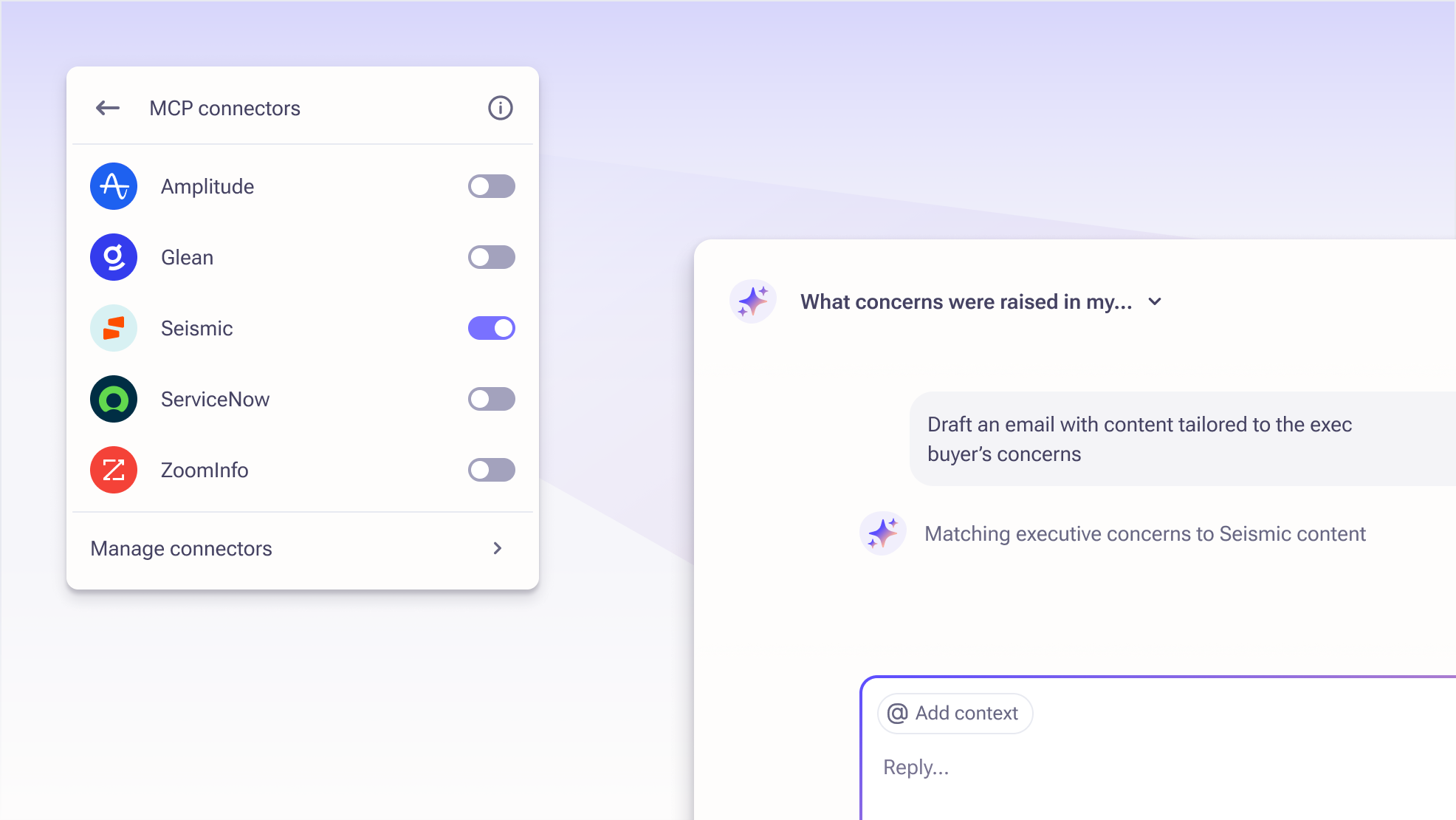
The value is not just that more data is available. The value is that the right context can be brought into the flow of work, where sellers and AI agents can use it to take action.
Outreach MCP Client creates value across the revenue organization because sellers, leaders, and RevOps teams all depend on connected context to execute well.
Sellers do not have time to dig through content libraries, analytics dashboards, enrichment platforms, and conversation notes every time they need to move a deal forward. With Outreach MCP Client, sellers can ask questions in plain language and receive context from connected systems.
For example, a seller might ask how to position against a main competitor based on concerns raised in the last meeting. Outreach can bring together recent conversation insights, competitive intelligence, and other connected data to deliver a tailored response.
Instead of forcing the seller to assemble the answer manually, Outreach helps bring the right context into the moment of execution. That means sellers can handle objections more confidently, personalize outreach more effectively, and keep deals moving.
Revenue leaders need visibility into what is happening across the pipeline, but the signals that matter often live outside the core revenue workflow. A leader might want to know which customers up for renewal in the next six months have seen a drop in product usage.
With connected context, Outreach can pull product usage data from external platforms and cross-reference it with opportunity stages. That gives leaders a clearer view of customer risk, renewal health, and where intervention may be needed.
The result is faster inspection, better coaching, and more confident decisions grounded in real signals.
RevOps teams are responsible for making sure revenue systems, data, and workflows support consistent execution. But when critical information is spread across disconnected tools, standardization becomes harder.
With Outreach MCP Client, RevOps teams can bring data, knowledge, and actions from across the revenue stack directly into Outreach. That helps standardize how teams use context, reduce tool switching, and ensure sellers and AI agents are working from the same information.
Instead of managing disconnected systems as separate islands, RevOps can help make Outreach the central hub where sellers work and AI operates.
The Agentic Ecosystem is a dedicated ecosystem of agent-ready integrations that extend what Outreach AI agents can access and do. It makes it easier to discover and activate partner-enabled AI capabilities, including MCP Client, MCP Server, Smart Data Enrichment, and Signals.
These capabilities help extend AI agents’ access to external data, knowledge, and actions across the revenue stack. The broader goal is to expand what AI agents can do over time. As more partner-enabled workflows become available, AI agents can operate with more context, support more use cases, and help revenue teams execute more effectively across the lifecycle.
Traditional integrations often focus on moving data between systems. Outreach MCP Client is designed to connect context and actions so AI can interpret what you’re asking, reason over the context across all your AI systems, and generate a more useful answer or take action, allowing sellers and AI agents can to execute multi-system workflows from inside Outreach.
That distinction matters.
This goes beyond simply syncing information. For example, instead of checking one system for product usage, another for opportunity stage, and another for recent meeting notes, a revenue leader can use connected context to identify risk and decide where to intervene faster.
That is the difference between integrated data and connected execution.
AI agents are only as useful as the information and actions available to them. Outreach AI already helps revenue teams execute across the revenue lifecycle. MCP Client expands that intelligence by connecting additional business context, knowledge sources, and actions from across the revenue stack.
With connected context, AI agents can reason across more of the revenue lifecycle. They can access more information, support richer workflows, and take on more work across connected systems.
That is what makes Outreach MCP Client important to the future of agentic AI in revenue organizations. The more connected the revenue stack becomes, the more useful AI agents become.
Revenue teams are inundated with systems, creating friction for both sellers and AI. Connected context across the revenue stack gives them the answers and actions they need to move deals forward faster.
Outreach MCP Client helps sellers reduce tool switching, gives leaders better visibility, and enables AI agents to do more across the revenue lifecycle. Supported by the Agentic Ecosystem, it helps bring the full power of the revenue stack into Outreach.
The result is a more connected way to work, where sellers have the context they need, leaders can make faster decisions, RevOps can standardize execution, and AI agents can operate with broader intelligence.
With Outreach MCP client, your team can bring the full power of your revenue stack into Outreach so they can move deals forward faster and capture revenue more efficiently.
Outreach MCP Client is a capability that brings external data, knowledge, and actions directly into Outreach. It helps sellers and AI agents access broader context and execute multi-system workflows from the same workspace.
In a sales context, Model Context Protocol helps AI systems connect to external tools, information sources, and actions so agents can reason across more of the GTM stack. This helps teams work from more complete account, customer, and pipeline context.
Outreach MCP Client helps sellers reduce tool switching by bringing relevant external context into Outreach. Sellers can access the information they need, ask questions in plain language, and act faster without losing momentum between systems.
Outreach MCP Client gives AI agents access to broader context and more actions across connected systems. This helps agents reason more intelligently, deliver smarter recommendations, and support richer revenue workflows.
The Agentic Ecosystem is Outreach’s partner-enabled ecosystem of agent-ready integrations. It helps extend what Outreach AI agents can access and do by connecting them to more data, knowledge, and actions across the revenue stack.
Traditional sales integrations often focus on moving data from one system to another. MCP connects context and actions so sellers and AI agents can reason across systems and execute multi-system workflows from inside Outreach.
Outreach MCP Client reduces tool switching by connecting external applications directly into the Outreach workspace. Sellers can review product usage data, competitive intelligence, buyer signals, and other account context in one place instead of opening multiple tabs.
Revenue workflow automation with Outreach MCP Client allows sales teams to build multi-threaded engagement plans and follow-up sequences using connected revenue data. AI agents can access this connected context to trigger next steps across the GTM stack.