Blog
How to improve sales performance across your revenue team
October 1, 2026
Read more
As the industry pivots from generative assistants to autonomous "Agentic AI," the conversation at the enterprise level is shifting from capability to reliability, transparency, and governance. For technical leaders, the challenge is architectural: how to transition from a compelling "black box" demo to a production-grade system that manages the entropy of a live enterprise environment.
To achieve the AI-driven revenue precision required in today’s landscape, we must move toward the Agentic Harness: a multi-layered engineering framework that anchors frontier models within a deterministic, state-aware operational architecture.
Modern Large Language Models are excellent at high-dimensional pattern matching. But they operate on the transformer architecture with attention mechanisms to predict the next token and function as sophisticated statistical inference engines that approximate reasoning behaviors rather than performing true symbolic reasoning.
This creates a key limitation when scaling them into agents: they do not inherently maintain a persistent, grounded world state. In isolation, an LLM can produce a convincing “right-sounding” answer, even approximate causal reasoning patterns. But in a dynamic sales cycle, it may struggle to model the causality of its actions, and how those actions lead to downstream outcomes. For example, in a sales workflow an agent might recommend discounting to close a deal faster during an early deal stage instead of first positioning cost-to-inaction with a proven talk track that has previously overcome pricing objections, potentially leading to poor pricing precedents.
Without a stronger structural layer, agents can exhibit "brittle" behavior when encountering edge cases outside their training distribution, such as when a multi-threaded deal involves stakeholders with different buying criteria and the agent may incorrectly assume alignment between them, recommending a pricing concession to move the deal forward even though the actual blocker is a pending security approval. In these situations, purely pattern-based responses can appear confident but are structurally incorrect. The architectural goal is therefore to augment them with the rigor needed for autonomous revenue operations.
At the core of autonomous revenue systems is a unified data layer that brings together every data attribute, and signal across the revenue lifecycle. This includes customer engagements, CRM records, first-party and third-party data, public information, and internal knowledge, creating a single, coherent, connected data foundation for agentic decision-making.
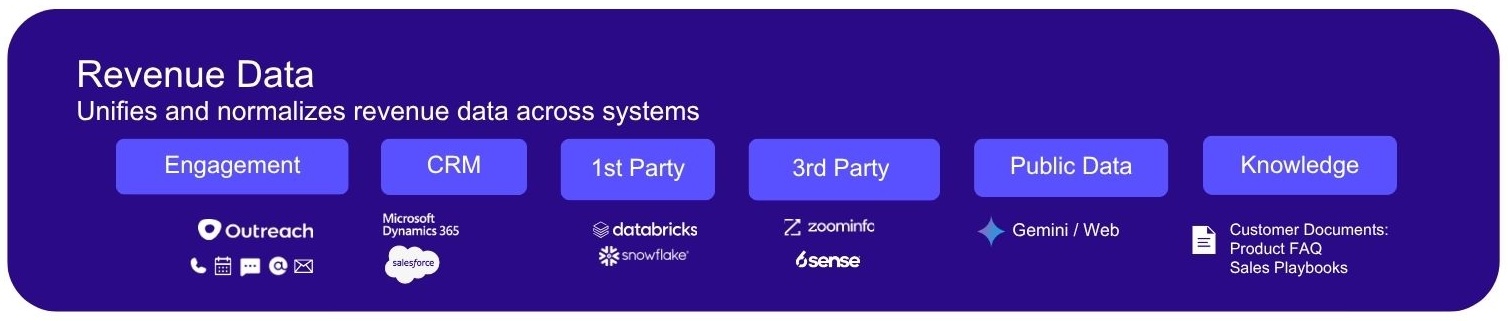
Together, this unified data layer forms the foundation for building reliable, state-aware, and contextually grounded autonomous revenue systems.
This layer extracts entities, relationships, and artifacts of interest from diverse data sources and processes them into an AI-ready revenue context layer.
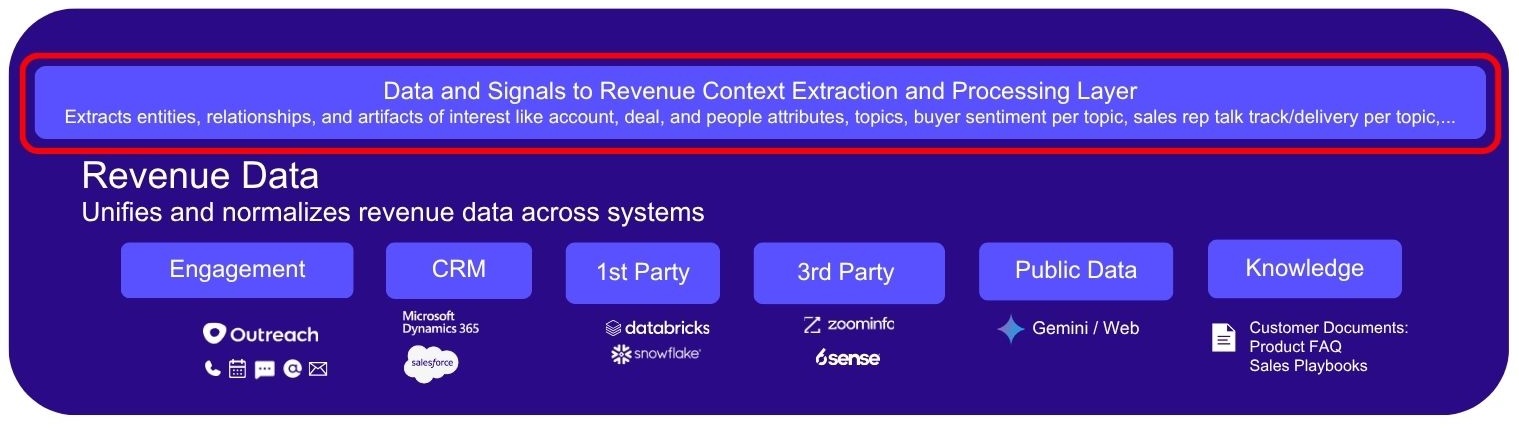
It identifies key entities such as proper nouns and links them to the underlying text snippets where they appear, preserving traceability to source data. It then applies customer context to structure raw inputs into entities, relationships, and artifacts of interest such as attributes on accounts, deals or prospects, deal stages, interactions (meetings, emails, messages), topics such as pricing or legal, buyer sentiment by topic, sales rep talk track and delivery by topic, etc.
This layer helps minimize, if not eliminate, the need to repeatedly rescan large volumes of unstructured data such as meeting transcripts or email content, which can grow significantly over time, slowing agent execution and increasing the risk of context drift. It also provides the ability to create semantically meaningful representations that make interpretation and downstream reasoning more efficient.
See how Outreach combines unified revenue data, AI agents, and enterprise-grade governance to automate workflows across prospecting, deal management, forecasting, and customer growth
Revenue context transforms data and signals into AI-ready understanding of the revenue system, making it actionable for autonomous revenue operations so that Outreach agents and third-party AI platforms can retrieve, reason, and act on it in real time.
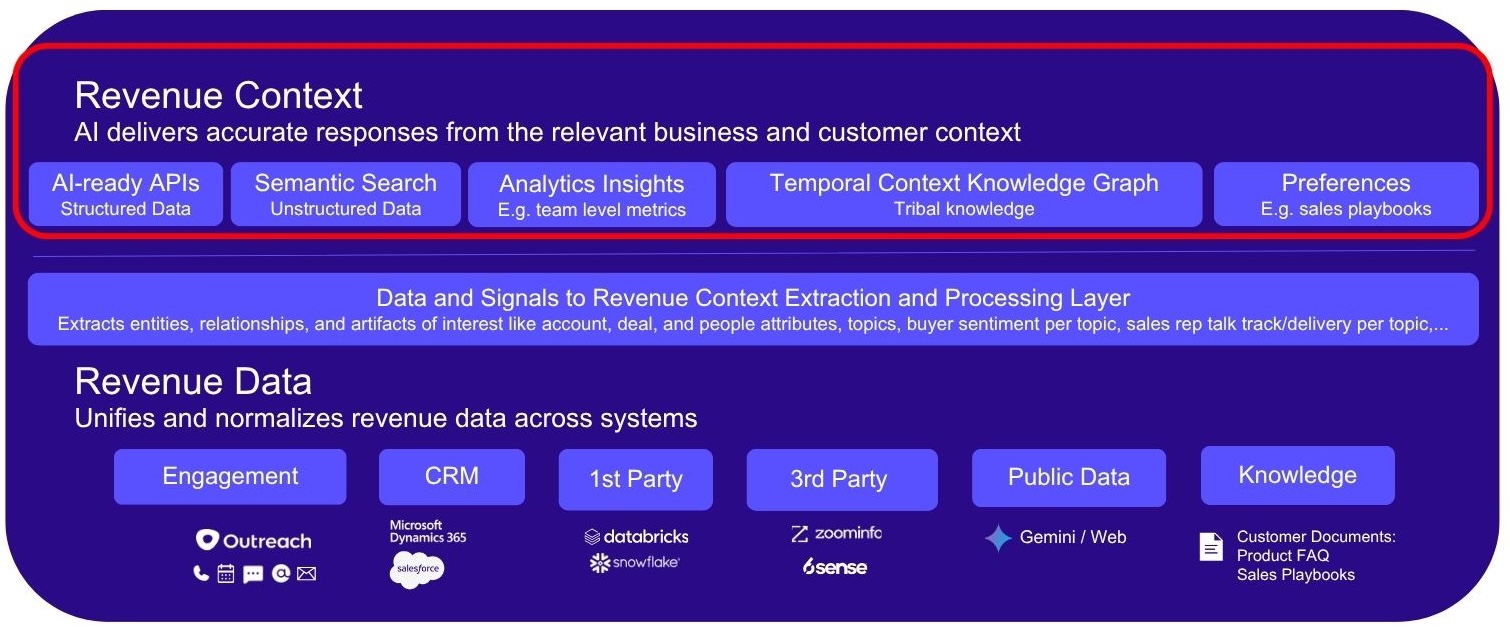
AI-Ready APIs are designed so frontier models can reliably understand and call them to access structured data such as accounts, opportunities, and prospects. They expose clear actions and resource-oriented endpoints, with strongly typed parameters, explicit constraints, and well-defined outputs and error handling. They also support search, filtering, and sorting, enabling models to retrieve exactly the data they need for downstream reasoning and actions.
For example, an API such as list_accounts returns a filtered list of accounts (e.g., account_id, name, industry) along with a next_page_token for pagination. A parameter like created_before (ISO-8601 datetime, optional) allows filtering records where created_at is earlier than a specific timestamp, such as 2026-04-01T00:00:00Z.
Semantic search enables retrieval of relevant unstructured snippets from emails, meeting transcripts, and documents based on meaning rather than keywords. This allows agents to surface contextual signals embedded in historical interactions. For example, it can retrieve feature requests mentioned in last week’s meetings or identify conversations within an account like Acme Corp where budget approval was discussed.
Analytics insights provide aggregated metrics and trends across teams, segments, and time horizons. Rather than serving as static dashboards, they act as inputs for agentic reasoning and decision-making. For example, win rate trends can be tracked by segment (midmarket vs. enterprise) on a week-over-week basis, or team-level email performance can be analyzed through open and reply rates segmented by persona and tracked over time.
Standard retrieval methods such as RAG treat information as flat semantic chunks, losing the connective structure that defines how deals actually evolve. Semantic similarity alone does not capture strategic relevance. To preserve this institutional memory, we implement a Temporal Context Knowledge Graph (TCKG).
The TCKG forms a per-customer network of connected intelligence that models accounts, deals, deal stages, and all buyer-seller interactions, including meetings and emails. It extracts high-fidelity entities such as economic buyers, technical blockers, champions, and incumbent vendors, and connects them through directed relationships grounded in real interactions. Within each interaction, it captures topics of discussion, buyer sentiment per topic, and sales rep talk track and delivery, etc., creating a structured view of how deals progress.
Beyond static representation, the TCKG introduces temporal state tracking, recording how relationships evolve over time. It does not simply identify a champion; it models the sequence of events that moves a stakeholder from neutral to advocate. In complex enterprise sales, when and why a relationship status changed is often more important than the latest status.
Over time, the TCKG enables self-learning signal inference by enabling analysis of cohorts of historical deals, various deal stages and leading indicators per stage or meeting type to distinguish true leading indicators from noise. It learns which signals consistently predict outcomes and which are incidental or non-predictive across similar deal patterns.
For example, in an enterprise EU healthcare cohort, the system may determine that an early security review is a high-confidence leading indicator of progression from evaluation deal stage, while an early executive introduction carries little predictive value if it occurs before technical validation is complete. The deal health agent can surface this context, which the next best action agent can leverage for follow-up.
In another case, a new healthcare deal entering the evaluation stage is automatically mapped to the appropriate cohort of historical deals. The system identifies recurring high-impact topics such as HIPAA compliance, EHR integrations, and data handling requirements, and recommends proven talk tracks such as leading with HITRUST certification and offering a live audit walkthrough that historically improved conversion rates. These insights can then be surfaced by the meeting prep agent.
This is the difference between a model that "knows" sales and a model that has tribal knowledge to understand your sales and the structure of revenue motion itself.
In practice, the graph continuously links leading indicators such as shifts in sentiment, declining engagement, or reduced champion activity to lagging outcomes like win/loss, deal velocity, contract size, time to close, etc. This enables it to surface not just what is happening in a deal, but why it is happening and what is likely to happen next. This is inherently an ability to model the causality of agentic actions and how those actions lead to downstream outcomes.
Preferences encode organization and user-level configurations such as playbooks, messaging style, and tone. These are used to personalize system behavior and ensure alignment with sales methodology and communication standards. For example, messaging may follow a defined sales playbook, while email tone and structure adapt to individual seller preferences while remaining consistent with organizational guidelines.
The Agent Harness is a vertical AI system that combines sales domain expertise with the customer’s revenue context, incorporating enterprise-grade governance and guardrails. It acts as a control layer that integrates institutional memory, appropriate tools and skills, a reasoning framework for frontier models, and monitoring and evaluation into a cohesive system for orchestrating multi-agent workflows tailored to the customer’s sales processes.
As the orchestration backbone of an autonomous revenue system, it enables multiple agents to coordinate and operate reliably in production environments rather than functioning as isolated model calls, while maintaining human oversight where needed.
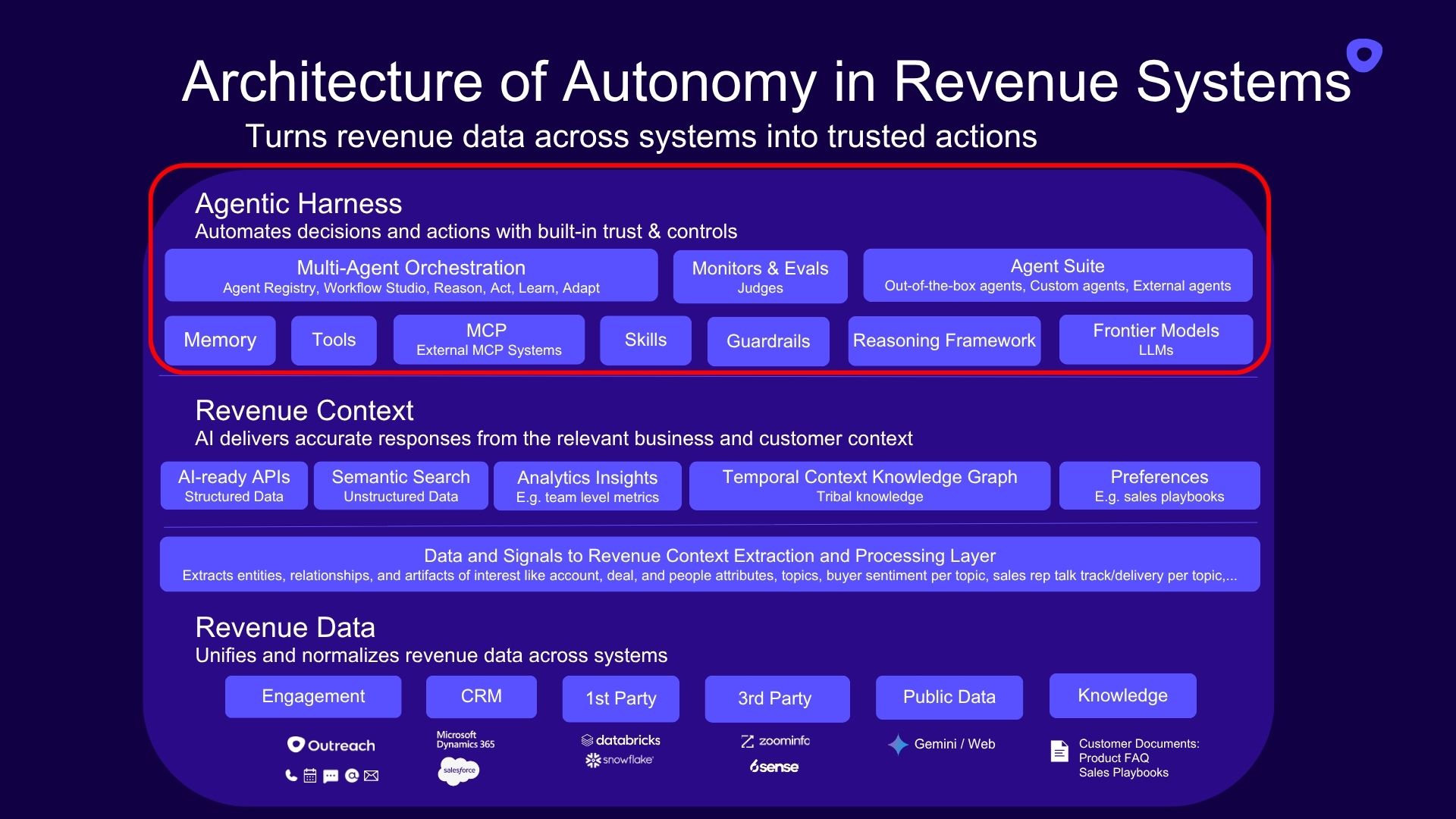
A key challenge in multi-agent systems is contextual amnesia where information is lost during transitions between agents or across sessions. The memory layer addresses this by maintaining persistent, shared context, ensuring continuity of reasoning, personalization, and workflow execution over time.
It learns and captures user and organizational preferences such as preferred communication style and decision-making thresholds. These learned preferences act as constraints that guide agent behavior and reasoning.
The Harness also maintains cross-agent session state, enabling continuity across multi-step agentic workflows. For example, insights generated by a Research Agent during discovery are preserved and passed to a Meeting Prep Agent, ensuring downstream decisions reflect earlier context without reprocessing or loss of fidelity.
In addition, the memory layer stores durable interaction signals, including user feedback, habits, and behavioral preferences. If a user prefers concise summaries, this preference is retained and consistently applied across interactions. In ambiguous situations, the system can either ask clarifying questions or proceed with stated assumptions, depending on user-configured preferences, ensuring consistent and adaptive behavior over time.
To ensure safe and reliable execution, the harness avoids unbounded model actions by introducing structured execution boundaries through standardized protocols and tools.
The Model Context Protocol (MCP) enables agents to securely connect to external systems through a standardized interface. Instead of ad-hoc integrations, MCP provides controlled access to third-party services while limiting each connection to only the permissions it needs. This separates model reasoning from external system execution while maintaining extensibility. For example, MCP clients allow Outreach agents to integrate with external systems such as Amplitude or Seismic to retrieve knowledge or relevant content when needed.
The Harness also maintains a dynamic library of skills, which are encapsulated, verified logic paths that execute specific revenue-related tasks. These are predefined execution units governed by deterministic logic rather than generated behavior. For example, a meeting summarization skill produces structured recaps with action items, while a deal risk assessment skill evaluates opportunity health using signals such as sentiment and objection patterns.
Tools complement this layer by acting as direct interfaces to data sources via AI-ready APIs, enabling actions such as retrieving account details or updating opportunity fields aligned with sales methodology.
To ensure trust, safety, and enterprise reliability, the Agentic Harness includes layered governance mechanisms that continuously evaluate and constrain system behavior.
Guardrails are policy checks that constrain what an agent can see and do (e.g., read, write, send), and define when it must stop for human approval. They act as real-time enforcement boundaries that monitor inputs and outputs to ensure compliance, prevent sensitive data leakage, and enforce organizational operational constraints.
For example, in email send actions, external emails to VP-level and above may be drafted by an email compose agent but still require seller approval before sending. In data access actions, agents might be able to read opportunity fields but may not be allowed to access sensitive artifacts such as specific call transcripts or emails unless the user’s role allows it.
The reasoning framework structures how models interpret and execute tasks, ensuring consistency, compliance, and stage-aware decision-making. It provides structured guidance that also embeds sales domain knowledge that helps models break down complex workflows into discrete steps.
For example, when identifying competitor mentions, the system follows a structured retrieval strategy - checking known competitor fields before using semantic search. Similarly, response generation adheres to organization-defined formats to ensure consistency across outputs.
The Orchestrator is the control system of the Agentic Harness. At its core is an agent registry, which contains a list of out-of-the-box agents, custom agents, and external agents, where each agent is registered with definitions of the tasks it can perform. Custom and external agents can be configured for the customer. The agents themselves can use smaller models for simpler tasks while reserving higher-capability models for complex tasks. This balance ensures both responsiveness and depth.
The next layer up is a workflow studio, which includes complex workflows modeling customer-specific sales processes that can be created and managed via natural language queries and are viewable and editable by customers as desired.
The Orchestrator consults the reasoning framework with frontier models to break down complex workflows and tasks into simpler, discrete tasks that can be executed by a combination of agents. It then schedules their execution on defined cadences like every Monday at 6am, heartbeat intervals such as every 30 minutes, or based on specific events or triggers (like a meeting completion event).
In multi-agent workflows, the Orchestrator coordinates execution across time and triggers. A research agent may continuously analyze accounts on a scheduled cadence, a long-running deal health monitor agent can spot deal risk from TCKG, raising an event that triggers the system to execute a Next Best Action agent for follow-up, while a meeting completion event triggers downstream workflows such as a deal agent to extract insights and automatically update opportunity fields.
The Orchestrator monitors workflow execution and manages the reasoning, action, and feedback loop, ensuring that every task executed by an agent is grounded in customer context and real system feedback rather than model assumptions.
Critically, it enforces verification of outcomes. If an agent task returns incomplete or missing data, the system does not infer or hallucinate results. Instead, it adjusts its reasoning based on the observed state. For example, if a security review is not found, the system recognizes the missing dependency and flags it as a blocker rather than proceeding with incomplete assumptions. It surfaces every run with full explainability so it is available for customer review.
Further, it maintains detailed audit trails of workflow execution, including agent actions, reasoning steps, tool usage, and approval checkpoints, enabling enterprise customers to support governance, compliance, operational review, and post-execution analysis.
If a workflow needs to be modified based on observed outcomes, it surfaces the modification by bringing a human in the loop for review and approval. This level of control is critical in an enterprise setting. However, users with the right privileges can also approve future modifications, with notifications and details of when changes are made.
This enables a shift from autonomous orchestration with human checkpoints to self-optimizing agentic revenue workflows.
Evaluation and monitoring are continuous quality assurance mechanisms that ensure agent performance remains accurate, safe, and effective across both real-time execution and offline review.
This layer combines LLM Judges with human-in-the-loop oversight to assess agent behavior at scale. LLM Judges automatically evaluate outputs such as generated emails and recommendations for quality, relevance, completeness, and alignment with business logic and compliance rules. Where human checkpoints are needed, reviewers validate system behavior in edge cases and high-stakes workflows. These signals are also tracked quantitatively, for example through acceptance rates of agent recommendations and quality scores of generated outputs, which create a feedback loop that continuously improves system reliability.
Together, these mechanisms ensure agents remain aligned with enterprise expectations while improving over time through structured feedback.
The next generation of competitive advantage will not come from the model alone, but from the intelligence architecture surrounding it. The moat is the architectural rigor of the Agentic Harness and the depth of the TCKG required for an autonomous revenue system.
We are moving toward a future where the best sales organization is the one with the most refined Organizational Intelligence: the ability to capture the tribal knowledge and silent wisdom of top performers and operationalize it across revenue workflows with consistent precision across the entire organization.
Within Outreach, this vision takes shape through self-optimizing agentic revenue workflows. A multi-agent orchestrator coordinates these workflows using a combination of agents and continuously learns from execution outcomes and feedback loops. It adapts workflow execution strategies over time, such as by selecting more effective agent sequences or prioritizing high-signal actions and contextual cues inferred from historical success patterns captured in TCKG. This drives progressively more intelligent revenue execution at scale while operating within enterprise governance and guardrails, with full auditability, user control, and human oversight where needed.
Agentic AI architecture is the technical framework that enables autonomous AI agents to reason, access data, take actions, and operate reliably within enterprise systems. It typically includes tools, memory, agent orchestration, governance, and monitoring layers.
An autonomous revenue system uses AI agents, revenue data and insights, and orchestration with enterprise governance and operational controls to automate workflows such as prospecting, meeting preparation, deal management, forecasting, and customer expansion.
The Agentic Harness is Outreach’s vertical AI framework that combines persistent memory, secure tools and deterministic skills, governance and guardrails, a reasoning framework, and multi-agent orchestration with monitoring and evaluations to enable reliable autonomous revenue workflow execution.
A Temporal Context Knowledge Graph (TCKG) is a structured, per-customer network of connected intelligence that models how accounts, deals, deal stages, stakeholders, their interactions, conversations, topics, sentiments, and deal signals connect and evolve over time. It enables AI systems to understand not only what is happening in a deal, but why it is happening and what is likely to happen next.
Over time, it learns from deal cohorts and historical patterns to identify which leading indicators reliably predict outcomes, forming institutional knowledge that can be leveraged across new and ongoing deals.
Persistent memory enables AI agents to retain context, preventing information loss during transitions between agents or across sessions, thereby enabling more accurate, consistent, and continuous reasoning and workflow execution over time.
Multi-agent orchestration coordinates specialized AI agents to execute complex workflows across time and event triggers, share context, manage the reasoning, action, and feedback loop across agents, monitor results, and enforce verification of outcomes, while operating within enterprise governance and guardrails, with full auditability, user control, and human oversight where needed.
Governance and guardrails are policy checks that define what AI agents are allowed to access and do, enforce compliance, protect sensitive data, and determine when human approval is required. This ensures enterprise-grade trust, compliance, safety, and reliability.
Organizational Intelligence is the ability to capture the tribal knowledge of top performers in understanding sales and the structure of revenue motions and operationalize it across revenue workflows with consistent precision across the entire organization.