Blog
Sales automation impact on customer acquisition cost
October 12, 2026
Read more
Most revenue teams are deploying AI, but few can point to real ROI. The gap is not adoption. It is trust.
As AI moves from copilots to autonomous agents, the question is not whether agents can act. It is whether they can be trusted to act, reliably, transparently, and inside the boundaries an enterprise needs. That trust comes from the architecture around the model, not the model alone.
Agentic execution is autonomous AI action on real business processes; not suggestions, not assistance, but actual work performed with enterprise oversight. Unlike copilots that suggest next steps, agentic execution means agents handle prospecting research, draft personalized outreach, qualify leads, update deals and even send emails; all within guardrails that keep your team in control.
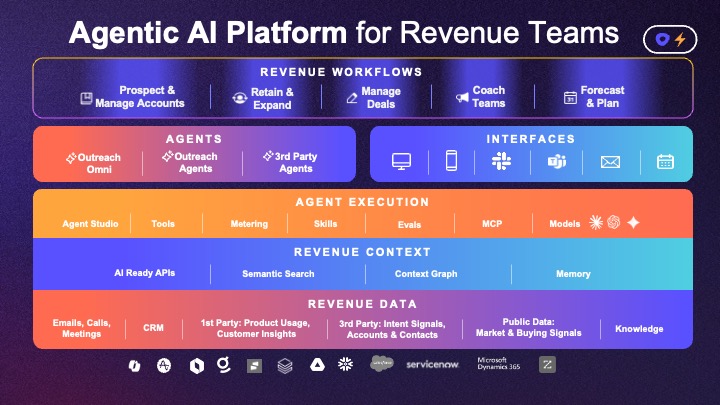
Outreach powers revenue workflows for every seller and leader: prospecting and managing accounts, retaining and expanding customers, managing deals, coaching teams, forecasting and planning. Agents, both our own and third-party, orchestrate that work, integrated into the interfaces where people work: mobile, Slack, Teams, email, calendar.
All of this runs on a trusted architecture underneath, three foundational layers that make it possible.
Revenue Data brings every data and signal across the revenue lifecycle into one place. Persistent Revenue Context turns that data into something a system can reason over at scale, with accuracy and speed. Governed Agent Execution is where agents act on that context, inside guardrails that keep enterprise teams in control.
Outreach was named a top performer in The Forrester Wave™: Revenue Orchestration Platforms for B2B, Q3 2026.
A common shortcut in the market is wiring a frontier model up to a set of tools through Model Context Protocol® (MCP) and calling the result an agent. MCP is genuinely useful; it gives a model a standardized, permissioned way to reach external systems. But access alone is merely a connection, not an architecture.
Without the layers underneath, an agent has no memory of why a deal stalled, no grounding to avoid misreading a multi-threaded deal, no discipline to flag missing data instead of guessing, and no audit trail to make its actions safe and reviewable.
Autonomous revenue execution starts with a unified view of everything happening across the revenue lifecycle. Instead of signals scattered across a dozen disconnected systems, this layer brings them into one connected foundation.
Most platforms in the market today only tap into a narrow slice of this picture. Some focus on conversation data, analyzing calls and meetings. Others are built around top-of-funnel signals for outbound, optimized for finding and reaching prospects but blind to what happens once a deal is in motion. Company playbooks, the actual best practices and enablement content a team runs on, tend to live in a separate enablement platform entirely, disconnected from both the conversation data and the funnel activity. Each of these tools operating in their own siloes make it difficult to understand the full story of an account.
To drive the right insight and the right action, an agent needs full customer context connected to your company’s own playbooks, in one place – a strong foundation for insights. That’s why Outreach’s Revenue Data includes:
Each of these is useful on its own but limited. The real value comes from bringing the data into one connected foundation, so nothing is missing when an agent needs the full picture.
This is where data and signals centralized in Revenue Data get turned into structured, AI-ready understanding, making it possible for agents to retrieve, reason, and act in real time. Relevance, accuracy, and latency for the agent actions all trace back to the context layer.
Searching across conversations, deals and accounts, at scale, is hard. Send raw data, like full transcripts, straight to an LLM and the context window blows up, retrieval slows down, and the risk of hallucination goes up.
To address this, we built an extraction layer that runs after every conversation. It captures sales specific observations, like competitors, objections, pain or a shift in sentiment, in a structured way inside our Context Graph. Revenue data, including pre-computed analytical metrics like win rates, and actions are exposed through AI-ready APIs and Tools, so agents can retrieve exactly what they need. At run time, agents pull structured facts from the Context Graph and use Semantic Search to retrieve other insights from unstructured data, including your playbooks and documents in Knowledge.
This ensures an agent can accurately surface the competitors coming up in a specific segment across all the deals in the quarter, identify specific compete objections for every deal and the conversations where it came up. From there, it can draft personalized objection handling responses from your enablement content and automate emails to the stakeholders for each deal, all in one workflow.
Finally, Memory captures organizational and user preferences, like communication style and decision-making thresholds, and it carries context across steps in a workflow, so the learnings from each step is available to the next agent.
Together, these components turn the data into a living, structured understanding of your revenue process. Agents use fewer tokens, generate faster responses, and stay accurate & consistent, even when the agent needs to act across thousands of conversations, deals, and accounts.
Once the data and context are in place, the next question is how agents operate: how work gets executed, how much access they get, and how anyone can trust what happened after the fact. This is the layer where agents do the work, inside a framework built to ensure the agent outputs are auditable, safe and consistent.
Enterprises need oversight on what an agent did, a way to trace its actions and steps, and control over what it costs to run at scale. Evals continuously check agent output for quality, combining automated judgment with human review where it matters most. The in-app Metering dashboard tracks usage and consumption across every agent, so you can govern your costs and drive accountability across teams. Models are selected per use case, so every agent task runs on the model best suited to it for quality and performance.
Agents need a way to execute complex, multi-step revenue work without guessing at every action. Agent Studio lets you build custom agents for a process, like qualifying an inbound lead or re-engaging a closed-lost deal, breaking it into discrete steps that run on a schedule, a trigger, or an event like a completed meeting. Tools give agents access through AI-ready APIs, so an action like updating an opportunity field happens through a defined interface, not an open-ended model action.
Agents also need context beyond Outreach. MCP Client gives them a standardized, permissioned way to reach external systems so Outreach agents can connect to your competitive playbook from your sales enablement platform to help address an objection on a deal.
Skills ensure agent responses are consistent and do not drift. Ask an LLM about deal risk directly and it will guess at what factors matter, giving a different answer every time you ask. Skills fix that: for deal risk and other critical sales tasks, the right tools are called across the data sources and factors built into that skill, so the response is the same every time.
Every agent follows security and access permissions, and guardrails such as how many prospects can be engaged or emails sent, to ensure no agent acts beyond the boundaries your team has set, no matter how much autonomy it is given.
Agents can act with real autonomy. This governance layer keeps them on track and gives you full visibility into every action they take.
Revenue Data feeds Revenue Context, Revenue Context feeds Agent Execution. Every action an agent takes, and every outcome, compounds the learning that the next agent acts from.
Making an agent perform in a demo is one thing. Revenue teams need agents they can trust to act on a real customer, a live deal. Many Outreach customers are already reaping the benefits of AI agents in their revenue workflows. SAP’s manual outreach has been reduced by 80%. Using agents in win-back scenarios, SolarWinds increased its reply rate by 45%. Freshworks has seen an 87% increase in closed-won revenue attributed to or influenced by AI.
Outreach’s architecture delivers agents acting across your revenue workflows, turning disparate signals into action you can trust.
Understanding agentic execution is one thing. Knowing whether to build custom agents or buy a platform is another. Download our Build vs. Buy ebook to explore the decision framework that enterprise revenue leaders are using—and get clarity on the right approach for your organization.
Copilots suggest what to do next; agents actually do it. Agentic execution means autonomous action on real deals, prospects, and workflows—handled inside guardrails that keep enterprises in control with full audit trails.
Because access alone (via MCP or APIs) is just connection. Enterprise trust requires: unified data context, structured understanding of your business, and governance that keeps agents transparent and accountable. These layers turn raw model capability into reliable, repeatable revenue execution.
Technically yes. But without the layers underneath (memory of past interactions, context about your deals, governed execution with audit trails) agents hallucinate, miss critical data, and leave no record of what happened. Outreach's three-layer architecture solves these problems.
It means agents can act autonomously while enterprises maintain full visibility, can trace every decision, set clear boundaries, and continuously verify output quality. Trust comes from transparency and control, not from turning humans into bystanders.
You understand the architecture. Now it's time to decide: should your team build on Outreach MCP Server or buy trusted agentic execution? Our Build vs. Buy ebook walks through the framework that enterprise teams use to make this decision—with ROI models, risk analysis, and real examples from companies like SAP and SolarWinds.