Blog
Sales automation impact on customer acquisition cost
October 12, 2026
Read more
TL;DR: Revenue tech vendors increasingly describe themselves the same way: unified, AI-powered, signal to action. That convergence in language makes it harder, not easier, for buyers to tell which platforms actually deliver on the claim. This piece proposes four questions — depth, continuity, governance, and span — that revenue leaders can use to test any "unified platform" claim in a demo or reference call, rather than accepting it at face value.
Open a handful of revenue technology homepages right now and you'll notice something…they've started to sound the same:
The vocabulary has converged across a category that, a few years ago, was still arguing about which point solution mattered most.
That convergence isn't necessarily a bad sign. It suggests the industry has landed on two related problems worth solving.
The first is fragmentation: revenue teams have historically relied on separate tools for things like sales engagement, conversation intelligence, deal management, and forecasting. A unified platform promises to bring those capabilities together so teams aren't stitching together multiple point solutions.
The second is what happens inside that platform once the data is there. Bringing capabilities under one roof is useful, but buyers still need to know whether the context captured in one part of the revenue process actually informs what happens next.
That leaves revenue leaders with a harder job than the marketing suggests. A claim that a platform is “unified” can describe how many capabilities it brings together. A claim that it connects signals, context, and action is a different question — and one that should be testable. The problem is that most buyers don't have a clean way to run that test.
Here's a useful way to think about it: "unified" can be a packaging claim. Whether a platform actually behaves as one coherent system, where what happens in one part of the revenue process meaningfully shapes what happens next, is a separate, harder question, and it's the one that actually determines whether the platform changes outcomes.
(Outreach has written previously about the shift from fragmented point tools toward unified, AI-ready revenue platforms and the operational costs of managing disconnected systems.)
This distinction matters more as AI gets layered into more of the revenue stack. It's one thing for a system to summarize a call or flag a risk in your forecast. It's another for that summary or signal to become part of the broader context around a deal, and then help inform the next relevant action. Buyers evaluating this next generation of platforms need a way to separate the two.
One way to approach this — and it's worth treating as a proposed starting point rather than an established industry framework — is to break "coordinated execution" into four separate questions. Each one can be asked concretely, in a demo or a reference call, rather than accepted as a marketing claim.
None of these are new ideas individually. What's useful is treating them as a set, because a platform can score well on one or two and still fall short of genuinely coordinated execution.
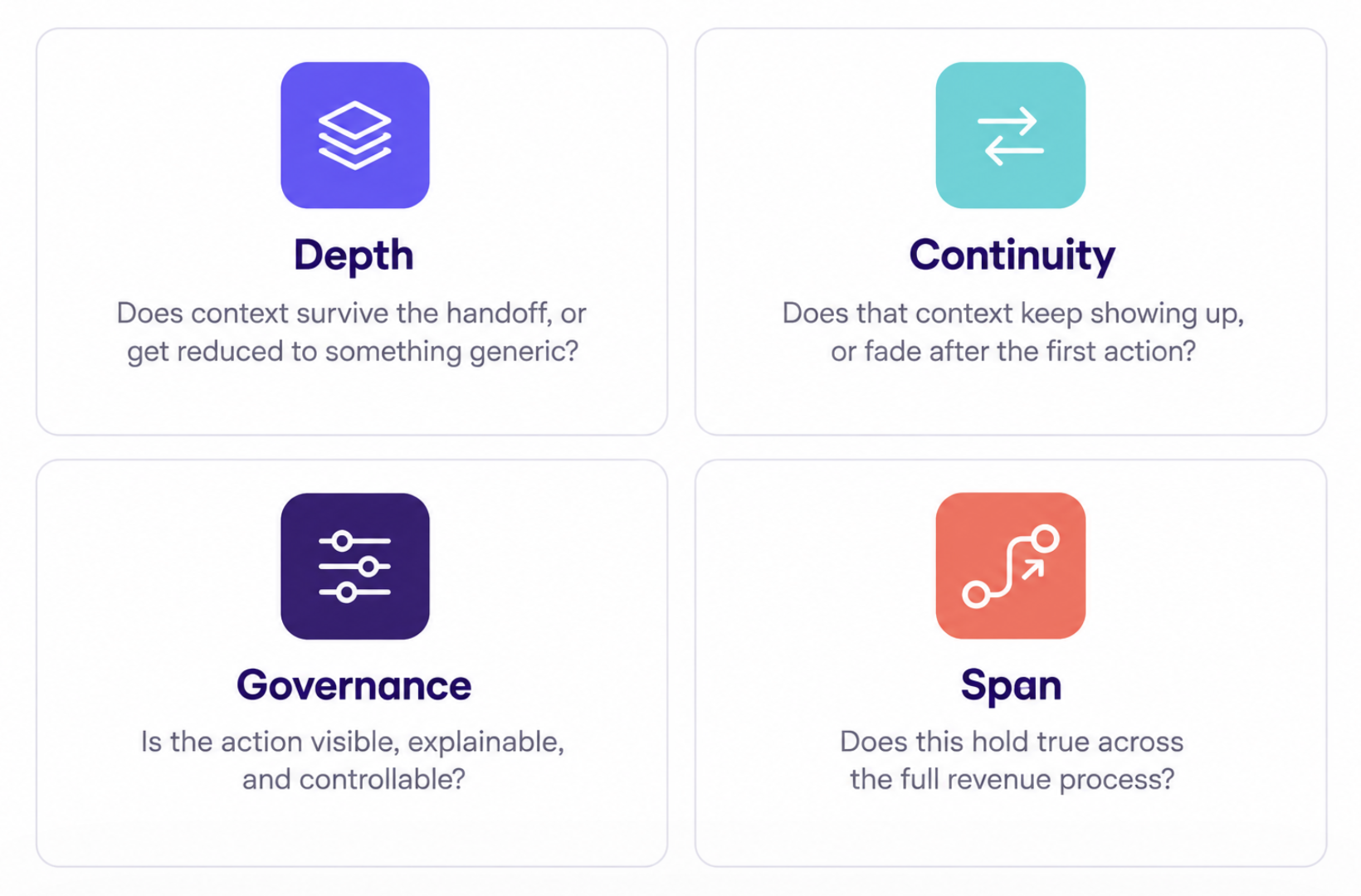
It's easy for a system to say a signal has been captured. It's harder for that signal to retain the specific information that made it useful in the first place: which account, which stakeholder, which commitment, which objection. A "customer raised pricing concerns" flag is a different, far less useful thing than a record that preserves what was actually said, by whom, and in what context.
A useful question to ask a vendor: When information moves from a conversation into a workflow, what specifically survives: a category label, or the substance behind it? Ask to see an example three or four steps removed from the original interaction, not the first hop.
A signal that informs one action and then disappears isn't much different from a signal that never left a dashboard. The more useful test is whether that same piece of context reappears later without someone having to manually go find it again. This can be in a follow-up meeting, in a deal update, or in a forecast note.
A useful question: If I raise something in a call today, will it still be visible and usable in a meeting three weeks from now, without a rep manually re-surfacing it?
As more of the revenue process becomes system-driven, the more important question stops being "did the system act" and becomes "can a leader see why it acted, and adjust the rules that produced it." As AI takes on more actions, visibility and control become part of the execution standard, not a separate compliance concern.
Useful questions: Can I see a log of what the system did and why? Can I set rules for when action should be recommended to a human versus taken automatically? If something goes wrong, can I trace it back to its source?
"End to end" is one of the easiest claims to make and one of the hardest to verify in a single meeting, because most demos are built around the part of the process a vendor is strongest in. The more rigorous test is to walk the claim backward: start at the forecast, and ask what fed it; start at a deal update, and ask what conversation or signal produced it.
Useful question: Can you walk me through one specific opportunity, from the first prospecting signal through the current forecast line, showing what happened at each step and why?
It's worth grounding this in a concrete example rather than leaving it abstract, and Outreach is a reasonable place to look; not because it's the only platform that can meet this bar, but because it's the one we can speak to with specifics rather than generalities.
In a fragmented revenue stack, opportunity context often has to move from one tool to another — from conversation intelligence to engagement, CRM, forecasting, and beyond — through fields, syncs, or summaries. Each handoff can strip away some of the detail that’s valuable to ensuring the deal keeps moving forward and the buyer chooses your product or service over the competition.
Outreach is designed differently: conversation data, email activity, meetings, CRM data, company knowledge and playbooks, and first-party data are available through a shared context layer that Outreach agents can draw from directly. That helps preserve the who, what, and why behind a signal as it moves into the next action.
You can see that in the product. Meeting Prep Agent brings account history and prior conversation context into upcoming meetings. Omni Agent can move from a specific question to a specific action, such as drafting a message or updating a record. Deal Agent is designed to update opportunity information based on the interaction that produced it. Conversation data can also feed Research Agent, Omni, and Deal Agent natively, while personalization can draw on broader account context, company playbooks, and web research.
One place to see, meter, and control AI: linked sources on recommendations, usage metering, AI Control Hub, and field-level access by role. Agent actions are as logged, explainable, and governed by controls an organization sets, and Deal Agent updates can be recommended or automated so a human can remain in the approval loop where appropriate. This sits alongside enterprise security and compliance certifications, including ISO 42001 and SOC 2.
In Outreach, prospecting, engagement, meetings, conversation intelligence, deal management, coaching and forecasting run on one platform and one data model. Agent Studio allows revenue teams to build tailored agents so that even bespoke workflows can be automated. More broadly, the Outreach platform is designed to carry context forward throughout the entire revenue motion, from pipeline generation and deal execution through forecasting. That same context extends into later-stage revenue workflows and forecasting as well.
None of this is offered as proof that other platforms fall short on these dimensions. Most vendors haven't published the kind of detail that would let a buyer make that comparison either way, which is arguably part of the point. The framework is useful because it gives buyers a way to interrogate the claim rather than accept the label at face value.
The category has mostly agreed on the destination: a system where signal and action aren't separate steps. Where it's still genuinely useful for buyers to push is on the how: whether context actually survives contact with the real, multi-step process a revenue team runs every day, or whether it holds up only in the version of the story a vendor tells in a first meeting.
"Unified" should describe how work actually happens across dozens of handoffs in the revenue process, not how a platform is packaged or positioned. That's a harder thing to prove than to claim, which is exactly why it's worth asking about directly.
The evaluation criteria are useful only if you can see them working in practice. Get a personalized walkthrough of how Meeting Prep Agent carries context forward, Deal Agent preserves human control, and Outreach's governance controls make every action visible and explainable — across the full revenue cycle.
It depends on the vendor, which is part of the problem. In practice, it usually refers to combining functions like engagement, conversation intelligence, deal management, and forecasting into one system. Whether that combination actually changes how work happens — versus just how the product is packaged — is a separate question this framework is designed to help buyers test.
Depth (does context survive the handoff, or get reduced to something generic), continuity (does that context keep showing up at later steps), governance (is the resulting action visible, explainable, and controllable), and span (does this hold true across the full revenue process, not just one stage).
No. It's proposed here as a practical starting point for evaluation, not an established standard. It's meant to be tested and refined, not treated as settled.
As more revenue actions become system-driven, the ability to see why an action happened and adjust the rules behind it becomes part of the execution standard itself, not a separate compliance add-on. A fast action that can't be explained or corrected is a liability, not a feature.
Rather than accepting an "end-to-end" claim, ask the vendor to walk one specific opportunity backward — starting from a forecast line, tracing back through the deal update, back to the original conversation or signal that produced it. Most demos are built around a vendor's strongest stage; walking it backward surfaces the weaker links.
No. It's written to be useful to a buyer evaluating any vendor making similar claims, regardless of whether they've heard of a specific competitor's announcement.
You now know what depth, continuity, governance, and span actually require. See how Outreach and other leading revenue platforms measure up against this framework—and where the real differences emerge when you pressure-test the claims.