Blog
How to improve sales performance across your revenue team
October 1, 2026
Read more
If cold outreach is feeling extra chilly these days, you’re not alone. Outreach data shows that engaging buyers requires sustained effort, with nearly five touches needed to generate an initial response and more than seven for cold outreach. And because response rates are highest early in the engagement cycle, sellers need to maintain momentum with timely, consistent follow-up. That challenge starts at the top of the funnel, as buyers become more hesitant to entertain new opportunities.
At the same time, sellers’ responsibilities are changing too. As teams have restructured and consolidated to match the new buying reality, many sellers are no longer just responsible for managing deals — they’re on the hook for sourcing them, too.
In short: Buyers are putting up more walls, sellers are increasingly stretched for time, and traditional tactics don’t have the same impact they used to. To meet their pipeline goals, today’s sales reps need more personalized, targeted, field-tested outbound prospecting strategies that can cut through the uncertainty plaguing the market.
This guide breaks down the new reality of email prospecting and what that means for sales teams. Keep reading for step-by-step guidance, common mistakes, and top-performing email templates to help you level-up your approach to prospecting.
Sales prospecting emails are the digital equivalent of a friendly knock on a prospect's door. They're targeted messages designed to initiate a conversation with potential customers, introduce your product or service, and ideally, spark interest that leads to a meeting or further discussion. Unlike mass marketing emails, prospecting emails are personalized and tailored to the recipient's industry, role, or specific pain points. Effective prospecting emails are concise, engaging, and offer value to the reader, going beyond a simple sales pitch.
Incorporating email into your multi-touch outreach strategy increases your chances of getting your message seen and heard.
The world of sales is noisy and competitive. Prospects are bombarded with messages from competitors across countless channels. When combined with other outreach methods like social selling and phone calls, email prospecting provides one more opportunity to connect with busy decision-makers and cut through the noise.
Email prospecting allows sales teams to reach a large number of potential clients quickly and efficiently. Sales platforms (like Outreach!) make it easy to automate and personalize emails at scale, ensuring that your message reaches the right audience without the need for extensive manual effort. This scalability enables sales teams to focus more on high-value activities and less on repetitive tasks.
Email prospecting gives you the ability to track and measure the performance of your campaigns. Look for analytics and reporting features that allow you to monitor open rates, click-through rates, and responses.
Tools like Outreach’s email sentiment detection go a step further. Sentiment analysis can help your sales reps understand how you’re resonating with buyers. It offers a whole new level of insights — like whether email responses are positive, objections, referrals, or unsubscribes.
These data-driven deal insights help you refine your strategies, optimize your outreach efforts, and achieve better results over time.
Email allows you to segment your audience and tailor your messages to specific industries, roles, or pain points. This personalization increases the relevance of your emails, making them more likely to be opened and read.
Generative AI tools play a role here, too — features like Outreach’s Smart Email Assist take the guesswork out of drafting that first message. Using details from the account, plus any previous calls, meetings, or emails, sellers can prompt the AI to draft a personalized message in just a few seconds.

For the best results, sales teams must truly understand what matters to their audience. Knowing what’s most important to prospects is the foundation of highly relevant email subject lines and email copy. Here are a few helpful tips for sending prospecting messages that convert into initial meetings, and ultimately, revenue.
When creating email content, it's important to consider the persona you're targeting: what’s their role, what are their primary responsibilities, and what about your solution resonates with them.
At Outreach, we segment our audience based on persona, which includes their job function (such as sales or marketing) and level of seniority (such as vice president or director). This information helps us write personalized emails that are tailored to each persona's needs.

Early in Outreach’s history, we found that our database contained approximately 50 million unique job titles. With so many titles to consider, our sellers struggled to determine whether they were precisely targeting the right people with their emails.
As a result, we built a Sales AI model that classifies every job title into one of five levels of seniority and one of 12 job functions. This allows sales teams to target an audience by persona, making it easier to send the right email to the right people every time.
About 35% of recipients open emails based on the subject line alone, making subject lines critical to email prospecting success. Consider these three best practices:


Sales teams need a blueprint for repeatable results. It doesn’t have to be a word-for-word template. It can simply be a framework.
For example, reps could follow this structure:
As a starting point, consider prospecting mid-week (Tuesday, Wednesday, or Thursday) during the late morning (between 9 am and 11 am). This time frame tends to have the highest open rates and click-through rates.
However, the optimal time for your specific audience might vary depending on:
Consider testing the timing of your email sends to further refine and optimize your email prospecting strategy.
The average cold email response rate is less than one percent. That low response rate indicates that something about the traditional initial email isn’t working. So, how can sellers stop getting tuned out? By writing relevant, personalized emails to prospects.
In a previous analysis of over 360,000 Outreach prospecting emails, our data science team confirmed what savvy sales teams already know to be true: Compared to high-volume “spray and pray” email tactics, highly personalized emails lead to better outcomes — including higher positive reply rates and more meetings booked.
Prospect emails with a degree of personalization consistently achieved higher positive reply rates and led to more meetings booked compared to less personalized emails. However, it's important to strike a balance, as there's a point where the returns on personalization start to diminish.
Focusing on two key areas for personalization is most effective for Outreach prospect emails: the introduction/hook and the value proposition. These are the areas where tailored messaging can make the biggest difference.
A low-personalization email is a generic email that lacks specific details about the recipient or their situation. It often uses a template or form letter approach with little to no customization. Low-personalization messages are best for higher-volume or lower-value persona lists.
A high-personalization email goes beyond basic personalization like using the recipient's name. It demonstrates a deep understanding of the prospect's specific situation, pain points, and goals. It often references recent actions or behaviors of the prospect, showing that the sender has done their research. We recommend drafting highly personalized emails for your most valuable personas. The extra time it takes to write more detailed emails is more likely to pay off if they respond.
Personalizing prospect emails isn’t a new strategy. However, many reps either don’t do it or don’t do it effectively, due to the time it takes. But it’s not for lack of trying: Hubspot claims that salespeople already spend 21% of their day writing emails.
Developing a thoughtful, tailored message takes time, and staring at an empty text window can feel daunting for any seller. Reps need the right tips and technology to get started so they can focus on crafting the message that buyers want to hear.
Fortunately, the advent of generative AI allows sellers to quickly and easily generate a first draft so that they can focus on customizing, tailoring, and personalizing.
Here’s how reps can use technology to streamline the personalization process.
An Agentic AI platform for revenue teams helps you gather data about your audience (i.e., the latest company news, social media, and essential details from the prospect’s personal LinkedIn page) without manual research, all in a single view. This information helps reps personalize emails with relevant facts about the prospect, company, or industry.
Platforms that include generative AI allow reps to focus their time on personalization rather than drafting, allowing them to be more productive. That way, sellers act as editors rather than authors.
Sequences are a series of touchpoints built to drive deeper engagement with a prospect. Your Sales playbooks consist of best practices, common sequences, scenario-based workflows, and contextual messaging that salespeople need to create and close more deals faster.
The sequences within a playbook give your team specific actions to take, like sending prospecting emails so that reps can convert leads into customers.
Track and monitor foundational email metrics such as reply rate, open rate, and conversion rate. While every company’s benchmarks will look different, these are the industry sequence best practices we share with customers who want to bring more rigor to their prospecting efforts:
Beyond the basic email metrics, buyer sentiment can help sales reps truly listen to what the prospect is telling them in their email response, whether the replies were “positive,” “objections,” “referrals,” or “unsubscribes.”
Rather than relying solely on reply rate to determine if a message is working, sales teams can analyze the buyer’s reaction to gauge the likelihood of the sales process moving forward or even the next best step to take.
The best buyer sentiment analysis should help sales teams dig even deeper. Sellers should be able to see:
Notice a high positive response rate on a particular email? Take that email, turn it into a template, and make it part of a sequence that the entire team can use. Now sales teams can fine-tune the messaging for even more success.
To get you started, here are example templates of the types of emails you’ll want to include in your prospecting sequences — from initial contact to re-engaging a lukewarm lead. Remember: personalization is key.
The success of an email sequence often hinges on the first email and its replies. A strong first email sets the tone and grabs the recipient's attention, making them more likely to engage with later emails. Like compound interest, early engagement builds momentum, increasing the effectiveness of your entire outreach, even without an immediate response.
If you don't get a response on your first email, don't get discouraged. We recommend a minimum of 12 touchpoints across multiple channels — and continue to test the number, order, and steps that are most successful. The team at Avanan, for example, found that 18 attempts their average. When following up over email, consider writing a message that is generic enough to be used with all prospects, make your value proposition clear, and ask for a meeting at a specific time at the end.
The more unique channels you use to get in front of someone, the better. If your prospects use LinkedIn, it’s a great channel. Sellers can send messages via a LinkedIn Connection Request, LinkedIn InMail, or LinkedIn profile view.
If previous emails haven't worked, it’s time for a break-up email. The goal is to provoke a reaction — ideally positive, but any strong response is better than silence. A funny email can charm, while an unusually direct one can spark curiosity or even a bit of healthy confrontation.
A re-engagement email is sent to prospects who've shown initial interest but gone quiet. Its purpose is to reignite their interest and move them down the sales funnel.
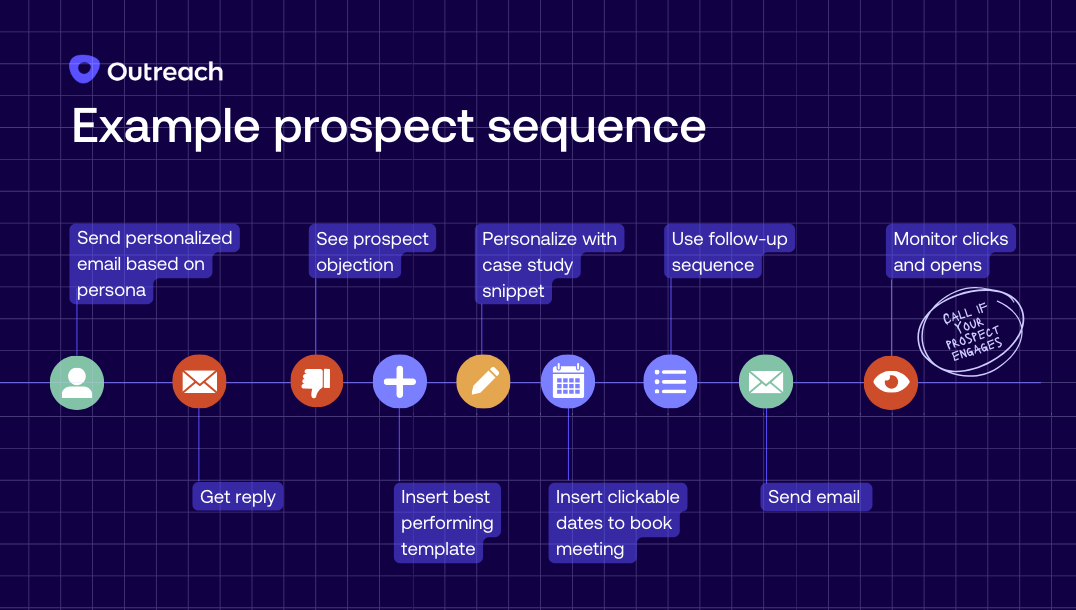
Every sequence has steps that predetermine how and when a prospect should be engaged: usually a mix of automatic or manual emails, phone calls, or tasks. Your team can rely on unique sequences for different types of leads, such as a no-show sequence, referral sequence, follow-up sequence, or re-engagement sequence. Here’s an example of an outbound prospecting sequence.
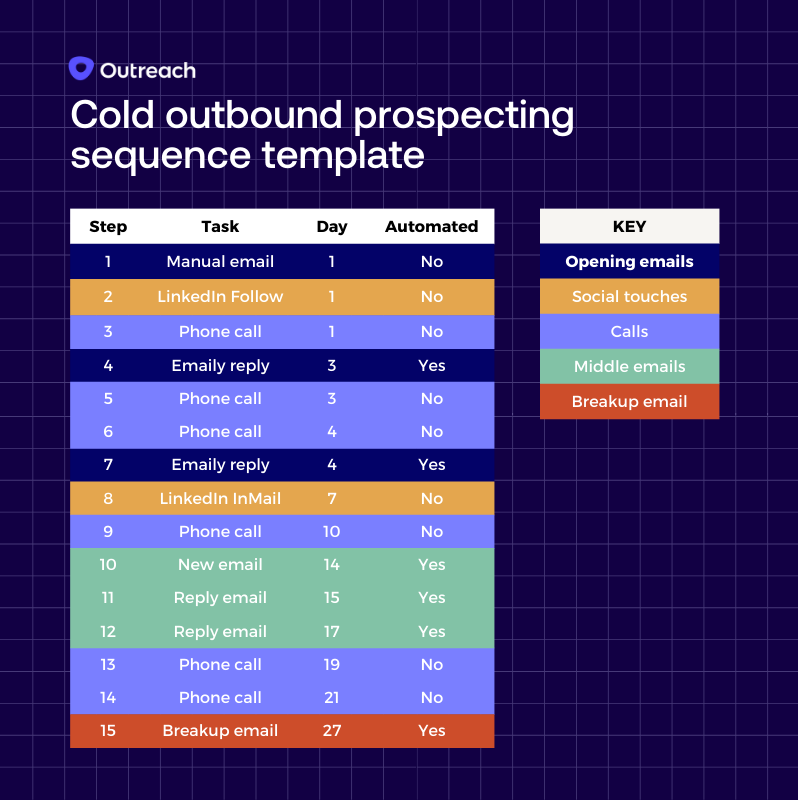
Successful email prospecting starts with workflows that help you build a quality sales pipeline and organize your book of business. If you’re searching for a better way to build, measure, and scale winning prospect emails, Outreach can help.
Outreach helps sales teams get more from their outbound prospecting activity. To see more of what Outreach can do, take a quick product tour of our account planning and management workflows. Or, for a more personalized consultation, request a demo.
Prospect emails can be found on LinkedIn profiles, company websites (contact pages, team pages, "About Us" sections), company databases, or enrichment tools such as Zoominfo or Clearbit.
The ideal length for a first cold email should be concise and to the point. Aim for around 50-125 words. This ensures that your message is brief enough to hold the recipient's attention while still providing enough information to convey your value proposition. Focus on personalization, a clear introduction, a relevant value statement, and a straightforward call to action.
Prospecting emails should provide enough information while maintaining conciseness — it’s a balance. Typically, that means between 100 to 200 words is ideal. This length allows you to cover essential points: the email's purpose, the prospect's benefits, and the next steps, without overwhelming the reader. Ensure each sentence adds value and encourages the recipient to take action.
This will depend on your audience and we recommend testing both approachs. But ultimately, personalized messaging, consistent follow-up, and an omnichannel approach will make a bigger difference. Making multiple attempts to connect over emails, phone calls, voicemails, and social media engagement will drive better results.
At the end of your email, clearly specify what you want the prospect to do next. This could be scheduling a call, replying with specific information, or visiting a link. For example, you could say: