Blog
AI Agent Interoperability: How Connected Agents Align Sales and Marketing
October 22, 2026
Read more
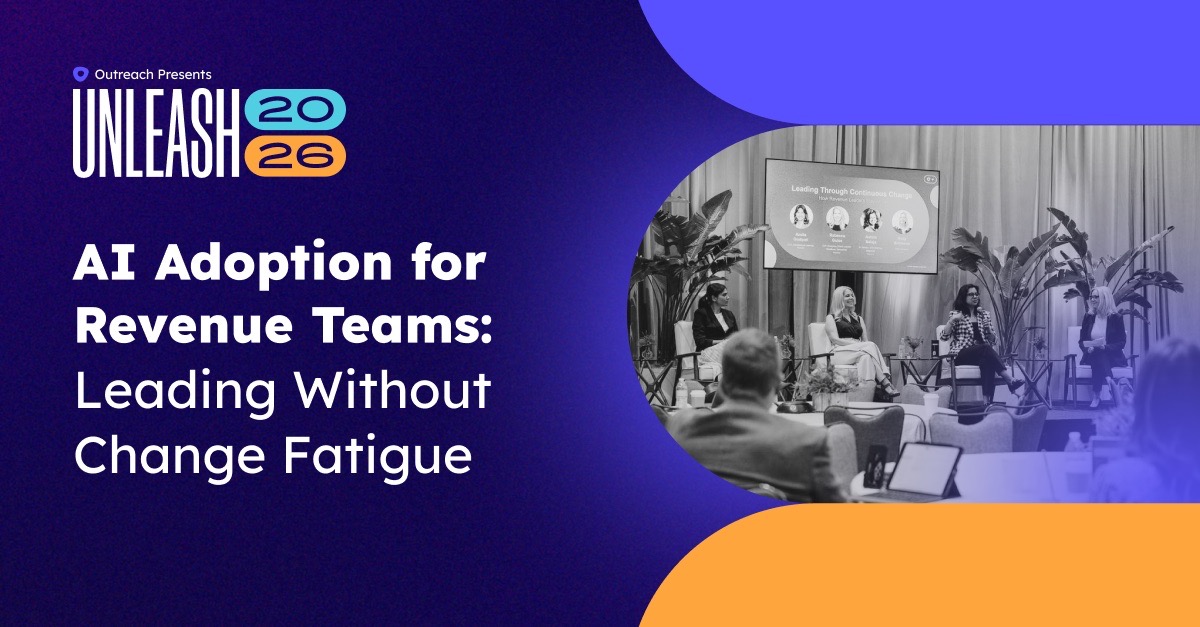
At our annual customer conference, Unleash 2026, I had the chance to moderate a roundtable with incredible revenue leaders. The session was called "Leading Through Continuous Change: How Revenue Leaders Stay Ahead," and the panel brought together three leaders who are launching and scaling AI in real time in their organizations: Amita Gudipati, Chief Customer Officer at Renaissance Learning; Rebecca Guise, AVP, Enterprise CRM & Industry Workflows at ServiceNow; and Ashita Saluja, Sr. Director, GTM StratOps at Databricks.
I went in expecting a conversation about AI technology. What everyone heard was something more candid: an honest account of what it actually takes to lead a revenue organization through continuous change with AI adoption. The technology, it turns out, isn’t the hardest part.
I want to share the takeaways that have stayed with me. Not a recap of the session, but the handful of ideas I keep coming back to when I think about where revenue leadership is heading. If you lead a revenue, marketing, customer success, or revOps team right now, I think a few of these will resonate with you.
This was the first thing that struck me, and all three panelists said a version of it. The AI itself is not where teams get stuck. They get stuck on getting teams aligned with process design, enablement, adoption as well as approaches for data quality andgovernance.
Ashita put it plainly: "Process and people before technology."
It sounds obvious until you watch how often it gets ignored. Organizations buy the tech, turn it on, and assume value will follow. It rarely does. The work that actually determines success happens around the technology, not inside it. How do people use it? Who decides what good looks like? How do you know if it's working?
I think this reframes the whole conversation. The question is not "which AI tool should we buy?" It is "are we ready to change how we work?"
Our customers shared candid stories here, and I appreciated how willing they were to share what they learned and how they would changed their approaches over time.
The pattern was consistent. Teams deployed AI broadly with minimal governance, expecting speed. Instead they experienced inconsistent usage, confusion, duplicate workflows, and what several panelists called "shadow AI"—side projects people built on their own because the capability was suddenly available to everyone. What we heard:
"Everybody started building their own side projects because we gave them the capability."
"We gave them the tools without the training."
The lesson is not "go slow."
The lesson is that speed without structure often slows you down later. Most of these leaders eventually had to pause, reassess, and rebuild around clearer process design and stronger enablement. The rework cost more time than the structure would have.
The teams seeing durable results built something deliberate to manage the change. Not a committee for the sake of a committee, but a real structure with ownership.
The examples across the panel included five governance models worth knowing:
AI Centers of Excellence — A dedicated team that owns AI strategy, prioritizes use cases, defines standards, and scales what works across the organization.
Cross-functional AI councils — Representatives from revenue, operations, IT, legal, and enablement who align on governance decisions and prevent fragmented deployment.
AI Operations teams — A functional team focused on the ongoing management of AI tools, workflows, and performance measurement — the equivalent of RevOps, but for AI.
Dedicated revenue AI teams — Embedded within the GTM org, focused specifically on identifying, deploying, and measuring AI use cases across the revenue motion.
Formal enablement programs — Structured training and change management designed to drive consistent adoption, not just tool access.
Governance gets a bad reputation as bureaucracy. In this context, I'd argue it's the opposite. It's the thing that lets you move quickly without the chaos.
This was the point I wish more leadership teams internalized. Turning on AI does not create value. People using it well does.
The panel kept returning to a distinction between deployment and adoption. You can deploy a tool to 1,000 seats and create almost no impact. The metric that matters is not licenses issued. It is usage, behavior change, and business outcomes.
One customer made this concrete by tracking adoption at the regional level, then using those insights to find barriers and improve enablement where it lagged. That's the right instinct. Adoption is the real KPI.
The panelists were clear that this is no longer experimental. They shared specific, measurable outcomes, and the examples are worth naming directly.
Renaissance Learning won back roughly 10% of churned customers through AI-powered sequencing and outreach, re-engaging customer segments that had previously been ignored entirely. That's a real number against a real problem, and it came from a segment that had received almost no attention before AI made it possible to cover it.
ServiceNow shifted from generating insights to driving proactive revenue actions, giving sellers recommended next steps based on customer opportunities and risks.
Databricks put AI to work on prospecting, forecasting, and accelerating internal reporting and analytics development.
The pattern across all three: the biggest value often showed up in underserved accounts. Long-tail accounts, under-covered territories, churned customers, and low-touch opportunities. These segments got limited attention historically because of capacity constraints. AI let these teams expand coverage without adding headcount.
If you're looking for where to start, I'd look there first. The accounts you've never had the capacity to serve well.
From winning back churned customers to automating account research and forecasting — the results are real. See how Outreach helps revenue teams expand coverage and drive pipeline without adding headcount.
I want to be careful not to overstate the machine's role here, because the panel was careful too. The future operating model is not AI-only. It is AAI augmenting teams.
One customer made the case that judgment will be one of the most important skills going forward. Leaders have to understand where AI can run autonomously, where human oversight is required, which workflows are production-ready, and which still need real expertise. Her line stuck with me: "The path from vibe coding to production is paved with good intentions."
So research, prospecting, forecasting, and reporting can increasingly be automated. Strategy, customer relationships, and judgment stay human. I don't think that line is fixed forever. But for now, knowing where it sits is the leadership skill.
One of the more forward-looking parts of the discussion was about people and career paths, not tools.
Roles are already shifting. Sales Operations is evolving into AI Operations. New GTM Engineering roles are appearing. Some organizations are building dedicated AI Operations career ladders. The expectations around AI fluency are rising across the board.
One customer shared "What got you here won't get you there."
Another customer pushed the panel with a question I haven't stopped thinking about: "Ten years from now, what do you think being a sales operations person means?"
Leaders asking that question now will be better prepared than the ones who wait for it to answer itself.
This part was honest in a way I appreciated. Resistance is real, and it shows up in predictable places.
Frontline sellers raise two concerns. The first is job security: "Will AI replace my job?" Most organizations are answering by positioning AI as augmentation, not replacement, and that framing matters. The second is change fatigue. Sellers already juggle a lot. Without clear value, a new AI tool feels like more work, not less.
Middle managers often have the hardest job of all. They sit between executive expectations, AI experimentation, team productivity, and customer-facing work. They're asked to drive adoption while keeping the current number. That's a genuinely difficult spot, and I think we under-resource these managers more than we admit.
The takeaway for me: resistance is usually a signal, not an obstacle. It tells you where value hasn't been made clear yet.
The strongest conclusion from the room was a shift in the question itself. We've moved from "Should we use AI?" to "How do we operationalize AI well?" AI has moved beyond experimentation, and the leaders who treat it that way are pulling ahead.
If I had to compress the session into one idea, it would be this: the winners won't be the companies with the most AI tools. They'll be the companies that align people, process, governance, and technology around a shared operating model.
So here's the question I'd leave you with, the same one I keep asking myself. If you could fix only one thing in your revenue organization in the next 90 days, what would it be? And is the thing you'd fix a technology problem, or a people and process one?
I think most of us already know the answer.
The hardest part is rarely the technology. According to the leaders on this Unleash 2026 panel, the real challenge lies in process design, data quality, governance, enablement, and adoption. Teams that focus only on deploying tools tend to struggle, while teams that align AI with workflows and employee adoption see meaningful results.
Deployment counts how many people have access to a tool. Adoption measures whether they actually use it to change how they work. Turning on AI does not create value by itself. The metrics that matter are usage, behavior change, and business outcomes. One customer, for example, tracks adoption at the regional level to find barriers and improve enablement.
Across the panel, the biggest value often appeared in underserved accounts: long-tail accounts, under-covered territories, churned customers, and low-touch opportunities. These segments historically received limited attention because of capacity constraints. One customer, for example, won back roughly 10% of churned customers through AI-powered sequencing and outreach.
The panelists framed AI as augmentation rather than replacement. Roles are changing—Sales Operations is evolving into AI Operations, and new GTM Engineering roles are emerging—but human judgment, strategy, coaching, and customer relationships remain central. Future revenue professionals will be expected to combine domain expertise, AI fluency, and sound business judgment.
Resistance shows up most often among frontline sellers and middle managers. Frontline sellers worry about job security and change fatigue. Middle managers sit between executive expectations and day-to-day team productivity, which makes driving adoption especially difficult for them. Clear value and strong enablement are the most common ways leaders address both.
The teams pulling ahead aren't the ones with the most AI tools — they're the ones who've built the right foundation around how AI gets used, measured, and scaled. See how Outreach helps revenue leaders operationalize AI across their entire GTM motion.