Blog
Build and buy: How winning revenue teams make the call
November 4, 2026
Read more
Every revenue leader we talk to is wrestling with the same question: should we build our own AI layer, or buy a platform?
Someone builds an agent connecting your data to a model and produces an impressive demo. The CRO asks whether it replaces the existing stack. The CFO asks what it means for the total cost. The CTO wants to know how it is governed.
The instinct is to frame this as either-or. That framing is wrong, and it costs teams time, budget, and competitive ground. The teams scaling revenue orchestration fast are not picking a side. They buy where the vendor has already solved reliability, compliance, and governance at scale. They build where the data and models are proprietary. They connect the two with interoperability that keeps their data safe and their complexity low.
This post is the practical version of that framework: a build and buy AI agents playbook covering where Outreach Agents win natively, where you should build on Outreach, and why each makes the other stronger. If you’re looking to go deeper, check out our Build vs. Buy AI Agents ebook.
Use this table as a quick gut check. The sections that follow explain the reasoning behind each row.
The two aren't mutually exclusive. You can also connect your own systems and data into Outreach agents through the MCP client, where the workflows in Outreach are the best fit for the task.
Transparency is one governance question among several. Outreach's Build vs. Buy AI Agents eBook lays out the RevOps and IT tradeoffs, including total cost, time to value, and governance.
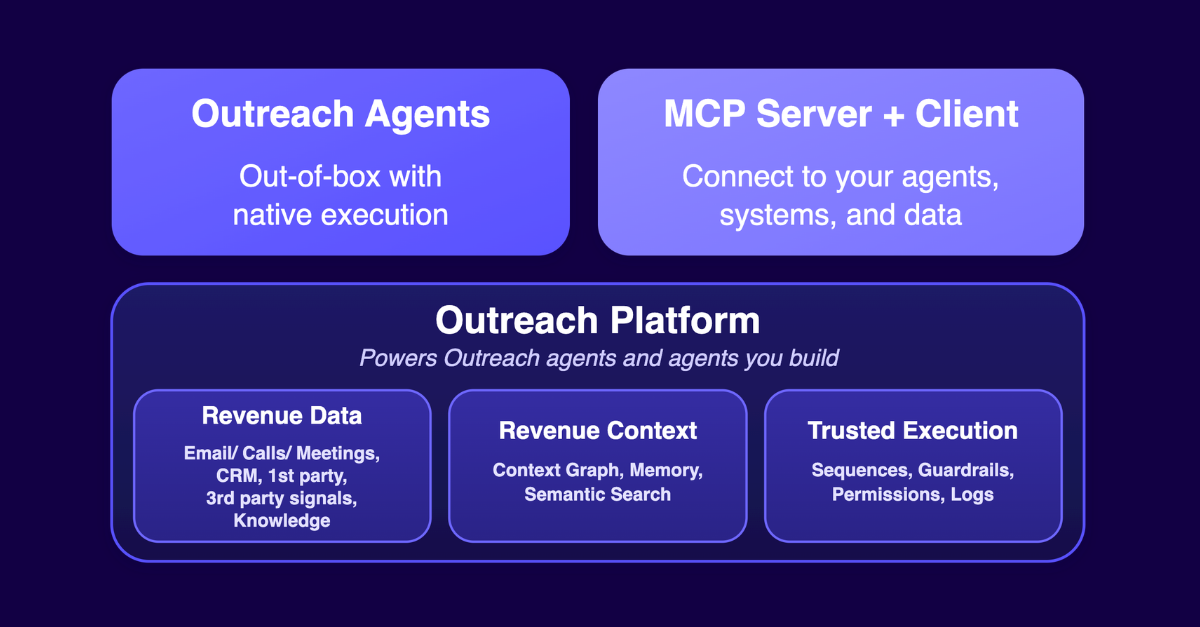
A general-purpose model pointed at your data can do genuinely useful things. It can summarize a meeting, draft an email, and surface a risk flag. . Now try to run that across your org, and across your pipeline. This is where most in-house builds break down. Outreach Agents ensure reliable agent actions built on these principles: trusted execution, shared intelligence and context, native user experiences, and a total cost of ownership that holds up at scale.
Outreach sits inside the relationship between your sellers and the people who buy from them: real prospects and real customers that take months to build trust with and one bad move to damage. Every agent action touching that relationship needs the right checks.
Human in the loop. Not every action calls for the same amount of oversight, and autonomy is configurable agent by agent in Outreach. An SDR revenue agent runs autonomously on lower-tier accounts where you do not have seller coverage. For strategic accounts and existing customers, the agent drafts engagements for a seller to review before anything goes out. The goal is autonomy matched to the value and risk of the relationship on the other end. As Gartner analyst Shiva Varma put it, "enterprises are treating AI agent governance as binary, either locked down or fully trusted, and that is the root cause of failure."
Permissions. Every agent runs inside the access a seller already has. It only sees the accounts and deals that the seller owns, and it can only send emails at the volume that the seller is allowed to send. An agent cannot reach into the pipeline of another rep. Additional agent permissions limit who can create or run agents.
Sequencing, guardrails, and logs. Agents act inside the same sequencing engine your sellers already run on, so follow-ups are automatic, a reply pauses the next step, and an unsubscribe holds the sequence.Every agent inherits that logic instead of rebuilding it. Outreach also enforces send limits on email and SMS, call limits on voice to conform to TCPA and other channel-specific rules, and throttles on how many accounts or prospects per account and agent can engage each day. Every agent action is logged, and every agent output is evaluated for quality, the same Evals and Metering layer covered in Outreach's revenue architecture, so usage and cost are tracked at the agent level. If an output looks off, you can trace exactly what ran, what it touched, and why.
Wiring a model up to your CRM is easy. Making the intelligence that comes out of it hold up, consistent, current, and grounded in what actually happened in a deal or across deals, is the hard part. Outreach has already done that work: what it already knows about how sales works is built into the platform before you log in, and what it learns specifically about your deals, your customers, and your team keeps compounding over time.
Built-in expertise. Outreach encodes years of sales practice: how to run a multithreaded account, how to sequence and personalize outreach, how to spot deal risks. Outreach Agents act on behalf of sellers or deliver guided actions for them to take, with governance and audit trails attached. Skills keep the answer to a question like deal risk consistent, the same factors checked the same way every time.
Connected to all revenue data and knowledge. Outreach captures activity and integrates with all relevant data sources: emails, calls, and meetings, your CRM, first-party product and renewal data, third-party firmographic and intent signals, and your own uploaded playbooks, all in one connected foundation. Built-in identity resolution finds the right account and the right contact across all of these sources through pre-built integrations, without requiring a custom IT integration.
Persistent context and memory. The data is aggregated into a context layer. A Context Graph captures observations, competitors, objections, sentiment, extracted after every conversation. Semantic Search runs over unstructured material like your own uploaded playbooks and documents. A Memory layer carries user preferences across sessions. For more information, check out the Outreach's revenue architecture blog. The result stays accurate and consistent even when an agent is reasoning across thousands of conversations, deals, and accounts at once.
An agent is only as useful as where it shows up. Most in-house builds land in a chat window or a Slack DM, one step away from where a seller is actually working and without the contextual information to confirm the action. Outreach Agents are built into the surfaces sellers already use every day.
In-context actions. Next best actions on a deal or account are ready the moment a seller opens the record or starts their day. An account plan updates automatically with the latest research, right on the account page. Omni, the conversational agent inside Outreach, already knows the filtered view, the selected rows, the record on screen, so a seller can ask about "this" deal without restating the context every time.
Meet sellers in their tools. Sellers spend most of their time building relationships inside their communication tools. Email Assist and Reply Agent draft emails and replies inside Gmail or Outlook. Meeting Prep Agent delivers meeting briefs inside the Calendar. Meeting summaries and follow-up actions land in shared Slack channels immediately after a meeting. The work happens right there, in the tool a seller already has open.
Continuity. A seller can edit a draft, get pulled into a call, and come back twenty minutes later to find it exactly as they left it, still tied to that specific deal. Chat-based agents lose that state, and since they are not connected to your records in the first place, there is nothing to pick back up.
A tool that adds even one extra step (copy this, paste it there, switch tabs) gets used once and abandoned. Pairing context with agent execution in the same surface is what drives seller adoption.
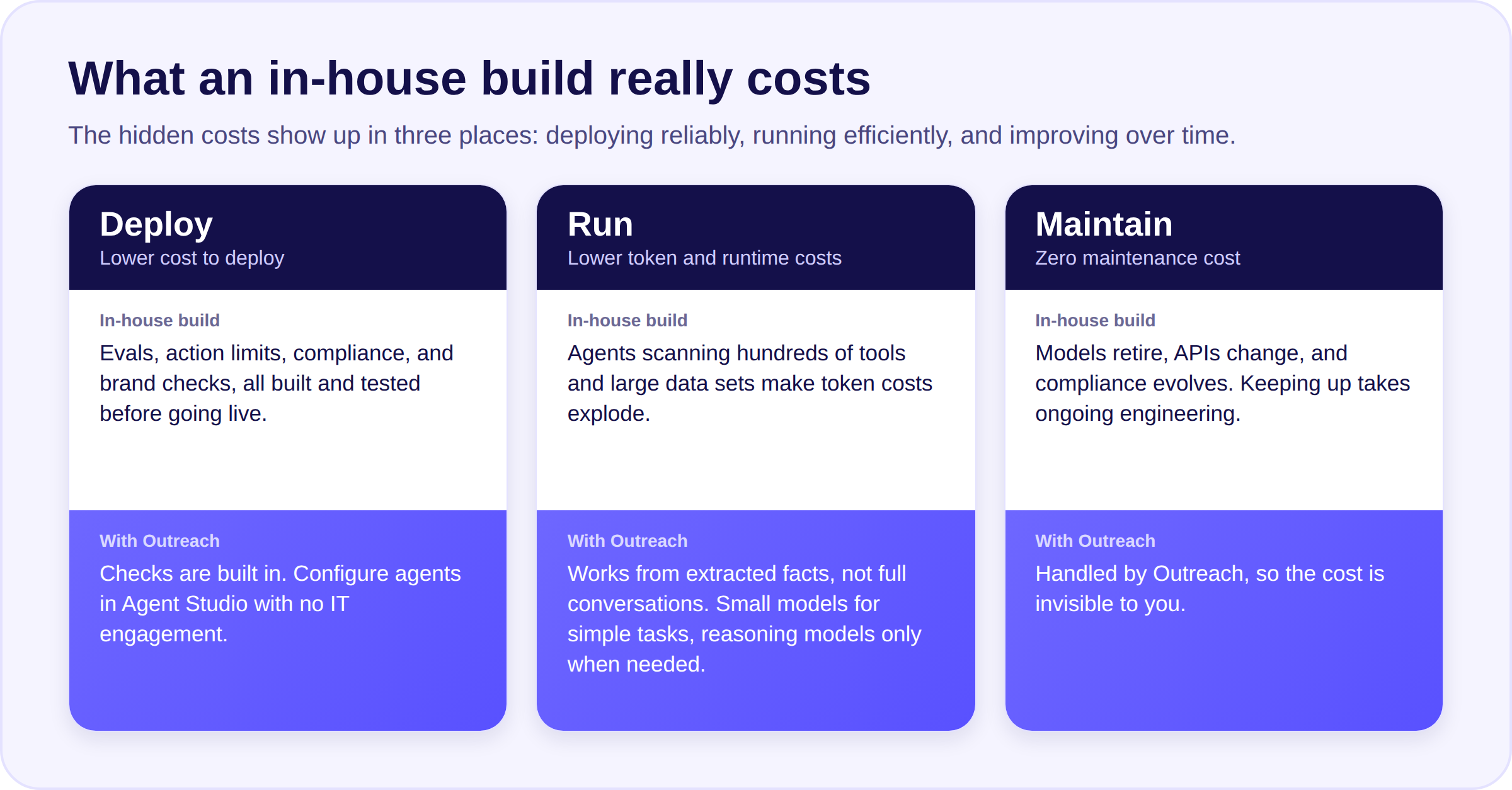
There are many hidden costs to an agent build: deploying it reliably, running it efficiently, and improving it over time.
Lower cost to deploy. An agent that works for one seller in a demo is not ready for the whole org. Getting there takes real work: evals to check output quality, limits on what the agent can do, compliance built into every send, keeping it on brand, and testing all of that before it touches a live account. Most in-house teams underestimate this step. Pre-built agents from Outreach have these checks built in. Custom agents built with simple configurations in Agent Studio get the same checks, so you deploy fast without requiring IT engagement.
Lower token and runtime costs. Tokenmaxxing is real. In-house agents connecting across MCPs, scanning across hundreds of tools and large data sets, explode costs. Outreach agents optimize for token usage by working from extracted observations and facts instead of full conversations, with context compaction built into chat threads and agent invocations. Outreach optimizes for model runtime cost: simple tasks like drafting an email run on a small, cheap model, while advanced tasks like assessing risk across deals run on reasoning models. Every agent action is invoked only when needed.
Zero maintenance cost. Models get retired, APIs change, and new compliance requirements come in. You need to keep tuning the system so it improves from feedback, catching a bad output and fixing it before it happens again. Each of these requires ongoing engineering investment to keep up, and the costs add up. For an Outreach customer, this cost is invisible.
Outreach MCP Server exposes your live Outreach data and context (activity history, deal patterns, buyer signals, seller actions, context graph) as a governed, permissioned interface for any AI tool your team uses: Claude, ChatGPT, Copilot, Gemini, Agentforce, or agents you build yourself. The shared intelligence built for Outreach agents is also available to yours: your agents reason over the same revenue data and context described above.
Executing through MCP means your in-house agents run off the same trusted execution platform in Outreach, including the same permissions and guardrails required for safe, reliable deployments. Build with Outreach MCP when the workflow is uniquely yours, including when you need control over your data, context, or models:
Enterprises have rich customer history and signals spread across multiple platforms. A common use case is building agents that synthesize these first-party insights to inform engagement strategy or deal execution, then using MCP to use that context to drive actions - targeting and sequencing prospects, or generating actions for sellers to progress deals.
Deal reviews in Claude, pipeline analysis within your BI stack: MCP means Outreach context travels to them without data duplication or sync lag. Data stays at source, and every query is governed, permissioned, and auditable.
The most sophisticated enterprises are also building their own models for purpose-built domains and tasks. Connecting to Outreach via MCP for the context and running agents via their models is how they get the benefit of both, a proprietary model doing the reasoning, and Outreach's execution layer powering the agent actions with right guardrails.
Build on MCP Server when the workflow is uniquely yours, including when you need control over your data, context, or proprietary models. An alternate path is to connect your systems and data via MCP client into Outreach agents, where the workflows and agents in Outreach are best suited to that task.
Not every MCP Server gives your agents the same footing. Outreach gives your agents a full set of tools to not just look up accounts, prospects, and opportunities, pull insights from emails and meetings, but also take action - enroll prospects in sequences, create sequences and tasks. Because every action runs through Outreach’s execution platform, your agents follow the same permissions and guardrails your sellers already trust.
Outreach agentic ecosystem includes verified connectors for multiple partners across MCP server and client, to give you the ultimate flexibility in your agent deployments.
Chris Finlayson, GTM Leader at OpenAI, put it plainly at Outreach Unleash: "We tell them not to build...partner with companies like Outreach for the most common agents your teams need. For the custom workflows, the things that are special about your business, you can build agents powered by the context that already lives inside of Outreach using MCP."
Building isn't always the right call. Skip the in-house build when:
If you do build, run customer-facing actions through Outreach MCP Server so your agents inherit the same permissions and guardrails.
Where trusted execution and user experience drive adoption, that’s your cue to buy. Pre-built Outreach Agents get you to market faster, at a much lower cost to run and maintain. Where your data, context, and workflows are uniquely yours, that’s your cue to build, connecting to Outreach via MCP for rich customer context and the sequencing, email, and calling infrastructure you don’t have to build yourself.
The two paths make each other stronger. The more your team runs on Outreach Agents, the smarter the shared context layer gets, and the context your in-house agents pass back feeds the same learning loop. Outreach is the only platform pairing purpose-built AI agents for every seller workflow and for leaders to coach, plan, and forecast, and Outreach MCP is available today as both a Server and a Client.
Buy for speed and reliability. Build for what’s uniquely yours. Connect both with MCP, and your sellers never have to choose between the AI tools they prefer and the platform that runs their pipeline. Doing both compounds. That is the advantage.