Step 1
Churn signal detected
Signal
Solves for customer disengagement and competitive signals that surface too late to protect the relationship and recurring revenue.
At-risk accounts are identified while there's still room to change the outcome, so the team can act before the choice is already made.
Every message is grounded in real context, acknowledging where things stand and reinforcing value to properly rebuild relationships.
Consistent engagement runs across your book without adding manual work, helping customers stay active, supported, and on track to renew.
Outreach connects to the CRM and tools your team already uses, then layers on AI agents that handle the manual work a rep would otherwise do. Here's the full path, from an early warning sign to a thoughtful message that reopens the conversation before momentum slips away.
Step 1
Churn signal detected
Revenue Agent engages the right stakeholders
Research Agent surfaces account insights
Personalization Agent crafts outreach
Engagement sends on behalf of the rep
Risk is flagged via account health score, product usage, or intent data, identifying disengagement or competitive activity.
It sources and enrolls key contacts into a churn prevention sequence on behalf of the account owner.
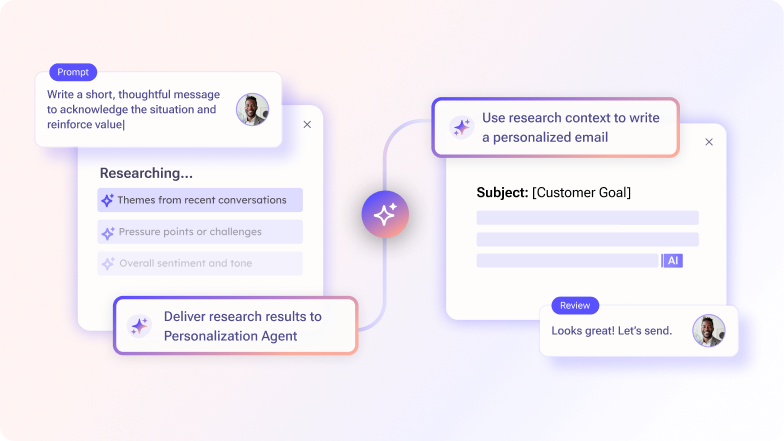
It identifies current priorities and focus areas, recent interactions, and any context that helps explain the risk.
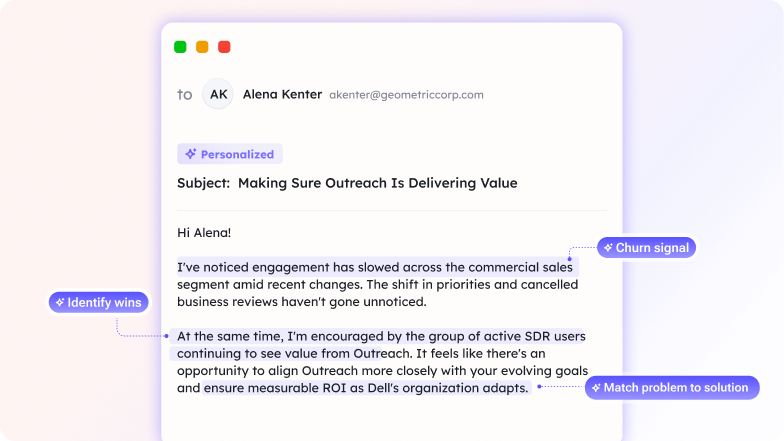
It personalizes messaging with research-backed context and reinforces value to open a conversation.
Timely, relevant outreach goes out while there's still time to change the trajectory.
In Outreach, you set up an agent once using plain-language instructions. No code required. You tell it what to look for and what to produce. Here's how the two agents in this recipe work together: one explains the risk, the other turns that context into a thoughtful message.
What early warning signs indicate a customer might churn?
The Research Agent monitors: declining usage or logins, tickets with negative sentiment, reduced product feature adoption, payment issues or delays, and conversations mentioning competitive tools. It flags accounts when 3+ signals appear simultaneously.
How much notice do I get before a customer churns?
On average, accounts show warning signs 30-60 days before churn. This recipe catches them early enough for your customer success or account team to intervene—usually through a check-in call, business review, or service upgrade conversation.
Who should reach out to an at-risk customer?
The recipe recommends the best person based on relationship strength: usually the assigned CSM or account manager, but sometimes a peer customer or executive. It also suggests the right messaging (e.g., "Here's how other companies in your industry use feature X...").
Is churn prevention reactive or proactive?
This recipe is proactive. Instead of learning about churn when they hit the cancel button, you're reaching out weeks earlier when you still have leverage. The success rate of saving an at-risk account is 40-60% if you reach out early enough.
Can this prevent voluntary churn or just accidental churn?
It works best on voluntary churn (customer wants to leave). It's less effective on accidental churn (payment failure, forgotten renewal). For accidental churn, combine this recipe with automated payment retry logic.
What kind of engagement can prevent churn?
Most common: business review to discuss ROI and expansion (40% success), product training on underutilized features (35% success), executive introduction/relationship building (25% success), pricing negotiation (10-15% success). This recipe recommends the best approach per account.


Diagnose customer churn
See what drove the loss, what signals appeared early, and where future win-back opportunities may exist.

Engage the right buyers
Reach people who shape the decision with targeted messaging that speaks to their role and reality.
Prep for key meetings
Get the full account picture with recent activity and strategic deal context in one exec-ready summary.
