Step 1
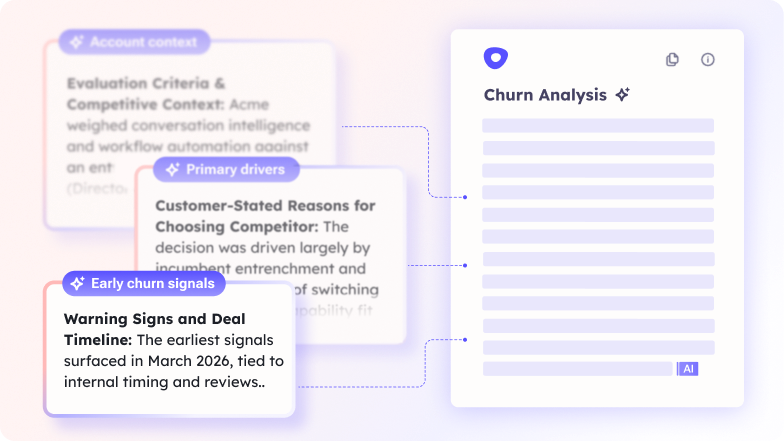
Research Agent reviews the data
AI Agent
Solves for scattered customer signals that make it hard to understand why revenue was lost and where recovery opportunities still exist.
Every breakdown is grounded in reality and sorted into clear sections, so you see the real drivers behind the loss.
When churn reasons are structured the same way every time, patterns surface fast, helping your team spot preventative issues.
Each summary flags whether the door is still open and who to reach out to, so re-engagement becomes a targeted play.
Outreach connects to the CRM and tools your team already uses, then layers on an AI agent that pulls together the context a rep would otherwise dig for manually. Here's the full path, from disconnected insights to a structured analysis your team can use to rebuild the relationship.
Step 1
Research Agent reviews the data
A structured breakdown is delivered
It reviews history and activity data to identify what drove the loss, which warning signs appeared, and how the relationship changed over time.
The agent returns the primary churn drivers and any win-back indicators in a format your team can use for analysis and action.
In Outreach, you set up an agent once using plain-language instructions. No code required. You tell it what to look for and what to produce, and it turns scattered account history into a clear, executive-level summary.
How does the agent determine why a customer churned?
The Research Agent pulls data from: exit interviews (if conducted), support tickets and sentiment analysis, conversation notes, product usage trends (what dropped off?), and market signals (did they buy from a competitor?). It synthesizes this into a diagnosis: price, product-market fit, customer success, competitive, or timing-based churn.
What's the difference between preventable and unpreventable churn?
Preventable: product gaps, poor onboarding, competitor pressure, pricing (you could have fixed these). Unpreventable: they were acquired, went out of business, product no longer fits their business model. The recipe surfaces which bucket each churn falls into so you can learn what to improve.
How do I use this insight to improve retention going forward?
The recipe identifies patterns across churned accounts—e.g., "All 5 churned customers were 0-6 months old and showed low API adoption." That tells you to improve onboarding or API documentation. Or "They all churned 6 months before contract end"—so you need better engagement at the 4-month mark.
Should I try to win back churned customers?
Sometimes. If the churn was preventable and you've fixed the issue, a win-back conversation makes sense. If the churn was due to a permanent fit issue, win-back efforts are likely wasted. The recipe recommends which customers are worth the outreach.
How do I talk to a churned customer about their decision?
Approach it with curiosity, not defensiveness. Ask open-ended questions: "What could we have done differently?" "If we fixed X, would you consider us again?" The goal is learning, not guilt-tripping. The recipe suggests talking points for these conversations.
What's a typical churn diagnosis breakdown?
Across B2B SaaS, typical churn reasons are: 35% product fit (they outgrew or moved away from your category), 25% customer success/support issues, 20% competitive pressure, 15% pricing/budget, 5% other. Your breakdown will be different—that's exactly what the recipe helps you discover.


Engage the right buyers
Reach people who shape the decision with targeted messaging that speaks to their role and reality.
Prep for key meetings
Get the full account picture with recent activity and strategic deal context in one exec-ready summary.
Spot product demand
Discover which accounts are talking about your products, what they care about, and who to engage.
