Step 1
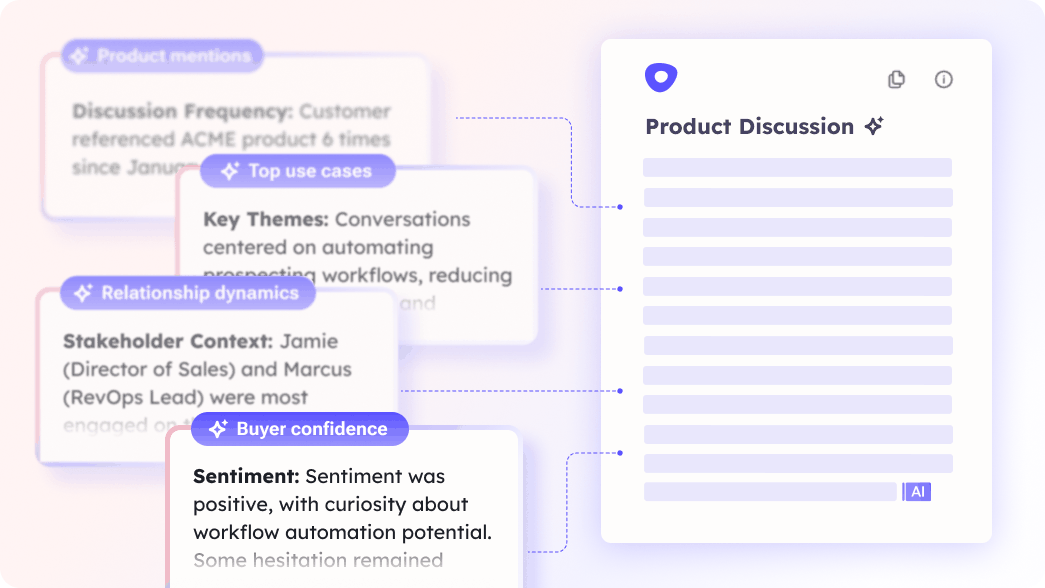
Research Agent reviews the data
AI Agent
Solves for missed product interest mentioned in conversations, scattered across calls, emails, and stakeholder activities.
Buried mentions get pulled into one clear view, so you know which accounts are leaning in on a specific product.
When you can see what's being discussed and who's driving it, you can prioritize those already showing interest.
Each summary shows the themes and sentiment, so you can lead with what matters and keep the discussion moving forward.
Outreach connects to the CRM and tools your team already uses, then layers on an AI agent that pulls together the context a rep would otherwise dig for manually. Here's the full path, from disconnected insights to a structured product discussion summary your team can use.
Step 1
Research Agent reviews the data
A structured summary is delivered
It analyzes calls, emails, and activity tied to the account, picking out every mention of the product, noting who raised it, and how the conversation went.
The agent returns one structured view of how often the product came up, what's driving the interest, who's involved, and the overall sentiment.
In Outreach, you set up an agent once using plain-language instructions. No code required. You tell it what to look for and what to produce, and the agent turns a stack of activities into key insights you can actually use.
Where does the agent find product demand signals?
The Research Agent monitors: social media mentions, industry forums, internal conversations your team hears about, customer reviews and comparisons, job postings mentioning product skills (e.g., "experience with Salesforce" in the context of a new hiring spree), and news articles about company initiatives.
How does discussing a product translate to sales opportunity?
If an account is talking about your product, they've likely evaluated it or at least know it exists. This is a strong buying signal. They're either (a) building a business case to buy, (b) trialing it, or (c) considering it as an alternative to their current tool. All three are sales-ready moments.
Should I reach out directly or do research first?
The recipe does research first. It identifies the account AND the likely stakeholder (the person discussing the product), then surfaces this to your sales team with context: "This account mentioned us in a [channel/source] on [date]. Here's what was discussed..." Then your team can reach out more intelligently.
What if they're discussing us negatively?
The recipe captures sentiment. Negative mentions are lower-priority leads but still worth following up on: you get to understand objections and possibly turn a critic into a customer by addressing their concerns. Sometimes skeptics become the most loyal customers.
How often are new demand signals found?
Depends on your product category and visibility. Popular enterprise products see 2-5 new mentions per day; niche products might see 1-2 per week. The recipe monitors continuously and flags high-priority signals in real time.
How much pipeline can this source generate?
It's a supplementary channel, not your primary one. But accounts actively discussing your product are 3-5x more likely to convert than cold outreach. Most teams source 10-20% of their pipeline from these "warm" demand signals.


Diagnose customer churn
See what drove the loss, what signals appeared early, and where future win-back opportunities may exist.

Engage the right buyers
Reach people who shape the decision with targeted messaging that speaks to their role and reality.
Prep for key meetings
Get the full account picture with recent activity and strategic deal context in one exec-ready summary.
