Step 1
Research Agent reviews the data
AI Agent
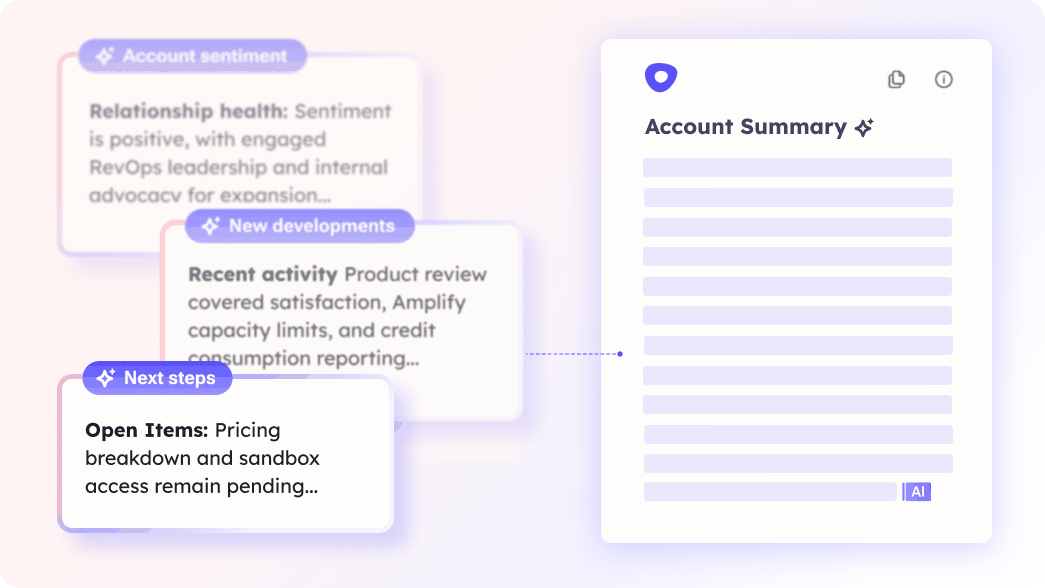
Solves for critical account information that’s missed when relationship health, recent activity, and open items live in different places.
Each summary pulls key insights in one place, so leaders arrive with a full picture instead of piecing it together manually.
Every account gets the same exec-ready snapshot, giving your team a reliable way to report on where things stand.
The agent handles the research and assembly behind the scenes, so leaders get to spend time on strategic work.
Outreach connects to the CRM and tools your team already uses, then layers on an AI agent that pulls together the context a leader would otherwise dig for manually. Here's the path, from scattered history to a structured summary.
Step 1
Research Agent reviews the data
A structured summary is delivered
It draws on conversation history and activities to assemble a complete picture of where the relationship stands right now.
The agent returns relationship health, recent activity, open items, and strategic context in a consistent, exec-ready format, on demand.
In Outreach, you set up an agent once using plain-language instructions. No code required. You tell it what to look for and what to produce, and the agent turns dispersed data into a structured snapshot of the account.
How far in advance should I request meeting prep?
The recipe works best when you run it 24 hours before the meeting, but it can also work on 1-hour notice. It pulls fresh signals (latest news, recent activity, hiring changes) and consolidates them into an exec-ready brief in minutes.
What's included in the meeting brief?
The Research Agent surfaces: company background and recent news, attendee bios and roles, previous conversations with these people, key initiatives they're likely working on, potential objections or challenges, and competitive context. The Meeting Prep Agent then distills this into a 1-page brief with talking points.
Can I use this for different meeting types (discovery, demo, negotiation)?
Yes. You can instruct the agent on the meeting type, and it adjusts the brief accordingly. Discovery meetings get more exploratory talking points; demos get more product-specific ones; negotiations get competitive + pricing strategy intel.
Should I share the brief with the whole team or just the lead rep?
Share it with everyone attending the meeting, especially if there are multiple attendees on your side. Everyone should know the attendees' names, roles, and any relevant context so your team presents a unified, well-informed front.
How do I use this brief during the meeting?
Don't read from it or show it. Use it as background so you can reference recent news or previous conversations naturally during the call. "I saw you guys just hired a new VP of X—how's that team building out?" sounds way more informed than cold research during the call.
Does meeting prep improve deal velocity?
Yes. Teams using meeting prep briefs report: shorter sales cycles (3-5% faster), higher win rates (10-15% improvement), and more confident sellers. When you walk in fully prepared, the conversation is more strategic and less scrambled.


Diagnose customer churn
See what drove the loss, what signals appeared early, and where future win-back opportunities may exist.

Engage the right buyers
Reach people who shape the decision with targeted messaging that speaks to their role and reality.
Spot product demand
Discover which accounts are talking about your products, what they care about, and who to engage.
