
Blog
What is AI Maturity in Sales? How Revenue Teams Move from Pilots to Impact
Read more
The bottom line: The challenge isn't getting teams to use AI. It's helping them move from experimentation to operationalization.
For the last two years, revenue leaders have asked one fundamental question: Are we using AI? Our new research suggests it's time to ask a harder question: Have we operationalized it?
Data from Outreach's AI maturity assessment suggests that, at least among respondents to our assessment, adoption is no longer the primary hurdle. Across every revenue motion we measured — prospecting, deal management, coaching, retention and expansion, and forecasting — a majority reported some level of AI use.
The harder question is what happens after adoption. Our data shows a consistent, sizable gap between teams using AI and teams that have operationalized it, embedding AI into repeatable workflows and building the data, governance, and measurement needed to support it. That gap ranges from 48 to 72 percentage points across every motion we measured. It's the clearest pattern in the data, and arguably the more important one.
A quick note on the data. These findings come from an interactive AI maturity self-assessment on our site, not a commissioned market study. After removing internal, vendor, and test submissions and keeping only complete responses, we were left with our sample size. The consistency of the results makes the data useful for identifying directional patterns, but this is a self-selected group of quiz-takers, not a representative sample of revenue teams at large. We're treating it accordingly: as a signal worth examining, not a market-wide benchmark.
AI use is already widespread across every revenue motion we measured:
Within this sample, adoption is clearly not the primary hurdle. Even in forecasting, the lowest-adoption motion we measured, nearly two-thirds of respondents report some AI use. The larger question is what happens next: how teams move from experimenting with AI to making it a systematic part of how revenue work gets done.
Here's where the picture changes. Reporting some level of AI use is very different from having AI embedded systematically into how work gets done. Across every revenue motion we measured, the share of respondents at that more operationalized stage is dramatically lower.
When we isolate respondents who describe AI as embedded or systematic — not just in use, but incorporated into the workflow — the numbers fall sharply:
The gap persists even in the motions with the highest adoption. Prospecting, for example, has both the highest reported AI use and the widest gap between adoption and operationalization. More teams using AI does not automatically mean more teams have made it a systematic part of the process. In this sample, operationalization appears to be a distinct hurdle of its own.
That makes the more useful maturity question not simply, "Has your team adopted AI?" but "Has your team embedded AI into a repeatable way of working?" Across all five motions measured here, relatively few respondents have reached that point.
This shift matters because it separates leading revenue organizations from those still in the exploration phase. While most teams are asking "should we use AI?", category leaders are asking "how do we make AI systematic and measurable?" That's the operationalization question.
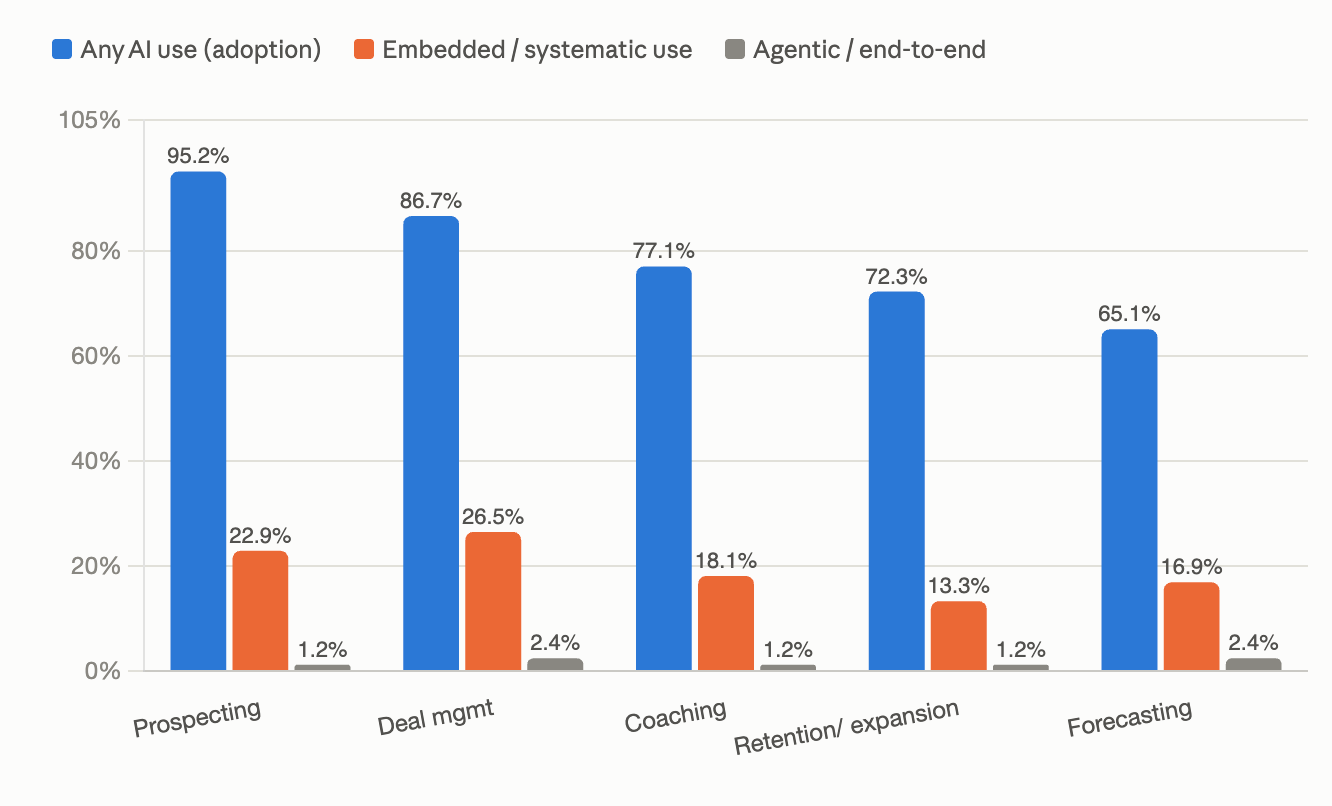
What the data tells us: Across all revenue motions, a consistent gap emerges between AI adoption (any use) and operationalization (embedded, systematic use). Prospecting leads in both categories (95.2% adoption, 22.9% operationalized), while retention and expansion lags (72.3% adoption, 13.3% operationalized). This gap—ranging from 48 to 72 percentage points—is the defining pattern in AI maturity today.
The progression becomes even more pronounced when we look at agentic or end-to-end AI use. Across all five revenue motions, the share of respondents reporting that level of maturity never exceeds 2.4%:
That stands in sharp contrast to the much higher rates of overall AI adoption. In this sample, AI may be widely used, but very few respondents describe that use as agentic or end-to-end.
That matters because it shows how much distance remains between adopting AI and reaching the most advanced stage of AI-enabled execution. Whatever the broader market conversation around agentic AI may sound like, these respondents are still overwhelmingly short of that point.
Key insight: "Adoption can happen before teams have established how they'll evaluate success. But moving from experimentation to a repeatable, trusted part of the operating model requires a way to measure whether the technology is actually delivering value, not mere usage alone."
Forecasting offers one of the clearest views into the measurement challenge behind AI operationalization. The progression is revealing: experimentation is far more common than formal measurement, and formal measurement is far more common than tying AI to business results.
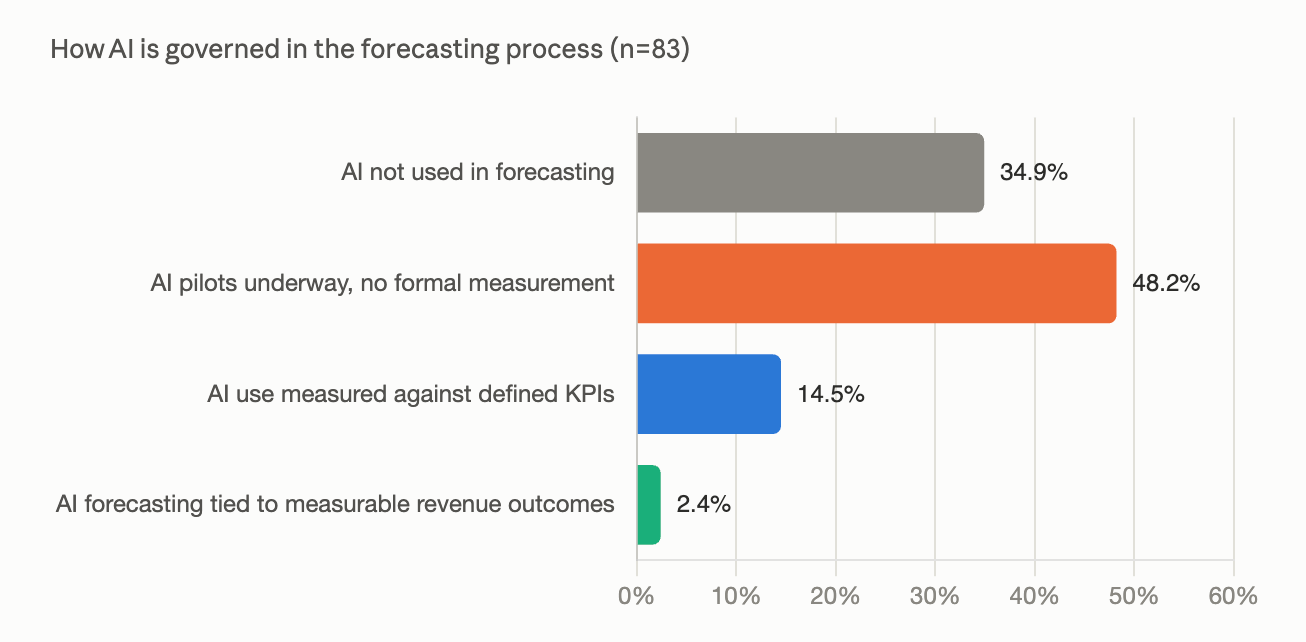
What this means: Nearly half of respondents (48.2%) describe their use of AI in forecasting as experimental pilots with no formal measurement. Another 14.5% report having defined KPIs around AI's role in forecasting, while just 2.4% say AI usage is tied to measured business outcomes. And 34.9% report no AI use in forecasting at all.
Taken together, that means the overwhelming majority of respondents have either not adopted AI for forecasting or have not yet connected its use to measured business outcomes. The progression is telling:
Experimentation is far more common than formal measurement, and formal measurement is far more common than tying AI to business results.
That's the distinction between trying AI and operationalizing it. Adoption can happen before teams have established how they'll evaluate success. But moving from experimentation to a repeatable, trusted part of the operating model requires a way to measure whether the technology is actually delivering value, not mere usage alone.
The data shows where the gap is. Outreach's AI Maturity Model helps explain what it takes to close it.
Moving from AI use to operationalized AI requires more than putting new tools in people's hands. It means building the conditions that let AI become a repeatable, trusted part of revenue execution:
Embedding AI into the process rather than treating it as a separate tool or one-off task. When AI is truly operationalized, team members describe it as part of their daily workflow, not something they access separately or think about as an add-on.
Giving AI access to structured, trustworthy data it can use reliably. This means your CRM data is synchronized, your engagement data flows automatically, and external intelligence is enriched and accessible. Poor data quality is one of the primary reasons AI pilots fail to scale.
Defining how success will be evaluated as AI moves beyond experimentation. This includes tracking usage metrics, process improvements (time saved, quality gains), and business outcomes (deal velocity, win rates, forecast accuracy).
Establishing clear standards, oversight, and accountability for AI-supported work. Teams need policies around when and how AI can be used, which people understand AI limitations, and where human judgment must override AI recommendations.
Connecting AI use to outcomes that matter to the revenue organization. The final step is tying AI deployment to measurable revenue results — not just usage, but actual business value.
These five pillars form the foundation of the Outreach AI Maturity Model, tested across 6,000+ revenue organizations. They help put the findings in context: adoption may be widespread, but systematic, embedded use is much less common. The gap between the two is where the next stage of AI maturity begins.
If there's one idea worth taking from this data, it's that the AI maturity conversation needs to move beyond adoption alone. Among respondents to this assessment, AI use is already widespread across every revenue motion we measured. The bigger challenge is operationalization — embedding AI into workflows, data, governance, and measurement in a way that can move beyond isolated experimentation.
That's where the next stage of AI maturity begins. The distinction between teams that simply use AI and teams that make it a systematic part of revenue execution may become increasingly important as adoption continues to spread.
This shift positions leading organizations to build competitive advantage through Revenue Action Orchestration—the convergence of AI-powered workflows, unified data, and measurable outcomes that point solutions cannot deliver.
Use this checklist to assess whether your revenue team is ready to move from AI adoption to operationalization. If you've checked 12+ boxes, your team is moving toward operationalization. Fewer than 8 suggests starting with workflow integration and data readiness.
Scoring: Count your checkmarks. Most teams find this checklist reveals quick wins they can address in the next quarter.
Pro tip: Copy this checklist into your AI tool (Claude, ChatGPT, Perplexity, etc.) and ask it to analyze your responses:
“Based on my [number] checkmarks across these five operationalization pillars, what’s the most impactful first step for my [sales/customer success/RevOps] team?”
You’ll get a personalized prioritization in seconds—plus specific actions for your next quarter.
Adoption means your team uses AI tools. Operationalization means AI is embedded into repeatable workflows with clear measurement and governance. In this study, 95% of revenue teams adopted AI, but only 23% operationalized it. The gap represents the work ahead.
The gap reveals that most AI use is experimental. Teams trying AI haven't yet built the data quality, governance structures, and measurement frameworks needed to make AI a trusted part of revenue execution. That's where ROI compounds — when AI becomes systematic, not sporadic.
Operationalization means agents become part of how your team works every day — not a separate step or dashboard. For example, Research Agent automatically pulls insights while your rep is prospecting, Deal Agent surfaces recommended deal updates during a call, and Meeting Prep Agent equips your team before every meeting without them asking. The work gets done faster because the agents are built into the moment it matters, not as something you toggle on and off.
Here’s what that looks like across a real workflow: Your Revenue Agent identifies high-intent accounts and sources fresh contacts (operationalization: prospecting is faster, not harder). Research Agent enriches those accounts with insights while reps prepare (operationalization: context is automatic, not manual). Meeting Prep Agent builds briefs and talking points in advance (operationalization: reps walk in ready). During the meeting, Kaia Live guides the conversation in real-time. After, Deal Agent recommends field updates based on what was discussed, and Personalization Agent drafts follow-up messaging tailored to objections you just heard. The result: Your rep focuses on selling, and AI handles the research, prep, coordination, and updates.
That’s operationalization — when agents execute workflows so reps don’t have to context-switch between tools. When it’s truly embedded, you’ll notice: prospecting takes less time, deal progression feels more coordinated, forecast prep is faster, and reps report less admin overhead.
Effective AI measurement tracks three levels: usage (is it being used?), process (is it improving the workflow?), and business impact (is it driving revenue outcomes?). Most teams measure usage. Fewer measure process improvements. Almost none connect AI to revenue results. That's the operationalization frontier.
The five pillars — workflow integration, data readiness, measurement, governance, and business impact — typically advance in sequence. Teams usually start with workflow integration and data cleanup, then build measurement frameworks, then establish governance, and finally connect to business outcomes. Most teams advance one to two pillars per quarter.
Agentic AI requires autonomous decision-making with minimal human oversight. That demands higher data quality, stricter governance, and clearer business outcome definitions than assistive AI. Most teams are still building these foundations. Expect agentic AI to scale 18 to 24 months behind assistive AI adoption.
Based on benchmarks across revenue organizations, teams typically move from adoption to embedded use over two or three quarters, depending on data maturity and organizational readiness. Teams with clean CRM data and strong governance foundations move faster.
Not necessarily immediate ROI, but sustainable ROI requires operationalization. Teams experimenting with AI may see quick wins — a few deals accelerated, some time saved. But those gains plateau without embedded workflows and formal measurement. Operationalization is what turns one-off wins into compounding advantage.
Embedded AI is integrated into workflows with human oversight (copilot mode). AEs see AI recommendations, then decide whether to act. Agentic AI makes autonomous decisions with minimal human intervention (autopilot mode). Embedded AI is more mature today; agentic AI is the frontier. Most organizations will spend two to three years in the embedded stage before scaling agentic workflows.
Our AI Maturity Assessment takes five minutes and gives you an instant readout across the five pillars: workflow integration, data readiness, measurement, governance, and business impact. Most teams find it reveals quick wins they can address in the next quarter — plus a clear roadmap for moving from adoption to operationalization.

