
Blog
How to plan your AI transformation responsibly
Read more
.jpg)
TL;DR: Revenue leaders commonly treat pipeline creation, seller productivity, and forecast accuracy as separate business problems. They aren't. All three degrade when revenue execution is inconsistent — when workflows vary by rep, data is incomplete, and follow-through depends on individual effort. As AI maturity increases, the execution conditions behind all three outcomes improve together. The goal isn't to deploy more AI tools. It's to build the operating model that lets AI improve how your team executes consistently.
Most revenue leadership teams have, at some point, turned to AI to improve pipeline coverage, increase seller output, and make the forecast more reliable. But most teams have adopted AI tools without building the workflows, data foundation, and operating structure that determine what those tools can actually do. The result is an execution gap.
An alert surfaces deal risk, but what happens next depends on the rep. A draft message is generated, but whether it goes out, and when, depends on whether the seller reviews and sends it. A forecast contains deals with a low probability of closing, but leaders aren’t prompted to review the deal makeup of their forecast calls.
Rather than focusing on more AI tools, revenue leaders need to consider a new operational shift: building your business for AI. When the foundation is in place, agentic workflows can then bridge the execution gap and improve all three priorities: pipeline creation, seller productivity, and forecast accuracy.
Revenue leaders who treat each priority as a standalone problem keep addressing symptoms. The question worth asking is: how can the business improve the quality and consistency of revenue execution so that AI investments don’t stall?
The Outreach AI Maturity Model shows revenue leaders where they stand and what the next step is. It helps teams assess their execution foundation, so they can see where gaps are limiting pipeline, productivity, and forecast confidence.
AI maturity doesn’t mean going straight from disconnected tools to agents running on their own. It means understanding where your revenue team is ready for more advanced workflows, and where the foundation still needs work. Before agentic workflows can scale, teams need consistent processes, trusted data, clear accountability, and guardrails that define how AI should act.
Your execution foundation isn’t the end goal, but rather the condition that determines whether AI improves business outcomes or simply adds another tool to the stack.
When AI tools exist without that foundation, the gains are real but isolated. An individual rep summarizes calls faster. A manager gets a risk alert they may or may not act on. The tools are useful, but outcomes still vary significantly by rep, by region, and by week.
When that foundation is in place, something different happens. The organization’s follow-through becomes more consistent. Signals get captured whether or not a rep remembers to log the call. High-priority actions happen because the workflow ensures they do — not because a particular rep is having a disciplined week. That shift is what AI maturity actually produces, and it shows up differently in pipeline, productivity, and forecasting.
Technology consolidation can help make that shift possible by reducing tool sprawl and bringing more revenue data into a shared system. But consolidation alone does not create maturity. Teams also need the context, data quality, workflow discipline, and governance required for AI to act on that information in a useful and reliable way.
The Outreach AI Maturity Model maps this progression across four concrete stages: Traditional, Connected, Consolidated, and finally to AI Efficient, each defined by the completeness of the execution infrastructure underneath it. The stages work as a diagnostic: most organizations are not at the same stage across every workflow, which is exactly where the assessment becomes useful.
The shift that matters is the revenue execution shift, moving your revenue organization from AI that helps people do work to AI that does defined, governed work on the team’s behalf.
Pipeline isn’t primarily lost because sellers lack effort. It’s lost because high-value actions don’t happen consistently across the team.
The follow-up that should have gone out on day three went out on day seven, or not at all. The account that showed buying signals last quarter didn’t receive coordinated coverage because no shared workflow defined who acts on that signal and when. The at-risk deal was flagged in a review but the response play wasn’t triggered until it was too late.
These are execution failures, not individual failures. They happen at scale in organizations where the workflow depends on individual rep discipline rather than shared infrastructure.
As AI maturity increases, more of these actions become standardized. Outreach sequences ensure that follow-up happens on schedule. Shared signals determine which accounts receive coverage, independent of which rep happens to be paying attention that day. AI agents can enroll qualified prospects, flag accounts showing risk signals, and surface opportunities before they go cold, within the parameters the team has defined.
The mechanism isn’t that AI creates pipeline independently. It’s that consistent, governed execution reduces the gap between what the team’s best moments produce and what average execution produces. When that gap narrows across hundreds of reps and thousands of accounts, the aggregate effect on pipeline is meaningful.
Sellers in most revenue organizations spend a significant portion of each week on work that doesn’t require their judgment. Updating CRM fields after calls. Researching accounts before meetings. Writing first drafts of outreach messages. Coordinating follow-up actions that could be automated. Pulling together information that already exists in the system.
This isn’t a motivation problem. It’s a structural one. The work has to get done, and if no system is doing it, the seller does it.
AI maturity changes this structurally rather than incrementally. When workflows are standardized and data capture is automated, the administrative burden decreases for the whole team, not just the reps who’ve adopted a particular tool. CRM records update from conversation data rather than manual entry. Account briefs are prepared by Research Agent rather than assembled by the rep. Outreach is drafted, personalized, and sequenced without requiring a rep to write each message from scratch.
The business value of this shift isn’t headcount reduction. It’s increased capacity. When sellers reclaim four to six hours per week from administrative work, they can devote that time to customer conversations, deal advancement, and relationship-building, which is work that AI cannot customer conversations, deal advancement, and relationship-building, which is the human work that AI can support, but not replace.
Forecast accuracy is often treated as a process problem. Teams try new a new cadence, add more data sources, and invest in forecasting tools. The results improve marginally, if at all.
The reason is usually upstream. The forecast is only as good as the data feeding it. And the data quality problem is almost always a workflow discipline problem in disguise.
When sales methodology is updated based on rep judgment rather than observed buyer behavior, deal status becomes subjective. When call notes aren’t logged consistently, deal health assessments are based on memory. When follow-up actions aren’t tracked, the system can’t distinguish an actively managed deal from one that’s been neglected for three weeks. The result is a forecast built on incomplete, partially stale information, and no forecasting model, however sophisticated, produces reliable outputs from unreliable inputs.
As AI maturity increases, more deal-relevant data is captured automatically, from calls, emails, meetings, and engagement signals, rather than depending on manual CRM entry. Stage discipline improves when workflows define what evidence is required to advance a deal, rather than leaving the assessment to each rep’s interpretation. The result is a forecast that’s built on a complete picture of what’s actually happening in the pipeline.
This is where the compounding effect matters:
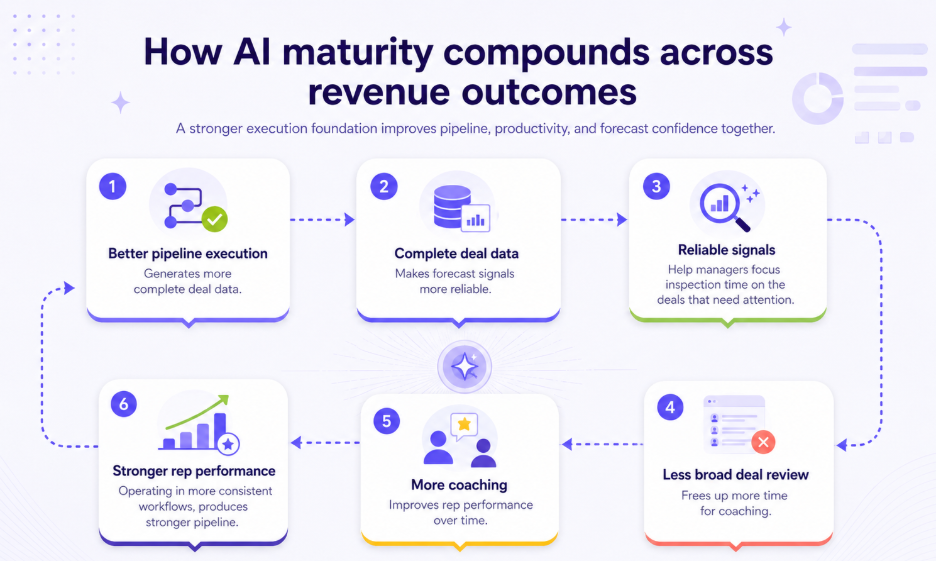
The same execution infrastructure that improves pipeline coverage also increases productivity and strengthens forecast inputs. That’s one operating model improvement showing up in three areas simultaneously.
Teams at earlier stages of AI maturity often see isolated gains: a particular rep is more productive, a specific workflow runs more consistently, some forecast deals are tracked more accurately. What they don’t see yet is the structural lift that comes when the whole operating model executes more consistently. That’s the difference between AI tools and advanced AI maturity.
When pipeline is weak, the instinct is to generate more leads or run more sequences. The more useful question is: where is follow-through breaking down, and which high-priority accounts aren’t receiving consistent coverage?
When seller productivity is low, the instinct is to add tools. The more useful question is: how much of each seller’s week is going to work that a mature operating model would handle automatically?
When forecast confidence is low, the instinct is to improve the forecasting process. The more useful question is: how complete and current is the underlying data, and are deal stages reflecting actual buyer behavior or rep estimation?
Each question points toward the execution layer, not the surface metric. The operational gap behind the metric is what determines whether any initiative — AI or otherwise, will produce a durable improvement.
This is what the Outreach AI Maturity Model assessment is built to surface. It evaluates where your execution foundation is strong and where the gaps in workflow consistency, data quality, and AI readiness are limiting what’s possible. Then it gives you a prioritized starting point for what to address first.
Learn the four stages of AI maturity, identify the gaps holding your revenue organization back, and get a practical framework for advancing toward more efficient, predictable revenue execution.
Pipeline, productivity, and forecast accuracy improve when revenue execution improves. Not because AI tools are more powerful, but because a mature operating model produces more complete data, more consistent follow-through, and more reliable signal capture — the conditions that allow AI to work at the team level, not just the individual level.
The path from today’s numbers to stronger ones runs through the same place: a clear picture of where execution is inconsistent and what to do about it.
The assessment is not meant to label a team and leave them there. Its value is in showing which maturity gaps are most likely limiting performance, then helping teams decide what to improve first.
That next step will look different depending on where the gaps are. For some organizations, the priority may be workflow standardization: making sure follow-up, deal inspection, forecasting, or account coverage happens the same way across the team. For others, it may be data trust: improving the quality and completeness of the CRM and revenue signals AI depends on. Other teams may need stronger inspection, accountability, or cross-team alignment before expanding agentic workflows.
To help customers progress toward more advanced stages of the maturity model, we have developed prescriptive playbooks that guide customers through their AI journey. This doesn’t mean just focusing on new technology, but how you can adapt your operating model to ensure success with your AI investments.
Each playbook is aligned to one of the drivers that help determine how mature your revenue workflows are. The drivers reveal where the friction is and the playbooks provide a prioritized roadmap for where to focus to progress towards more advanced stages of AI maturity.
That is why AI maturity is a progression, not a shortcut. Teams need the right operating foundation before AI agents can reliably support more advanced workflows. Once that foundation is clear, Outreach can help teams focus on the right next playbook, activate the capabilities that match their current maturity, and measure progress as they move toward more advanced stages.
The result is a more practical path forward: not a generic AI roadmap, but a maturity plan tied to the workflows, data, and operating gaps that are actually limiting performance. That is how teams move from isolated AI gains to a more scalable revenue execution model.
It is a framework built on 15 years of revenue data that shows where your organization stands on the path to AI Efficient GTM. It gives you a clear, prioritized starting point for what to focus on first.
Using AI and being built for AI are different things. Most teams have the tools, but very few have the workflows, data quality, and connected operating model to scale what those tools can do. The assessment shows you specifically where those gaps are.
RevOps leaders who are responsible for configuring your organization’s revenue processes, identifying where there may be gaps, and reimaging how AI can transform your go-to-market organization. Revenue leaders accountable for pipeline health, forecast accuracy, and go-to-market alignment. — CROs, CIOs, CFOs, or anyone evaluating where AI investments can make the most impact on team performance.
Outreach has developed prescriptive playbooks that outline a customer’s journey towards more advanced stages of maturity. Based on assessment results, these provide a prioritized roadmap of where to focus first and how to advance to the next stage.
You define the parameters. Most teams start with AI in a co-pilot role and expand automation deliberately as trust and data quality grow. The model helps you figure out exactly where you're ready to hand off, and where you're not.
The short version gives you your overall stage and a high-level breakdown of your biggest gaps in about 10 minutes. The full assessment goes deeper across all five dimensions. Our team is available to walk through your results and show you what advancing your maturity looks like in practice.
Forecast accuracy is downstream of data quality, which is downstream of workflow discipline. When deal records are updated from actual conversation and engagement signals rather than manual CRM entry, and when opportunity stages reflect real deal progression, forecasting becomes significantly more reliable. AI can accelerate this by automatically capturing deal updates from calls and meetings, generating projections based on historical patterns, and surfacing early signals on deals that are at risk of slipping.
Key evaluation criteria include coverage across the full revenue lifecycle, data quality and context architecture, governance controls for AI-driven actions, adoption and measurement capabilities, and integration with existing CRM and tech infrastructure. A platform that performs well in one motion but creates new data silos elsewhere produces limited compound value. The goal is a connected platform where improvements in one stage reinforce execution quality across all the others.
The AI Maturity Assessment shows you exactly where your team stands across workflow standardization, data trust, and AI readiness — and gives you a prioritized starting point for what to address next.
How to plan your AI transformation responsibly
