Blog
How to improve sales performance across your revenue team
October 1, 2026
Read more
Revenue fragmentation is the breakdown of consistency across a revenue organization's people, processes, and technology. It emerges when teams follow different sales methodologies, when data moves across disconnected systems, and when activity goes uncaptured — making forecasting unreliable, scaling difficult, and AI investment less effective than it should be.
Every Monday morning, sales and revenue leaders sit down to go through pipeline. They examine the numbers, challenge assumptions, and try to build a confident view of the quarter. But many of them have a persistent feeling they can't quite shake: they don't fully trust what they're looking at.
The forecast call is where fragmentation shows up most visibly. But it isn't where fragmentation starts.
Revenue organizations fragment long before anyone pulls a report. They fragment in the way teams are structured, in the methods reps use to engage customers, in how data moves, or doesn't, between systems. By the time a forecast looks wrong, the underlying dysfunction has usually been accumulating for years.
This is the hidden cost of revenue fragmentation. And it matters now more than ever, because fragmentation isn't just an operational headache. It's quietly becoming an AI-readiness problem.
Fragmentation rarely announces itself. It accumulates gradually, through decisions that each seem reasonable in isolation.
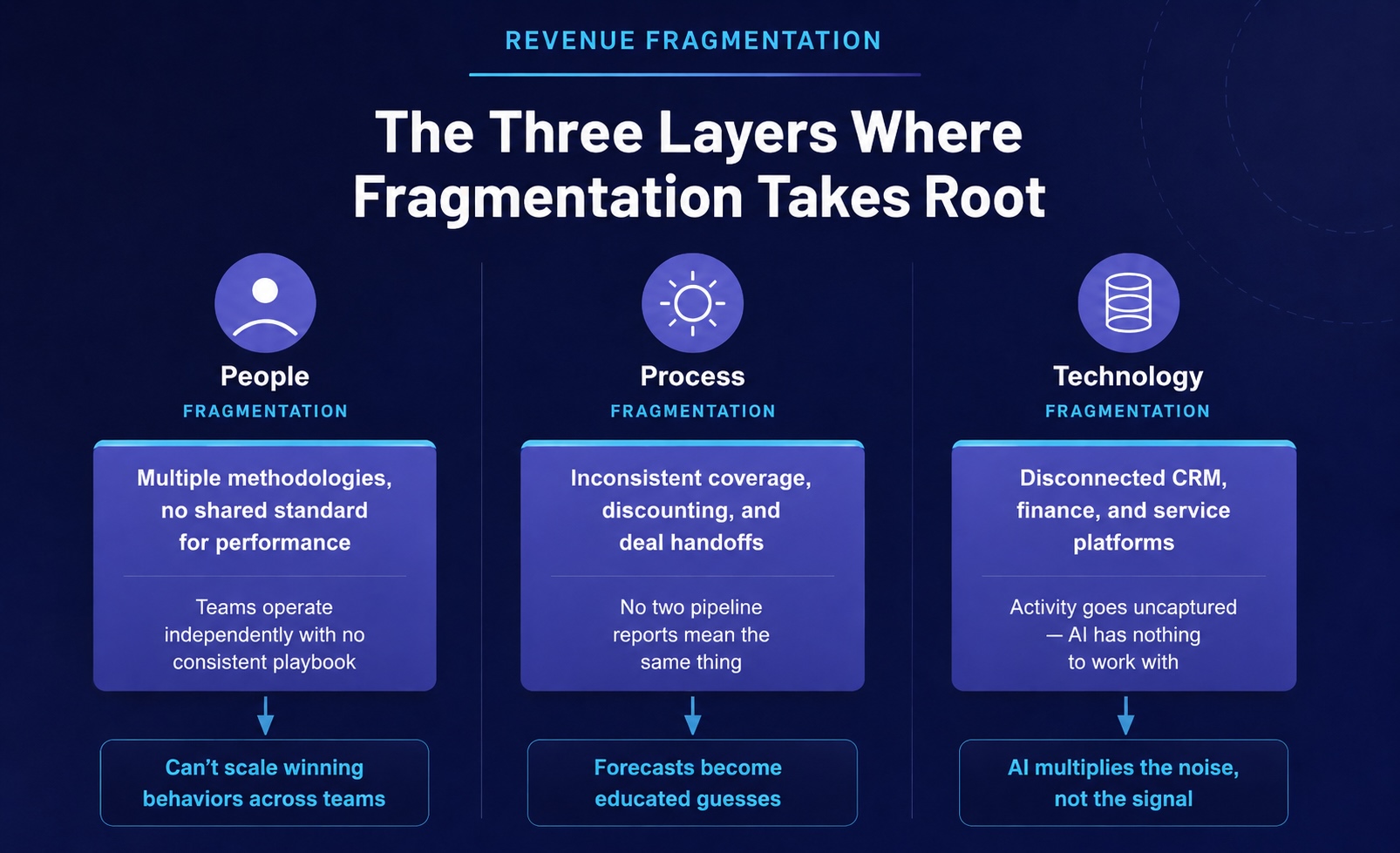
People fragmentation is often the most visible. Consider a revenue organization running three distinct sales teams under one roof, each following a different sales methodology because each team leader built their approach independently. There's no consensus on what "good" looks like, which means there's no consistent behavior to measure, coach, or replicate. Leaders can ask each team to perform, but they can't systematically build the conditions for performance.
Process fragmentation shows up in inconsistency: how accounts are assigned, how pricing and discounting decisions get made, how forecasts roll up, how deals transition between stages or teams. When individual reps and their managers can independently edit price, cost, and discount on any opportunity, precision disappears from every deal. When sales teams operating as effectively separate business units apply different logic to similar customers, no two pipeline reports mean the same thing. These aren't policy failures. They're structural ones.
Technology and data fragmentation is often the hardest to remediate. Finance, CRM, and service platforms frequently operate without meaningful integration. When revenue types evolve, as many organizations have experienced in the shift from perpetual licensing to subscription models, legacy systems force new structures into old containers.
The result is revenue reporting that collapses dozens of meaningful categories into a handful of legacy roll-ups that no longer accurately reflect the business. A board-level report might show top-line and bottom-line figures, but the granularity that would allow anyone to understand margin, mix, or momentum simply isn't there.
Sales activity is often the most glaring gap. When reps use personal devices, work outside of shared systems, or operate without a standardized engagement platform, there's no record of what actually happened in an account. Productivity becomes unmeasurable in any meaningful way. The only metric that survives is whether someone hit their number.
These aren't abstract concerns. They compound into three concrete business problems.
Without consistent process and shared data, sales forecasting accuracy become educated guesses aggregated through spreadsheets. Leaders know when a forecast feels wrong, but they lack the structured evidence to challenge it or correct it. Trust in the pipeline breaks down.
Without trusted pipeline data, every resource allocation decision becomes harder.
If you don't know which behaviors are driving results, you can't replicate them. You can ask for a 10% revenue lift, but if you can't identify what your top performers are doing differently, you're essentially asking teams to try harder without telling them what to change. Growth targets feel arbitrary because there's no clear lever to pull.
Reps managing large account lists, in some cases, 250 accounts or more, may meaningfully engage with only a fraction of them. Orphaned accounts accumulate. This structural precision loss is a primary driver of revenue leakage; the untracked margin that escapes through orphaned accounts, unmonitored discounting, and coverage gaps that no one owns. Customer health signals go unnoticed.
The irony is that most leaders already sense this. Fragmentation isn't hard to notice, but it's difficult to quantify, and difficult problems are easy to defer.
There is a version of the AI conversation that overpromises. It suggests that AI can find signal in noise, surface insights from incomplete data, and optimize what was previously opaque. That version isn't realistic, and revenue leaders should be skeptical of it.
AI cannot create insight from activity that was never captured. It cannot standardize a process it has never seen. It cannot connect customer signals that are scattered across three teams using different systems and different data definitions.
A useful way to think about it: the platform is the foundation; AI multiplies the value of what's already connected. If activity is undocumented, AI has nothing to analyze. If revenue types are jammed into legacy categories, AI will reproduce the distortion, not correct it. If the handoff between sales and customer success happens informally and outside the system, AI cannot tell you when a customer is at risk, because it doesn't know the customer was engaged in the first place.
This doesn't mean AI isn't valuable. Rather, it means that AI value is proportional to the quality of the execution infrastructure underneath it. Organizations that have invested in connected data, standardized processes, and shared visibility will get compounding returns from AI. Organizations that haven't will get noise.
The answer isn't a wholesale AI rollout. And it isn't waiting for a multiyear system consolidation before attempting anything. It's a more deliberate sequence.
Before anything else, align on what you're measuring and why. What counts as a qualified opportunity? How are revenue categories defined? What does a complete account record look like? These aren't glamorous conversations, but they're prerequisites for everything that follows. You cannot build a consistent sales methodology on top of inconsistent language.
If you can't see what reps are doing, you can't coach them, benchmark them, or help them prioritize. Platforms like Outreach exist precisely to create this visibility by capturing what's happening in accounts, how deals are moving, where engagement is strong or absent, and what the pipeline actually looks like based on evidence rather than rep judgment. That kind of connected activity record is the raw material for both human coaching and AI analysis.
Sales and customer success often operate in parallel, using different tools, sharing minimal information. A rep closing a deal may not know that the customer told their CSM about a growing frustration. A CSM trying to retain an account may not know that the sales team already has a renewal conversation underway. Bringing those teams into a shared view of customer activity — conversation history, engagement data, health signals — changes what each team can do.
A few well-chosen use cases will do more to build confidence and demonstrate ROI than a broad deployment that overwhelms teams and produces inconsistent results.
Some of the highest-value starting points include:
These aren't moonshots. They're achievable with platforms that have clean activity capture and connected data, and they build the organizational confidence to go further.
The organizations that will get the most from AI are not necessarily the ones that move fastest. They're the ones that have made their revenue operations coherent enough for AI to help them act.
That means consistent methodologies, not three different ones running in parallel. It means revenue data structured to reflect how the business actually works, not forced into categories that made sense a decade ago. It means activity captured and connected across the teams that interact with customers. It means a forecast that leadership actually trusts.
AI readiness, in practice, is execution readiness; the degree to which your data is connected, your processes are standardized, and your activity is captured.
None of this happens overnight. But the organizations that treat fragmentation as a prerequisite problem, rather than a background condition, will find that AI accelerates them meaningfully. The ones that skip this step will find that AI accelerates the noise.
The organizations best positioned to get value from AI will not necessarily be those that adopt the most tools first. They will be the ones that make their revenue data, workflows, and teams connected enough for AI to help them act.
What happens when account intelligence meets agentic AI? Learn how Demandbase and Outreach work together to help revenue teams identify the right accounts, prioritize the right actions, and execute more effectively across the entire revenue lifecycle.
Revenue fragmentation is broader than a data quality problem. It refers to the breakdown of consistency across the three layers of a revenue organization: people (teams using different methodologies and incentive structures), process (inconsistent account coverage, discounting, forecasting, and handoffs), and technology (disconnected systems with incompatible data definitions). Messy data is often a symptom. Fragmentation is the structural condition that creates it.
Forecasts depend on consistent inputs. When sales teams use different methodologies, when revenue types are collapsed into legacy categories that don't reflect the actual business, and when rep activity goes unrecorded, the pipeline view is built on incomplete and inconsistent evidence. Leaders may know the numbers look off, but without standardized data they can't easily identify why — or correct it. The result is a forecast that gets challenged every week rather than trusted and acted on.
AI analyzes what exists in connected, interpretable form. It cannot reconstruct activity that was never captured, standardize definitions that were never established, or connect signals scattered across systems that don't communicate. If a rep manages 250 accounts but logs activity for only a fraction of them, AI has no basis for assessing the rest. If revenue categories don't reflect how the business actually works, AI will reproduce that distortion in its outputs. The platform and its data are the foundation; AI multiplies the value of what's already connected, while it doesn't replace the foundation.
The practical starting point is alignment on definitions; what counts as a qualified opportunity, how revenue is categorized, what a complete account record looks like. From there, the priority is visibility: capturing activity, account ownership, and deal movement in a centralized platform rather than across personal devices and disconnected tools. Connecting sales and customer success around a shared view of the customer is a high-leverage next step. These create the conditions for AI to be useful, rather than introducing AI before the foundation is in place.
The highest-value starting points tend to be narrow, evidence-rich, and clearly useful to the people who have to act on them. Prioritizing dormant or orphaned accounts is a strong early case because it requires activity data that a connected platform can already provide. Surfacing deal-health signals based on engagement trends and time since last meaningful interaction gives revenue teams something concrete to act on in forecast reviews. Giving sales and customer success a shared view of customer activity reduces the coordination failures that create churn risk. These use cases build confidence and demonstrate value without requiring the entire organization to transform at once.