Blog
AI saves customer success teams time. But does it drive growth?
November 9, 2026
Read more
TL;DR: AI is helping customer success teams work more efficiently, but productivity gains alone don't guarantee stronger retention or revenue growth. The 2026 Customer Revenue Leadership Study reveals a gap between AI adoption and measurable business outcomes. To close it, customer success leaders need to move beyond automating individual tasks, connect AI to end-to-end workflows, and measure its impact on customer adoption, retention, and expansion.
In the 2026 Customer Revenue Leadership Study from ChurnZero and 6sense, 81% of 580 customer growth leaders say AI has cut the time their teams spend on manual work. Net revenue retention, the number customer success is judged on, fell from 2022 through 2024. The 2025 and 2026 results are statistically indistinguishable from 2024.
Flat NRR doesn’t tell us whether AI has helped or hurt retention, because the study can’t show what retention would have looked like without it. What it prompts is a question about what the AI is attached to. The gap between what AI can do and what it delivers for the business comes down to execution: a specific workflow, tied to an outcome the business already cares about.
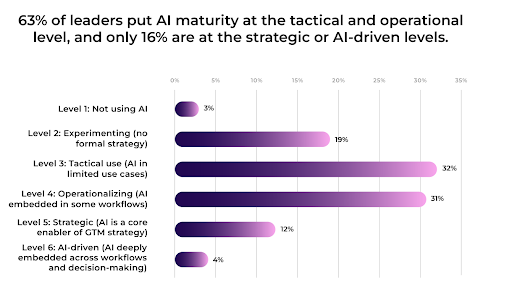
Most AI in customer success is aimed at administration. CS teams most often use it for account research and call summarization, each at 72%. Across all respondents, 63% describe their AI use as tactical or operationalizing, and only 16% as strategic or AI-driven. Four in five teams stop AI short of strategic actions such as initiating a QBR or surfacing an opportunity.
AI aimed at administrative work should save administrative time, and by the study's account it has. A summary changes nothing for a customer until someone acts differently because of it.
The study reports two findings about NRR. In the aggregate, it has been flat since 2024. Separately, among strategic and AI-driven teams, 65% report NRR of 100% or higher, against 39% of teams not using AI or still experimenting. One is a trend across survey years; the other is a comparison between maturity groups. The research can't establish how the two relate, so it doesn't show whether the maturity gap helps explain the flat aggregate, or whether it would change it.
There may be other forces at work, too. As customers use AI to operate with smaller teams, seat-based SaaS contracts can shrink even when those customers are getting substantial value from the product. Timing may also play a role. Much of today's AI adoption is recent, while NRR reflects renewal decisions made over longer cycles. Improvements in execution may take time to appear in retention metrics.
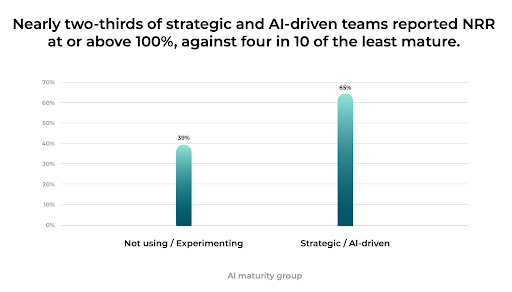
Nor does the comparison show causation. It covers only the two ends of the distribution, and the 63% in the middle isn't in it. Maturity is self-rated, and the study itself warns about AI washing. Stronger businesses may simply invest more in AI. The chart's axis suggests NRR is reported in bands, which would hide small gains.
Our assessment evaluates where your organization stands across core workflows and gives you a directional picture of where to focus first to achieve an AI-efficient GTM.
Consider a usage drop. AI can detect it, summarize the account and draft a note. Retention changes only if the right person acts in time to affect the renewal. The unit that matters is the workflow, from signal to owner to action to outcome. That’s where GTM AI Advisors come in, guiding the right action at the critical moment.
Leaders rank product adoption (55%) and onboarding and time to value (42%) among their top priorities. The most-cited metrics in the study are NRR (46%), expansion revenue (46%) and GRR (43%). The study doesn't report how many teams track adoption or time to value, so it can't say how often they are measured.
Ownership is also split. Customer success holds renewals outright at 40% of companies. Expansion ownership is spread across the organization: 20% customer success, 22% sales, 23% account management, 22% shared between sales and CS, and 13% a dedicated expansions team. With a median 70% of revenue coming from existing customers, an AI-surfaced insight often has to cross a function boundary before it becomes revenue. That is an inference, not a study finding.
Adoption isn't the outcome. Business impact is. Usage and hours saved show a tool is working, not that the business is improving.
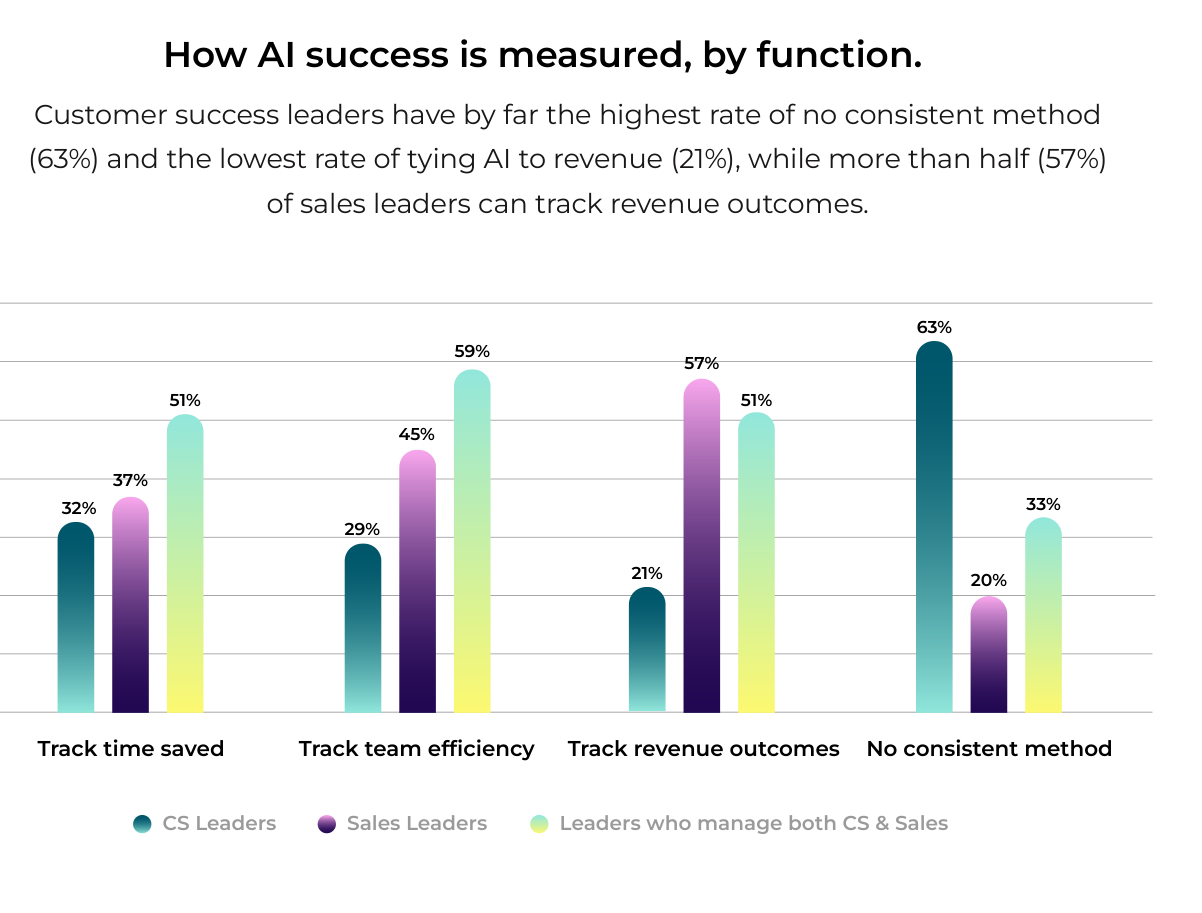
Customer success has the furthest to go here. Among CS leaders, 63% have no consistent method for measuring AI, and 21% tie it to revenue, compared with 57% of sales leaders. The study's own "one thing to change now" on measurement is a workable start and needs no framework:
This also bears on the autonomy debate. Across all respondents, teams that can't measure AI are four times more likely to require human approval of every recommendation (40% versus 9%), and 30% of the least mature teams approve everything, against 6% of the most mature. John Gleeson reads this as a shortage of evidence rather than of distrust: leaders who can't measure AI have no way to earn the confidence to let it act.
Evidence is only part of the decision. Eromosele argues in the study that customer segment sets how much human attention an account can justify, but the risk and reversibility of the task should decide how that attention is spent. A low-risk, easily reversible task can be automated even in an enterprise account, and a high-risk, hard-to-reverse moment warrants a person even in a small one. Derek Roberts, VP of Customer Success at OnRamp describes his own handback test: an agent whose actions and reasoning he can't see goes back behind a human approval queue. Measurement tells you where AI has earned more room, and task risk tells you where it shouldn't have any yet.
Lukas Alexander, VP of Customer Success ChurnZero, frames the open question in two parts: getting the time back, then deciding what goes into it. The study can't tell us what teams do with recovered capacity. It can show what leaders say matters: adoption, time to value, renewal and expansion revenue.
But recovering time only matters if teams put it toward work that improves customer outcomes. AI can identify risks, surface opportunities, and reduce administrative work. Customer success professionals still need to act on that information, build relationships, and demonstrate value.
From my perspective, there are four priorities for putting that capacity to work:
The same question applies to headcount. Among teams cutting roles, AI is the most-cited reason, at 52%. Only 20% of respondents are reducing headcount at all, and the study finds those teams cluster at lower AI maturity. Gleeson draws the sharpest conclusion from this: the fastest reductions are happening where AI is least proven. He separates teams restructuring around a capability they have demonstrated from teams using AI as the reason for a cut they were already going to make. The study's own advice is to prove the capacity before planning headcount around it.
For many customer success teams, the first phase of AI adoption has been about reducing manual work. The next is about determining whether that efficiency translates into better customer outcomes. That requires measuring what changes when AI takes on a workflow, rather than simply tracking how often AI is used.
Start with a customer success workflow you want to improve, such as identifying at-risk accounts, preparing business reviews, or driving product adoption. Establish the baseline before introducing AI: how long does the work take, what results does it produce, and which business KPI should improve? Then introduce AI into the workflow and measure those same indicators over a comparable period. Where possible, compare results with a similar team or set of accounts that hasn't adopted the workflow.
For example, a team introducing AI into its expansion workflow could first establish how many opportunities it identifies, how quickly it acts on them, and how many progress into pipeline. Measuring those same indicators after deployment provides a clearer picture of AI's contribution and where the workflow still needs improvement.
For workflows already using AI, look to pre-adoption data or a comparable non-AI workflow to establish a meaningful benchmark. If neither is available, track performance going forward, but don't assume any improvement is attributable to AI alone.
The next step is to connect those measurements to what customer success teams accomplish with their recovered time. Are they responding faster to risk signals, building stronger customer relationships, increasing product adoption, or identifying expansion opportunities? Tracking these outcomes can help teams understand where AI is creating value, where adjustments are needed, and how to turn productivity gains into stronger retention and growth.
Discover how your team is using AI today, identify gaps in your approach, and get practical guidance for moving beyond task automation toward measurable revenue outcomes.
According to the 2026 Customer Revenue Leadership Study, 81% of customer growth leaders report that AI has reduced the time their teams spend on manual work. The most common use cases are account research (72%) and call summarization (72%).
For deeper insights into how much productivity AI agents unlock, see our Agent Productivity Impact Report, which quantifies time savings across specific workflows like account research, call summaries, and strategic workflows.
However, time savings alone don’t guarantee better retention or revenue growth — it’s what you do with that recovered capacity that matters.
The 2026 Customer Revenue Leadership Study found that 65% of organizations reporting strategic or AI-driven adoption achieved net revenue retention (NRR) of at least 100%, compared with 39% of organizations not using AI or still experimenting. While the findings suggest a relationship between AI maturity and stronger retention performance, they don't establish that AI caused the difference. For customer success leaders, the opportunity is to move beyond administrative efficiency and connect AI-enabled workflows to measurable outcomes such as customer adoption, retention, and expansion.
Tactical AI automates individual tasks: summarizing calls, researching accounts, drafting emails. 63% of teams operate here. It frees up time but doesn’t directly drive revenue.
Strategic AI is embedded in end-to-end workflows tied to measurable business outcomes: detecting churn risk → CSM action → renewal saved, or surfacing expansion opportunity → account plan → revenue added. Only 16% of teams operate here—and they’re the ones seeing NRR gains.
The shift requires moving AI from “tools” to “workflows.”
Start with this framework:
Key point: Measure business impact (renewal rate, adoption, expansion), not activity (hours saved). Teams that can’t measure AI are 4x more likely to require human approval of every recommendation — evidence builds the confidence to let AI act autonomously.
That’s your decision — AI can’t make it for you. Leaders cite adoption, time to value, renewal, and expansion revenue as top priorities. But recovered capacity only matters if you channel it into a workflow with a measurable outcome.
For example:
Prove the capacity gain before planning headcount around it.
It depends on task risk and reversibility, not maturity level alone.
Measurement builds autonomy: Teams that can quantify AI impact are more confident letting it act. Teams that can’t measure AI require approval 4x more often —not from distrust, but from lack of evidence.
You’re not behind — most teams are here. The 2026 study shows 63% describe their AI use as tactical or operationalizing. To move toward strategic AI:
Start with one workflow tied to one metric. Prove it. Scale it.
See how Outreach helps revenue teams connect customer insights to action, automate workflows across the customer lifecycle, and focus on the activities that support retention and expansion.