Blog
Platform consolidation in 2026: Why revenue teams are moving to unified execution-ready AI
September 11, 2026
Read more

Data from the Outreach Insights Group, based on 148 internal Outreach sessions, April–May 2026. Quota attainment findings are directional and based on an internal cohort of New Logo AEs. Not a cross-industry benchmark.
TL;DR: Outreach's Insights Group analyzed 148 internal sales sessions and found account plans function as a workflow hub, not a briefing document. No rep navigated to a plan directly — every visit arrived from a deal, task, prospect record, or email — and reps took 517 downstream actions immediately after, most often composing an email. Reps who revisit plans 26+ times a month hit 159% of quota, versus 90% for reps who rarely open them.
There’s a common misconception about account planning. Many orgs think it’s just a briefing doc, where reps visit before a big meeting and update afterwards, but doesn't have an effect on sales. From our observations, this idea couldn’t be further from the truth.
The Outreach Insights Group analyzed 148 real internal sales sessions over two months, and a different picture of account plans emerged. Account plans weren't being used as briefing documents. They were being used as the central hub of the day-to-day sales workflow — the place reps returned to before every call, every email, every sequence enrollment. Three to four times a day, on average. The account plan wasn't a destination. It was infrastructure. In this blog post, we’ll go over our key findings from the data and what they tell us about the true power behind an account plan.
In 148 sessions, not a single rep opened their account plan by navigating directly to it. Every session arrived from somewhere else, from a deal record, a task queue, a prospect profile, or an email notification. The five confirmed entry points:
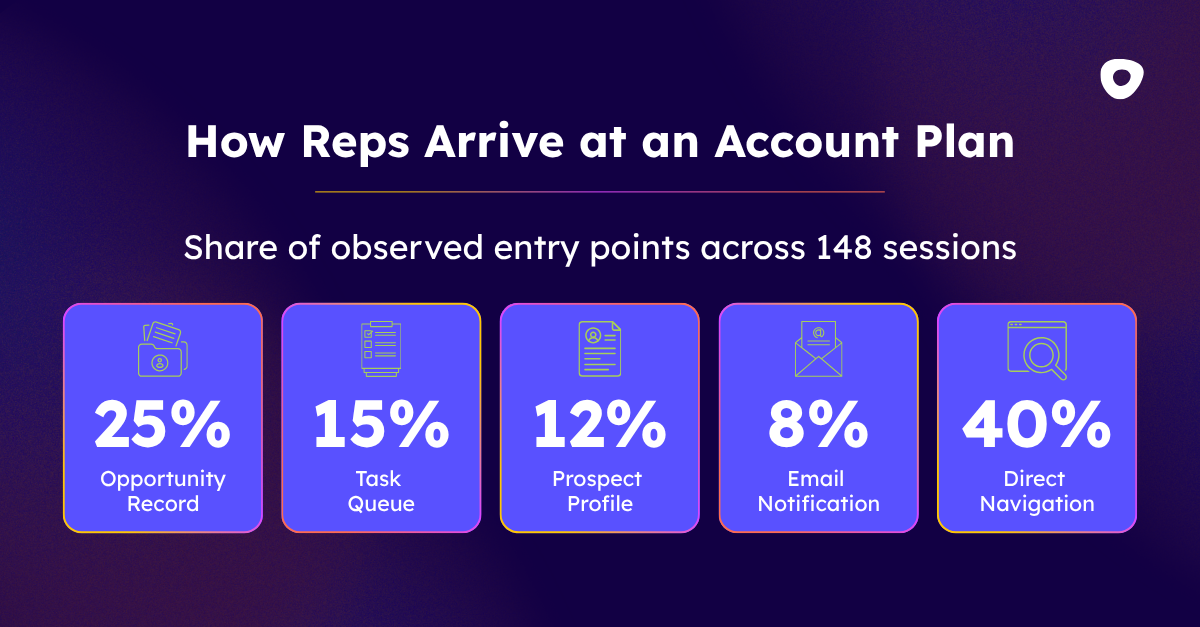
What this tells you is that account plans aren't a separate module that reps visit on purpose. They're woven into every other part of the workflow. Reps arrive from deals, tasks, contacts, and their inbox, and the account plan acts as the connective layer that pulls everything together before they take action. That's a fundamentally different role than "planning document."
Once inside an account plan, the behavioral data is consistent: without exception, reps read before they act. Every single session began with information gathering before any action was taken. And across 13 sections, attention was concentrated at the top.
Opportunities/Deal Health and Activity Feed dominated. They appeared in 92% and 78% of sessions respectively. After those two, Engagement Strategy, Strategic Initiatives, and Kaia Recordings rounded out the top five. These five sections were universal, engaged by AEs, CSMs, and managers alike.
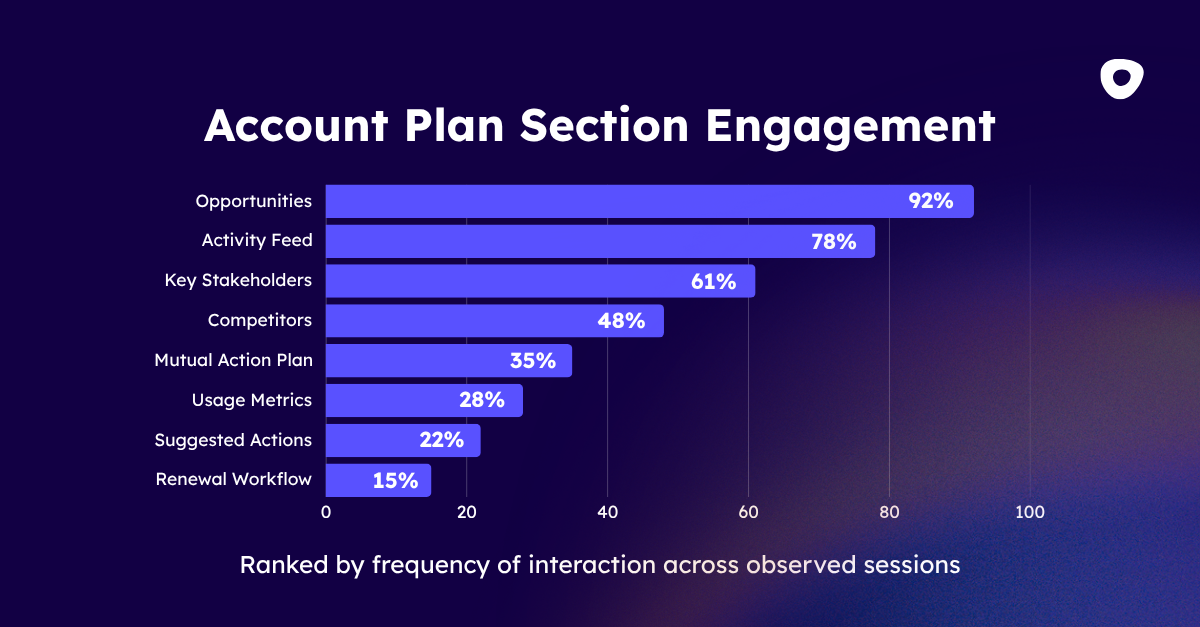
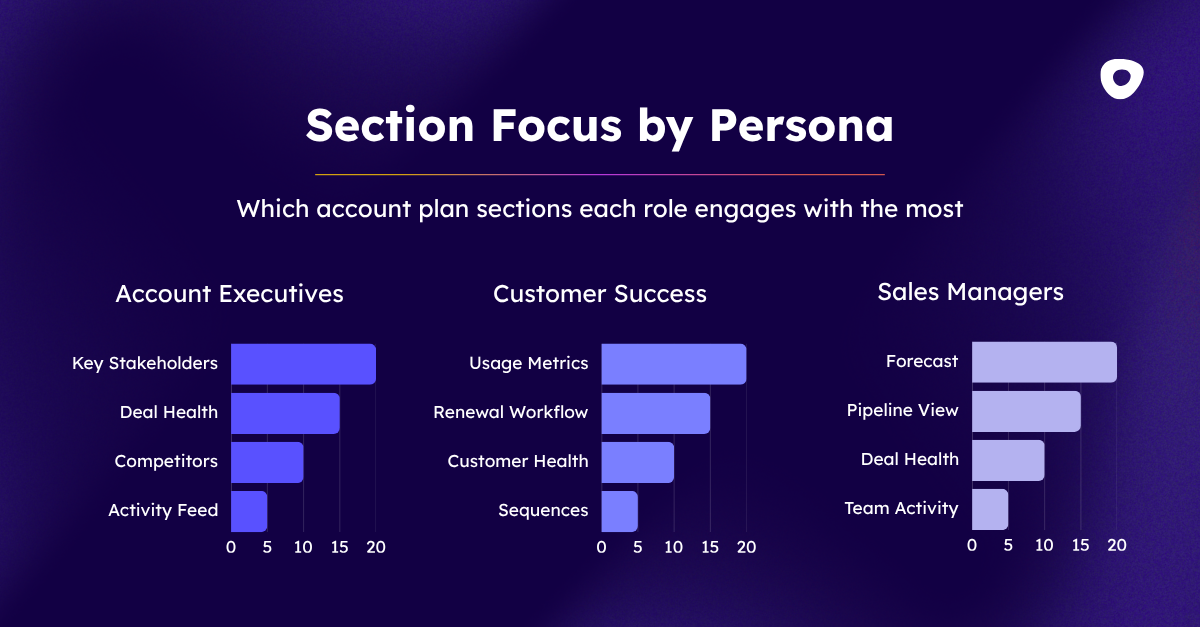
After the top five, the plan splits by role. AEs head to Key Stakeholders and Competitors. CSMs move to Usage Metrics and the Renewal workflow. Managers look at Forecast and Pipeline. The same product, three different jobs , which is exactly what you'd want from a true workflow hub.
The entry point data and the section engagement data point to the same conclusion: account plans are valuable not because of what's in them, but because of what they connect.
In a modern revenue workflow, reps are moving between call recordings, deal records, forecast views, email, sequences, and CRM updates — often in a single session. The account plan is the one place where all of that context lives together. It's where a rep can go from "I just reviewed a Kaia recording" to "here's the account strategy" to "I'm composing a follow-up email" without ever switching tools or losing thread.
Across 148 sessions, reps took 517 downstream actions immediately after account plan visits. The top action by a wide margin? Composing an email. It accounted for roughly 25% of all downstream activity. Sequences, calls, task flows, and meeting bookings followed. The account plan triggered the full spectrum of sales execution, not just one type of follow-up.
The five loops are just one part of the story. The full report covers how reps enter account plans, which sections get the most attention, what happens after every session, AI adoption in practice, and how account plan usage connects directly to quota attainment.
If your account plans are functioning as quarterly deliverables rather than daily workflow surfaces, you're likely leaving performance on the table. The data on this is direct: reps who interact with account plans 26 or more times per month hit 159% quota attainment. Reps at 1–5 interactions hit 90%.
That gap doesn't come from having better plans. It comes from using them more often — and using them as a hub, not a document.
A few practical questions worth pressure-testing with your team:
The teams getting the most out of account planning aren't doing more planning. They're making the plan the place where execution starts.
Not based on this data. Across 148 observed sessions, reps used account plans as a daily workflow hub, returning 3–4 times a day rather than only before and after meetings.
Through five entry points: the accounts list, opportunities list, tasks queue, email notifications, and prospect profiles. No rep in this cohort navigated to a plan directly.
Composing an email was the top downstream action, accounting for roughly 25% of the 517 actions observed, ahead of sequences, calls, task flows, and meeting bookings.