

Blog
Sales engagement data in Snowflake: Bring Outreach activity next to the rest of your GTM data
October 28, 2026
Read more

TL;DR: AI agents that lack business context create more work for sellers, who must correct product details, refine messaging, and add competitive insights by hand. Outreach Org Context gives agents a shared understanding of your company, products, and positioning so they can deliver more accurate, relevant outputs from the start. The result: less time spent editing AI-generated content, more consistent messaging across the sales team, faster preparation for customer conversations, and more time focused on advancing deals.
An AI agent can write a follow-up, summarize a call, or help a seller prepare for a customer conversation. At first glance, the output may read well. Then the seller looks closer and finds the gaps.
The agent didn’t recognize your product name. It missed how the team positions against your competitor. It used language that does not sound like your company.
Sellers then close those gaps by hand. They edit the draft, paste in background, and correct terminology. For RevOps and enablement teams, the problem compounds. When every seller supplies context differently, messaging drifts across the team, and the time AI was meant to save goes into rework.
The issue is not that the agent cannot complete the task. It’s that it cannot infer facts it has never received.
Org Context moves the company knowledge agents need out of individual prompts and into a shared source. It gives Outreach agents an always-on foundation: the company, product, competitive, and sales context they should have before they respond.
Put a call transcript into an AI tool and you can get a polished follow-up. That is useful. But sales work rarely stops at, “What did the buyer say?”
Precise agent outcomes depend on understanding your company value — what your company sells, how you position it, which competitors matter, and how your team moves deals forward.
The trick is to establish that information only once, keep it in a shared source, and require every agent to reference the context before it produces an output.. Sellers can then spend their time on what only they can judge: the customer, the relationship, and the moment.
Org Context gives Outreach admins a dedicated way to define and manage the core company information agents should reference before producing an output.
It starts with three pre-built blocks:
Admins can edit those blocks, add their own, and choose which ones are active. Active blocks are referenced by the Outreach agent experiences that use Org Context, giving each response the business context your team considers essential.
Admins do not have to build every block from scratch. They can populate blocks from web sources, review the suggested content and sources, then accept, reject, or edit it before it is used by agents.
Say a user asks Outreach Omni to help create a success plan.
Without context, “success plan” can sound like a generic strategy document. With Org Context, you can use a Products block that establishes “Success Plan” as one of your product offerings. Omni can then recognize the business-specific meaning behind the request and start from the right interpretation.
If it needs more detail, it can turn to Knowledge. Org Context holds the curated, broadly applicable information an agent should always know. Knowledge holds the deeper material it can reference when a question calls for it, such as technical documentation, detailed competitive research, positioning briefs, or customer case studies.
The two work together. Org Context provides the company-level frame. Knowledge adds depth when needed.
Now consider a seller preparing for a competitive call.
They need more than a generic list of discovery questions. They need to understand how their product fits the customer’s priorities, what the competitor is likely to claim, and how their company should respond.
With Org Context, the agent brings the relevant company context. The seller brings the judgment about the customer, relationship, and moment. Together, they can shape a response that is both consistent with how your company sells and relevant to the deal in front of them.
That shared context helps teams stay aligned while giving individual sellers room to do what strong sellers do best: listen, diagnose, and adapt their approach to each customer's needs.
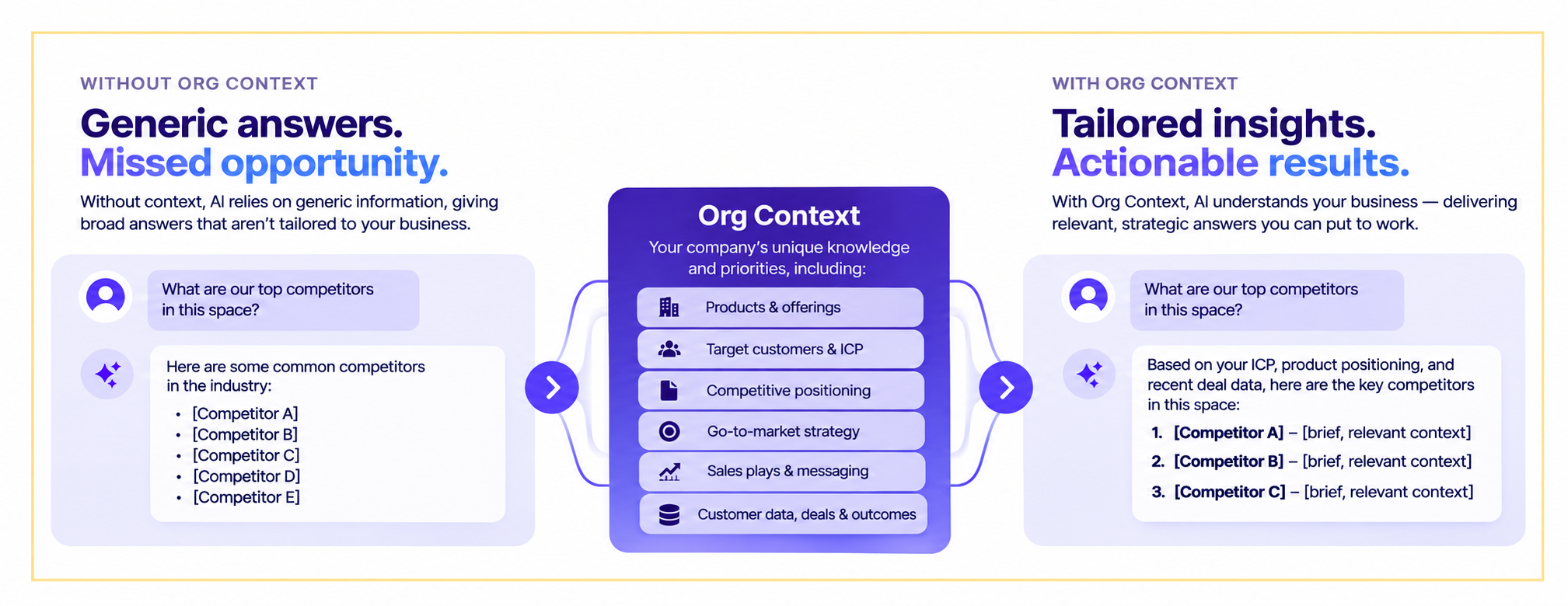
Org Context delivers measurable improvements across three dimensions:
The value compounds: every agent that uses Org Context brings the same company perspective, turning company knowledge into a flywheel for revenue execution.
The value of Org Context grows with every agent that can use it.
Establish what is true about your business once, then make that shared context available wherever Outreach agents help teams prepare, analyze, and act. Each experience starts with a better understanding of the company it represents, while admins retain control over the information behind it.
Your company context should not get lost between the conversation and the next action. Give every agent a stronger starting point with Org Context.
Centralize your company knowledge once, then make it available to every agent across your platform. Eliminate the rework, align your messaging, and help sellers spend their time on what matters: closing deals.
Org Context is an Outreach platform feature that gives admins a centralized way to define and manage company knowledge — including company overview, products, and competitors—that Outreach agents reference before producing outputs. This ensures every agent-generated response reflects your company’s value, positioning, and business language.
Without Org Context, AI agents produce generic responses that sellers must edit by hand, adding your product names, competitive positioning, and brand voice. With Org Context, agents start with your company’s business context built in, reducing rework and keeping team messaging aligned. Sellers spend less time editing and more time on what matters: understanding customers and closing deals.
Org Context holds the core company information every agent should always reference — company overview, products, competitors, and sales context. It’s broad and universally applicable.
Knowledge is deeper, detailed material agents can reference when a question calls for it — technical documentation, case studies, competitive research, pricing information, and process documentation. Org Context provides the frame; Knowledge adds depth when needed.
Org Context currently powers Outreach Omni. The roadmap includes extending Org Context to more agents across the platform, so every agent experience starts with the same understanding of your business.
To set up Org Context, navigate to your Outreach admin settings, find the Org Context section, and populate the pre-built blocks with your company overview, products, and competitor information. You can use web sources to auto-populate content, then review, edit, and approve before activation. See the full setup guide for step-by-step instructions.
From company information to product positioning and competitive insights, Org Context helps your agents start with a shared understanding of your business. See how to configure your context blocks and get started.
Sales engagement data in Snowflake: Bring Outreach activity next to the rest of your GTM data
October 28, 2026
Why your AI agents should know your business: The Org Context advantage
October 28, 2026

AI transparency in sales tools that your team can test
October 27, 2026
