

Blog
The subtraction gate: Why AI agent deployments fail (and what to measure in the ones that work)
November 19, 2026
Read more
Managing sales operations across multiple teams, technologies, and touchpoints is complex. Without the right systems in place, organizations struggle with slow, inefficient sales cycles and inconsistent results.
Agentic AI platform for revenue teams unify connect data, intelligence, and workflows across the revenue lifecycle. By combining AI agents, automation, and real-time insights, these platforms help teams prioritize opportunities, reduce manual work, execute consistently, and drive more predictable revenue growth.
Choosing the right agentic AI platform can feel overwhelming. This guide breaks down the essential capabilities, evaluation criteria, and questions revenue leaders should consider when selecting a platform that supports their teams today and scales with their business.
Not all AI-powered revenue platforms offer the same capabilities. Some focus primarily on individual tasks or AI-generated insights, while others connect data, automation, and AI agents across multiple revenue workflows. Understanding these differences is essential when evaluating which platform can best support your organization's goals.
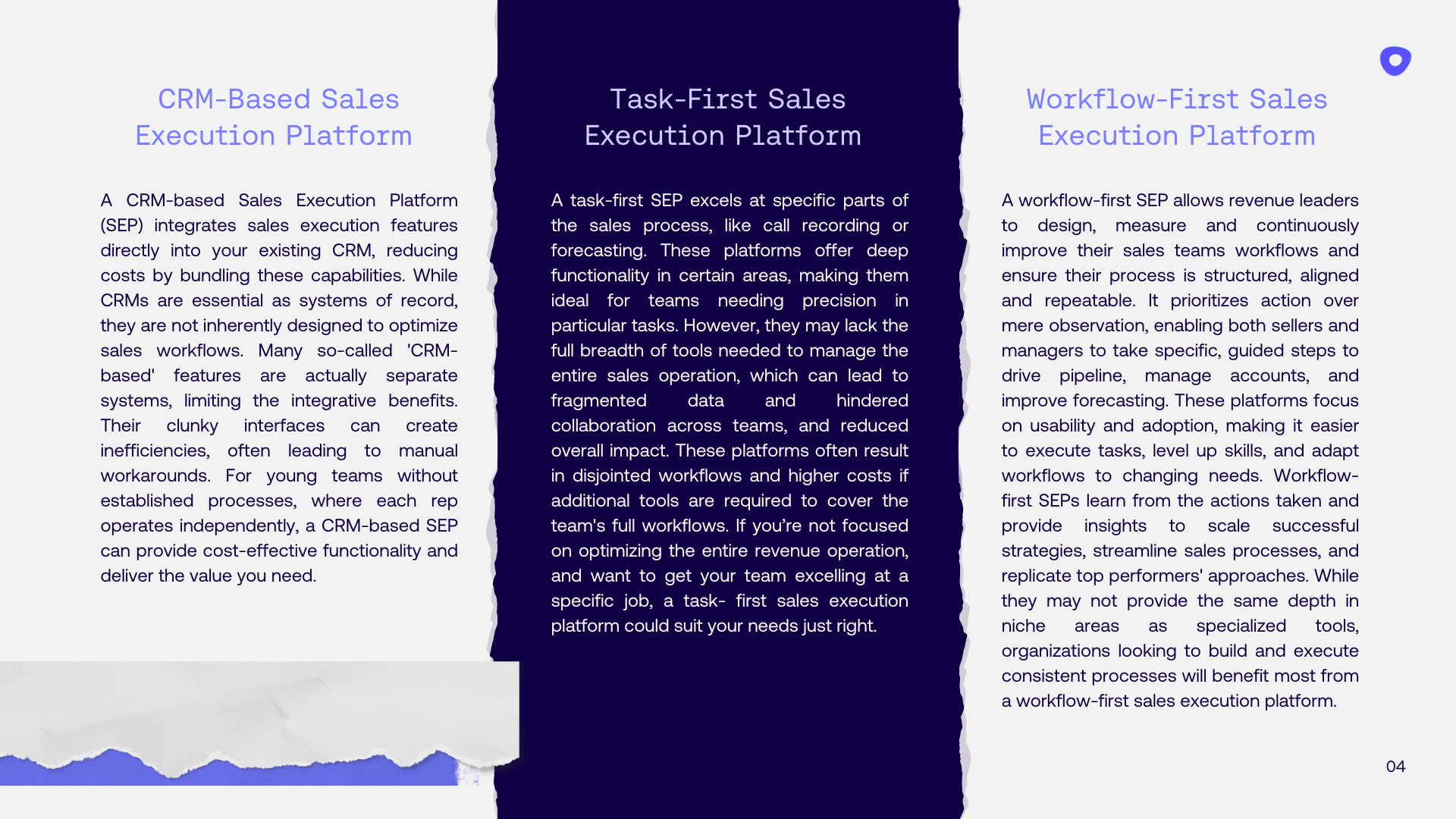
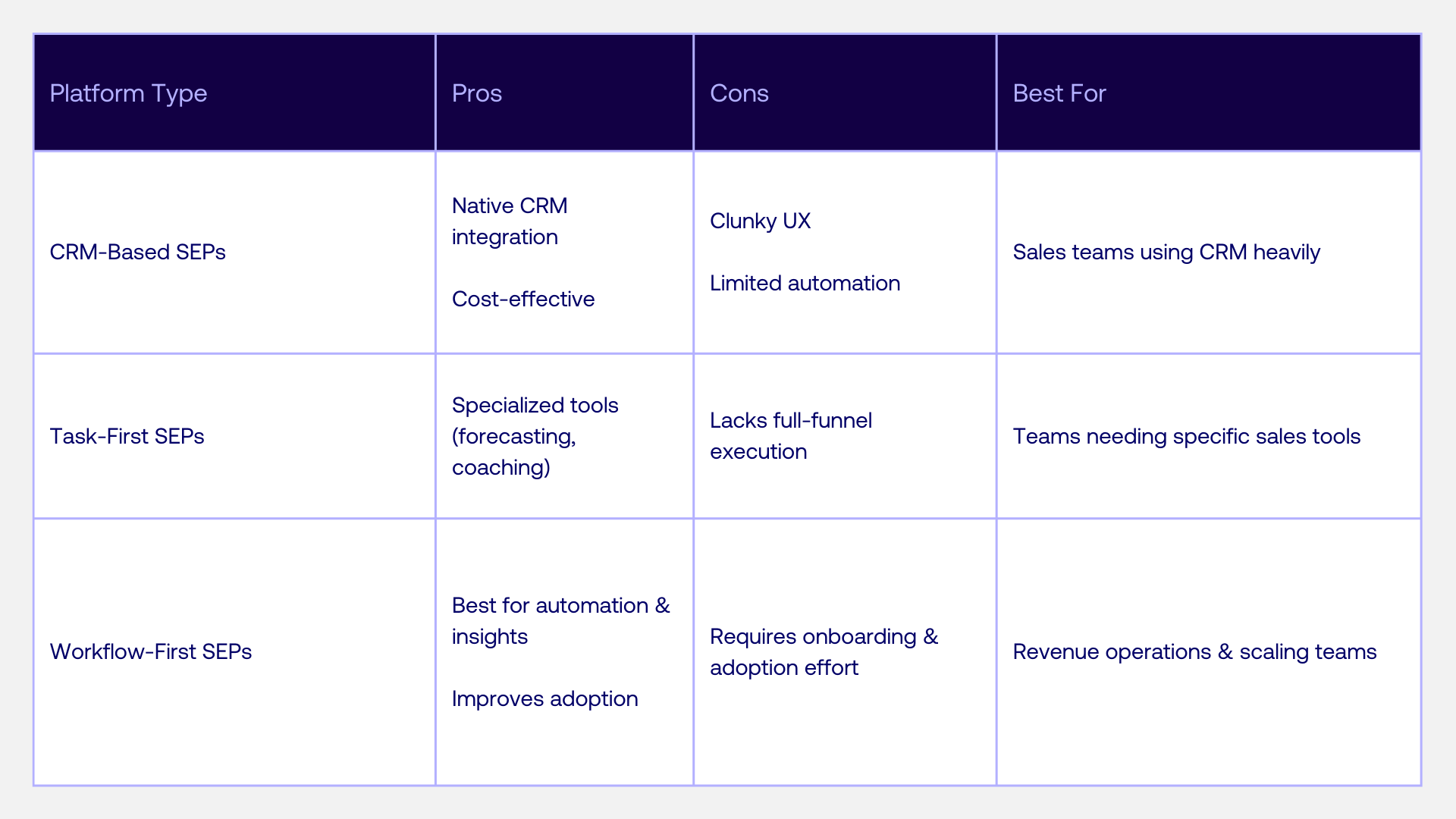
CRM-based SEPs integrate directly with an existing Customer Relationship Management (CRM) system, making them an attractive option for teams that want to extend their CRM’s capabilities without adding a separate tool. These platforms help reduce costs by bundling sales execution features within the CRM interface.
However, while CRMs serve as an essential system of record, they are not inherently designed for sales execution. Many CRM-based SEPs rely on clunky interfaces and manual workarounds, making them inefficient for fast-moving sales teams.
Task-first SEPs specialize in specific areas of the sales process, such as call recording, forecasting, or coaching. These platforms offer deep functionality in their niche but may lack the full suite of tools needed to manage the entire sales workflow.
For example, a task-first SEP may provide advanced AI-driven call insights but lack features for prospecting, automation, or deal management. As a result, teams using these platforms may experience fragmented workflows and require additional tools to fill the gaps.
A workflow-first SEP provides a fully integrated approach to sales execution, ensuring that revenue teams have structured, repeatable processes. These platforms help sales managers design, measure, and continuously improve their team’s workflows, ensuring every rep follows best practices.
Unlike CRM-based or task-first SEPs, workflow-first platforms prioritize automation and guided execution, allowing teams to move seamlessly from prospecting to closing deals. They also use AI-driven insights to help sellers optimize their approach, replicate top performers, and increase win rates.
The right agentic AI platform can help revenue teams move beyond disconnected tools and manual processes. By bringing together AI agents, revenue intelligence, and connected workflows, organizations can expand seller capacity, improve pipeline execution, strengthen forecasting confidence, and drive more predictable growth.
An agentic AI platform for revenue teams is a software platform that uses AI agents, automation, and connected revenue data to support and execute workflows across the revenue lifecycle. These workflows can include prospecting, customer engagement, meeting preparation, deal management, coaching, forecasting, and customer retention.
Unlike traditional sales tools that primarily organize information or assist with individual tasks, agentic AI platforms can execute multi-step workflows, reduce manual work, and help teams focus on higher-value activities.
A CRM primarily helps organizations manage customer records, contacts, opportunities, and sales data. An agentic AI platform builds on that information by connecting revenue signals and executing workflows across the customer lifecycle.
For example, a CRM may store account details and opportunity updates, while an agentic AI platform can use that context to research accounts, personalize engagement, prepare sellers for meetings, identify deal risks, and automate follow-up activities.
Together, these capabilities help revenue teams turn customer data into more consistent execution.
When evaluating an agentic AI platform for revenue teams, look for capabilities that go beyond basic automation and AI-generated insights. The right platform should connect revenue data, automate complex workflows, and help teams execute more effectively across the entire revenue lifecycle.
Key features to consider include:
Ultimately, the best agentic AI platform should help revenue teams reduce manual work, improve execution consistency, increase seller productivity, and drive more predictable revenue outcomes.
Start by identifying the revenue outcomes your organization needs to improve, such as pipeline generation, seller productivity, deal velocity, forecast accuracy, or customer retention.
Evaluate whether each platform can support workflows across teams, connect with existing systems, execute tasks through AI agents, and provide the governance needed for enterprise adoption.
Finally, compare vendors based on implementation requirements, scalability, measurable business impact, and total cost of ownership.
The subtraction gate: Why AI agent deployments fail (and what to measure in the ones that work)
November 19, 2026

Sales call coaching that sticks: How Outreach and Yoodli help reps put feedback into practice
November 18, 2026

Before you add more AI: 6 lessons on building the right foundation
November 17, 2026
