
.png)
Blog
Outreach named a Leader in the Forrester Wave™ for revenue orchestration
September 24, 2026
Read more
TL;DR: As AI shifts from generating content to taking action inside business workflows, the barrier to enterprise adoption is shifting too—from capability to control. Organizations that can clearly control how AI is enabled and deployed across teams are better positioned to move from pilot to production. AI Control Hub is Outreach's answer to that requirement for revenue teams.
Most conversations about enterprise AI still center on capability: what a model can generate, what an agent can automate, what a copilot can summarize. That conversation is starting to miss the point. The organizations best positioned to scale AI are not relying on advanced capabilities alone. They are also figuring out how to govern them.
This is the quieter, less glamorous half of the AI story, and it is becoming the more decisive one. As AI systems move from answering questions to participating in workflows and taking action on business data, the question enterprises have to answer is no longer just "does this work?" It's “where should this AI be enabled, and who should have access to it?”
That question is at the center of AI governance, and it is quickly becoming a determining factor in whether adoption scales past the pilot stage.
Enterprise AI governance is the system of policies, controls, roles, and oversight an organization uses to manage how AI is deployed, what data it can access, who can use it, and how its activity is supervised.
The first wave of enterprise GenAI largely supported human decision-making. Tools summarized calls, drafted emails, and surfaced recommendations, but a person still had to review the output and decide what to do next. That kept the stakes relatively low. If a suggestion missed the mark, a person still had an opportunity to catch it before action was taken.
That model is changing. AI is increasingly built to do more than suggest. It can enroll a prospect in a sequence, update a record, trigger a workflow, or take the next step in a process without waiting for a person to approve each action. IDC projects that 40% of roles at Global 2000 companies will involve direct engagement with an AI agent by the end of the year.
As AI moves from assistance to execution, the governance requirement changes with it. The question is no longer only whether an AI output is useful. Organizations also need to decide where AI should be enabled, who should have access to it, what information it can draw on, and how its activity is supervised.
That raises a broader set of governance questions. Which AI agents or capabilities are actually turned on across the business? Who is permitted to use them, and at what level of autonomy? What data can they access? Where in the workflow do they operate? And what records exist for reviewing their activity after the fact?
None of these questions are new to enterprise technology. IT and security teams have asked versions of them about every system that touches customer data for decades. What is new is the pace and scale at which agentic AI raises them — across more teams, more workflows, and with new capabilities arriving much faster than most governance models were built to handle.
That is why enterprise AI adoption increasingly depends on stronger governance. As AI becomes more embedded in day-to-day work, organizations need a clearer way to control how it is deployed, who can use it, and how it operates across the business.
Deloitte research indicates that 38% of organizations are piloting agentic AI, but only 11% have agents running in production.
Even when AI performs well in a pilot, gaps in governance can make broader deployment difficult. Controls may be scattered across different settings, ownership may be unclear, and leaders may lack a consistent view of which capabilities are active and who has access to them.
That creates tension between teams pushing to expand AI and those responsible for deploying it responsibly. RevOps and sales leaders want to scale what is working, while IT and security need enough control and visibility to understand how AI is being introduced across the organization. Neither side is being unreasonable; the tension reflects a governance layer that has not kept pace with AI capabilities.
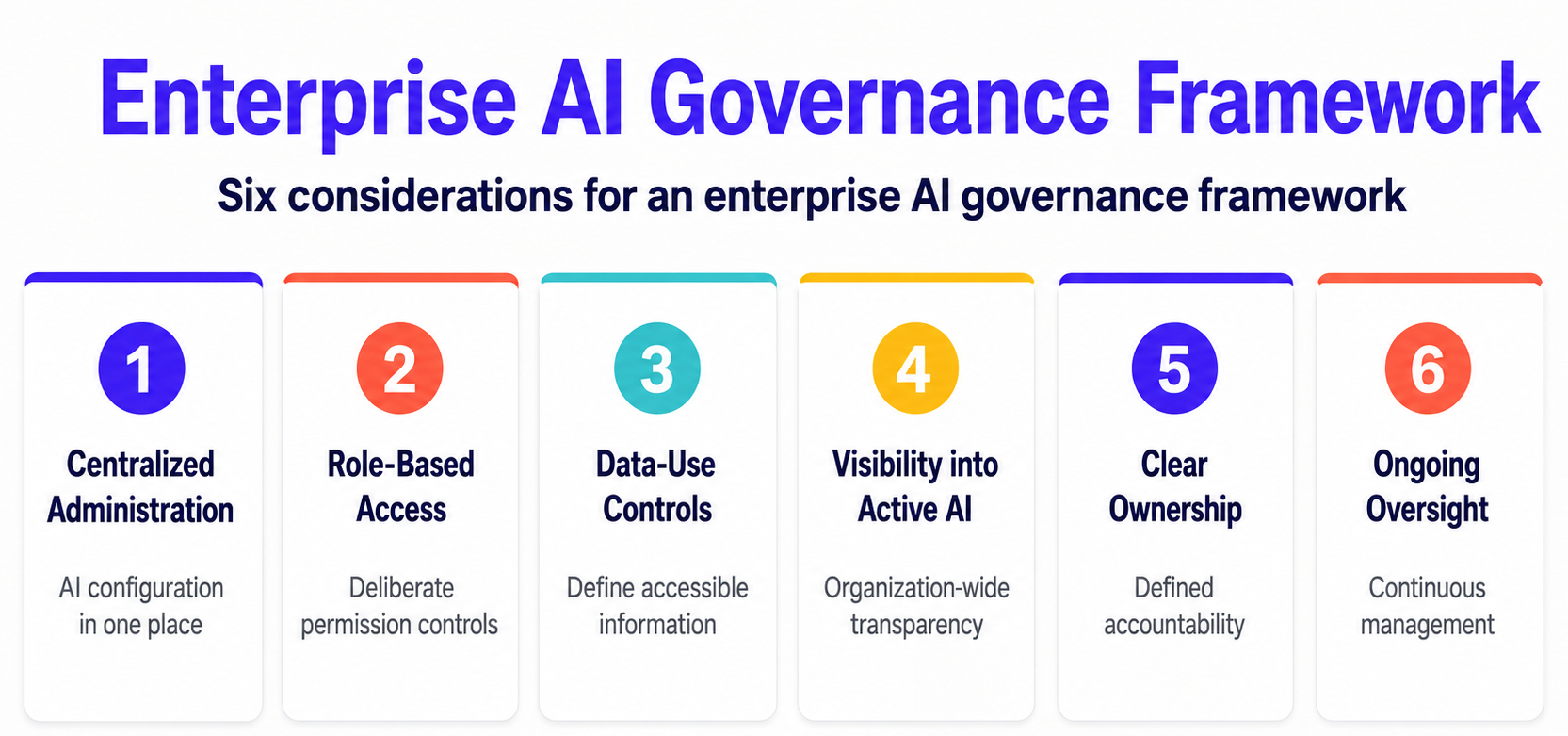
Closing that gap requires treating governance as infrastructure that supports the policies each organization has established, not just paperwork. A workable enterprise AI governance framework typically includes several recurring components across industries.
Auditability and traceability also belong to an enterprise governance framework. Organizations should understand what records a platform maintains about AI activity and how those records can be reviewed.
These are industry principles, not a single vendor's feature list, and any organization serious about scaling agentic AI will end up building toward most of them.
Governance is not the opposite of speed. Clear controls can give IT and security teams greater confidence to expand AI adoption because they can determine where specific capabilities should (and should not) be deployed.
A shared governance model also gives RevOps, sales leadership, and technical teams a common reference point. Instead of negotiating AI adoption project by project, organizations can establish guardrails that allow teams to expand use deliberately. Governance cannot eliminate AI-related risk, but it can help organizations manage that risk without either freezing adoption or moving forward without sufficient control.
This is the problem Outreach designed the AI Control Hub to address for revenue teams specifically.
Enterprise AI governance spans multiple layers, including access, data, oversight, and usage controls. AI Control Hub begins with a foundational one: giving organizations centralized control over where AI capabilities are enabled and who can use them.
As agentic AI expands across the Outreach platform, IT and RevOps need a consistent way to govern how those capabilities are deployed across revenue teams.
AI Control Hub gives IT and RevOps a centralized way to control which Outreach AI capabilities are enabled and which users can access them through profiles. It provides a centralized view of which capabilities are enabled and who has access, helping organizations introduce new capabilities deliberately rather than treating AI adoption as an all-or-nothing decision.
AI Control Hub does not represent the full enterprise AI governance stack. It addresses a foundational layer: centralized enablement and access control for Outreach AI capabilities.
Enterprise AI governance is the system of policies, roles, controls, and oversight an organization uses to manage how AI is deployed, who can use it, what data it can access, and how its activity is monitored.
Agentic AI can participate in workflows and take action, rather than only generate content or recommendations. That makes controls around access, data use, permissions, and oversight more important.
A practical framework typically includes centralized administration, role- and team-based access, data-use controls, visibility into active AI capabilities, clear ownership, and ongoing oversight.
Governance gives business and technical teams a shared set of controls. That can help organizations expand AI use while maintaining visibility over where it is deployed and how it operates.
Outreach named a Leader in the Forrester Wave™ for revenue orchestration
September 24, 2026
Outreach is a Leader in IDC MarketScape for Unified Revenue Orchestration Platforms — here's why
September 22, 2026
.jpg)
What is revenue orchestration? How AI agents change revenue work
September 22, 2026
