Blog
How to improve sales performance across your revenue team
October 1, 2026
Read more

TL;DR: Account executives don't need more tools for managing outreach volume — they need conversation intelligence that connects what buyers say to how deals are managed. This post covers what AE-focused conversation intelligence actually requires, why standalone recording tools fall short, and what to look for when evaluating platforms built for complex deal cycles rather than high-volume sequences
For most account executives, the hard part is not finding the next person to contact. It is understanding what is happening inside the deals already on their plate: which stakeholders are engaged, where momentum is slipping, what objections are emerging, and what needs to happen before the next meeting.
Once an SDR, BDR, or inbound source creates an opportunity, the AE takes ownership of a far more complex job. They need to:
Sequences still have a place in that work. They can help AEs follow up after meetings, maintain engagement, reach additional stakeholders, and re-engage buyers who have gone quiet.
But sequences alone do not solve the central challenge of AE work.
An AE managing active opportunities needs to understand what buyer conversations reveal about risk, momentum, stakeholder coverage, and next steps.
They also need support in the moments that shape those conversations: guidance while a buyer concern is still on the table, and coaching afterward that helps them run the next conversation more effectively.
Conversation intelligence gives AEs a clearer view of whether buyer activity is creating meaningful deal progress — and helps them strengthen the selling behaviors that move opportunities forward.
That’s where conversation intelligence for account executives matters.
Many AE teams are caught between two types of sales technology.
On one side are engagement platforms built primarily for outbound prospecting and sequence-based activity. They can be valuable for pipeline generation, especially for XDR and BDR teams, but may not reflect the day-to-day reality of AEs managing complex opportunities already in motion.
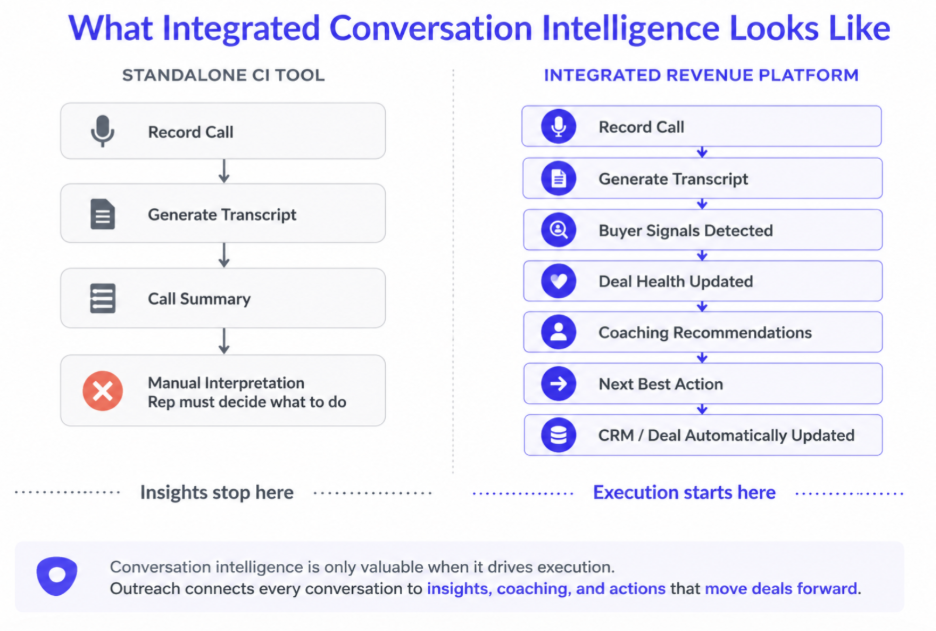
On the other side are standalone conversation intelligence tools. They can record calls, generate transcripts, summarize meetings, and surface useful moments for review. Many also integrate with CRM systems and provide valuable post-call analysis.
The question is whether conversation insight is connected closely enough to the workflows where AEs actually manage deals.
For an AE, a useful conversation is not simply a recorded interaction; it's a source of information about what the buyer needs, what could slow the opportunity down, who needs to be involved, and what should happen next.
When that information remains in a recording, transcript, or separate analytics view, the rep still must interpret the signal, decide whether it matters, and carry it into the CRM, account plan, forecast conversation, and follow-up workflow.
That is the execution gap.
Every meaningful buyer conversation contains information that should change how an AE understands or manages an opportunity.
That information is a deal signal, a piece of information that affects the health, direction, or next required action of an active opportunity. It may indicate momentum, risk, a missing stakeholder, a buying-process requirement, an objection, or a needed follow-up action.
Deal signals are not always dramatic. They are often subtle, and they are often easy to miss when a seller is focused on the next meeting, the next email, or the next opportunity in their pipeline.
Consider a familiar scenario.
During a discovery call, a buyer says that the CFO will need to approve any purchase above a certain threshold. They raise concerns about implementation complexity. They want their security lead involved in a technical review. They express interest in moving forward, but the meeting ends without a specific next step or agreed timeline.
Each of those statements changes the deal.
The CFO comment introduces a new approval requirement and a potentially important stakeholder. The implementation concern may become a risk if it is not addressed. The technical review adds another requirement to the buying process. And the lack of a concrete next step may indicate that the opportunity is less advanced than its CRM stage suggests.
Taken together, those signals should shape how the AE prepares for the next conversation, what internal resources they involve, how they assess deal risk, and what they discuss with their manager.
For AEs, the value of AI conversation intelligence lies in clarifying what each buyer conversation means for the deal: where momentum is building, where risk is emerging, and what needs to happen next.
Standalone conversation intelligence tools can capture valuable call insights. For many teams, recording, transcription, and post-call analysis are useful starting points.
But capturing insight is different from helping a team use it consistently.
Return to the buyer conversation above. The AE now knows that a CFO may need to approve the purchase, that implementation is a concern, and that a technical review must happen before the opportunity can move forward.
What happens next?
The rep may need to review the recording, update the opportunity record, revise the account plan, identify the security stakeholder, coordinate with a solutions consultant, create follow-up tasks, and explain the new risks in the next forecast review.
With that many moving pieces, an important detail can easily be missed or forgotten. The implementation concern may not make it into the account plan. The security review may not get scheduled. The CFO may never be added to the stakeholder map. The meeting may end without a next step, and no one notices until the deal has already slowed down.
The challenge is not simply that the work spans multiple systems and workflows. It is that deal signals can get buried beneath the administrative work required to keep an opportunity moving.
That creates risk beyond extra clicks. A missing stakeholder, unresolved concern, or weak next step may never change how the opportunity is managed—and may only surface later, when the forecast slips or the deal stalls.
Integrated conversation intelligence brings conversation context closer to the places where AEs and managers already manage opportunities.
Before a meeting, an AE should be able to prepare with a clearer picture of the account: recent interactions, open commitments, relevant account context, relationship coverage, and potential deal risks. That reduces the need to reconstruct the history of an opportunity from disconnected notes, old recordings, and scattered CRM updates.
During a conversation, AEs need to recognize the moments that can change the direction of a deal: an objection, a newly mentioned stakeholder, a competitor reference, an implementation concern, or a vague commitment. Real-time topic detection and relevant guidance can help reps notice those moments and explore them while the buyer is still in the conversation.
The learning should continue after the call. Post-call insight gives AEs and managers a clearer view of what worked, what was missed, and how the next conversation could be stronger. A rep may see that they moved too quickly past an objection, did not probe the buying process, or ended without securing a meaningful next step. Managers can use the same conversation data to provide more consistent coaching across the team.
That turns conversation intelligence into more than a record of what happened. It becomes a way for AEs to improve how they discover, respond, and advance deals over time.
After a meeting, the most important question is whether the information captured becomes part of how the deal is reviewed and managed.
A strong workflow makes it easier for sellers and managers to review commitments, risks, stakeholder gaps, and next steps alongside the account and opportunity context they already use. It gives managers a more structured basis for coaching, grounded in what buyers actually said rather than what a rep remembers from a call.
That’s the model behind Amplify Essentials.
Amplify Essentials is a CI-first offering for AE-led teams whose primary work is managing and advancing active opportunities, rather than running high-volume sequence programs. It’s designed for teams that want stronger visibility into buyer conversations, deal context, and coaching without adopting sequence- and automation-heavy capabilities they may not currently need.
With conversation intelligence, account context, relationship mapping, and AI-assisted coaching and deal insight in one environment, the goal is to help AEs connect what buyers say to what the deal requires next.
Capabilities such as Meeting Prep Agent, Deal Agent, AI Coach Cards, and AI Topic Mentions can support that workflow by helping sellers prepare, identify important moments, and bring more consistent insight into deal reviews and coaching conversations.
For AE-led teams evaluating standalone CI tools — or looking to consolidate an existing stack — this creates a more focused starting point with room to expand as their needs evolve.
Whether your team is evaluating conversation intelligence for the first time or reconsidering a standalone CI tool, these questions can help clarify what you actually need.
A recording is useful, but it is only the starting point. Ask how conversation insight is surfaced alongside the opportunity, account plan, and deal-review workflows your team already uses.
Manager coaching should not depend on the few calls someone happened to review that week. Look for a platform that helps managers identify patterns across conversations, evaluate important selling behaviors, and coach from evidence rather than intuition.
Sequences can be valuable, but they are not the primary workflow for every sales organization. If your AE team is focused on complex deal management while a separate group handles outbound prospecting, evaluate whether the platform fits that motion.
The value of CI for AEs depends on what happens after the call. Evaluate not only what the tool captures, but how easily sellers can review that context while managing stakeholders, preparing for meetings, and assessing deal risk.
Post-call analysis matters. But in a complex opportunity, what an AE notices during a meeting (and how quickly they act afterward) can matter even more. Look for tools that support preparation, real-time awareness, and effective follow-through.
AE-led teams can have plenty of activity across their pipeline. The harder question is whether those interactions are creating real progress in the deals that matter.
A deal may look healthy in the CRM while an important concern sits buried in a recent conversation. A buyer may remain responsive while their internal priorities are shifting. A champion may still attend meetings while losing the influence needed to move a decision forward.
AEs need conversation intelligence that helps them understand what is happening in buyer conversations, connect those insights to the health of the deal, improve how they handle the next conversation, and reduce the administrative work that takes time away from selling.
Request a demo to see how Amplify Essentials can help AE teams bring conversation intelligence, deal context, coaching, and more efficient follow-through closer together.
Bring conversation intelligence, deal context, and coaching together for your AE team.
Conversation intelligence for account executives helps sellers understand what buyer conversations reveal about active opportunities. It can surface important topics, objections, stakeholder information, commitments, and coaching opportunities so AEs can manage deals with more context.
SDR and BDR teams often use sales technology to generate initial engagement and build pipeline through outbound activity. AEs may also use outreach tools, but their central work is usually managing complex opportunities after interest has been established.
For AEs, conversation intelligence is especially valuable when it helps them understand deal health, stakeholder coverage, risk, next steps, and potential expansion opportunities that emerge in buyer conversations.
Yes. Sequences and outbound automation can be useful, but they solve a different problem. AE teams can use conversation intelligence to prepare for meetings, understand buyer concerns, identify deal signals, support follow-up, and improve coaching even when sequence usage is minimal.
A standalone CI tool may provide recording, transcription, summaries, and call analysis. An integrated platform brings conversation context closer to the workflows sellers use to manage accounts, assess deals, prepare for meetings, and work with managers on coaching and next steps.
Buyer conversations often reveal information that does not appear clearly in activity metrics alone. A missing stakeholder, unresolved implementation concern, shifting timeline, weak next step, or change in champion confidence can all affect how healthy an opportunity appears. Conversation intelligence helps teams identify and review those signals before they become larger forecast problems.
What happens when account intelligence meets agentic AI? Learn how Demandbase and Outreach work together to help revenue teams identify the right accounts, prioritize the right actions, and execute more effectively across the entire revenue lifecycle.