Blog
AI Agent Interoperability: How Connected Agents Align Sales and Marketing
October 22, 2026
Read more
TL;DR: AI agents improve sales productivity by automating research, meeting prep, and administrative tasks — freeing sellers to engage more accounts, respond faster, and close deals more consistently. According to Outreach's 2026 Agent Productivity Impact Report, AI cuts meeting prep time by up to 50% and saves 15–21 minutes of admin work per day. This article breaks down how those time savings translate into measurable gains across pipeline coverage, conversion rates, and revenue execution.
Sales professionals have to constantly juggle their admin work with meaningful buyer engagement. When revenue teams operate across fragmented tools and manual workflows, valuable selling time is lost to research, data entry, and follow-up; slowing pipeline progression and delaying revenue opportunities.
AI agents introduce a fundamentally different model. Instead of simply storing information, they actively assist sellers by preparing accounts, capturing insights, and automating routine work in real time. The result is faster execution across the sales cycle; enabling teams to engage more accounts, expand pipeline coverage, and improve conversion rates.
According to recent data from our 2026 Agent Productivity Impact Report, sellers using AI agents reclaim significant time across their workflow — cutting meeting prep time by up to 50%, saving 23 to 26 minutes per meeting, and reducing administrative work by 15 to 21 minutes per day.
This reclaimed time directly translates into business impact. It allows revenue teams to engage more accounts, respond faster to buyer intent, and execute deals with greater consistency. Speed is critical; faster response times directly influence conversion rates and determine whether opportunities are captured or lost.
The sections below show how AI agents translate reclaimed time into measurable impact across pipeline coverage, conversion, and revenue execution.
Pipeline growth is often constrained by time, not opportunity. When sellers can’t engage enough accounts, pipeline coverage suffers and revenue opportunities are left untapped.
Sellers are expected to research accounts, identify stakeholders, review past interactions, and craft personalized outreach before a single conversation takes place. These tasks are essential, but they limit how many accounts a rep can realistically engage.
AI agents remove this bottleneck by automating the research and preparation phase, allowing sellers to engage more accounts and expand pipeline coverage more efficiently
Instead of spending an hour gathering account context, sellers receive a synthesized briefing with key insights, recent activity, and recommended next steps.
The impact is measurable. AI reduces meeting preparation time by 50%, saving roughly 23 to 26 minutes per meeting.
Get the full 2026 Agent Productivity Impact Report to see how leading teams use AI agents to reduce prep time, engage more accounts, and improve conversion rates.
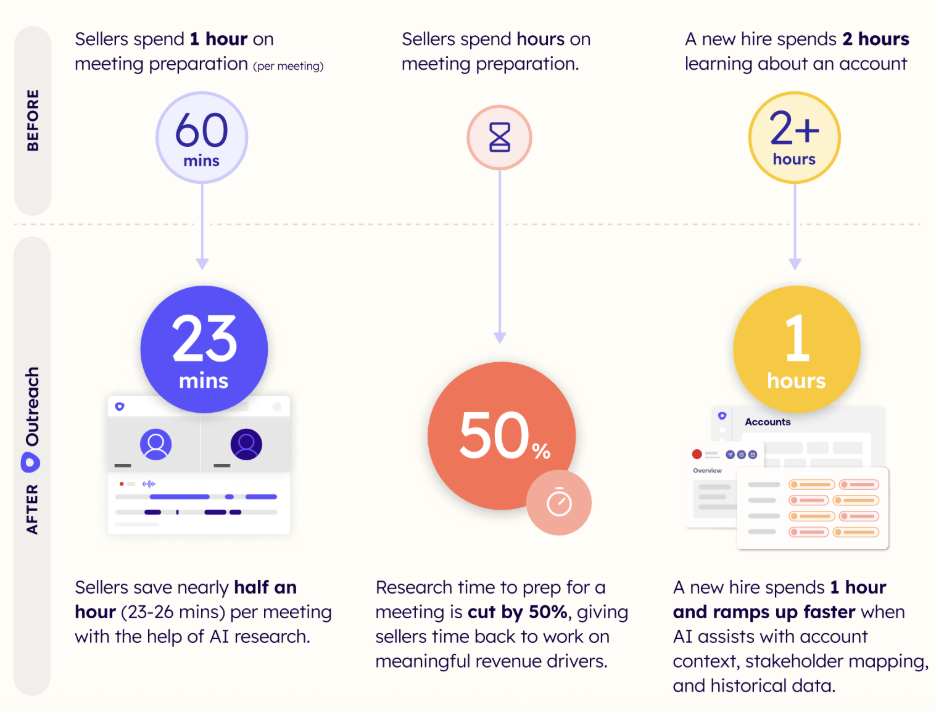
That recovered time increases execution capacity:
Pipeline expands when teams can engage more accounts with the same time — not by working harder.
Generating pipeline is only the first step. In enterprise sales, deals are won or lost in the moments between interactions; where timing, relevance, and execution quality determine whether opportunities convert into revenue.
Response speed plays a defining role in whether opportunities move forward or stall. Faster response times directly impact conversion rates by ensuring engagement happens when buyer intent is at its peak.
AI agents eliminate this gap by acting as a digital first responder; engaging buyers immediately and preserving momentum when intent is highest. This directly improves conversion outcomes.
The report reinforces: delays introduce friction and increase the likelihood that opportunities are lost or competitors step in .
AI agents improve conversion in two critical ways:
During meetings, agents capture notes, track action items, and surface relevant information in real time. Sellers no longer need to split their attention between the conversation and administrative tasks.
Post-meeting summaries, follow-ups, and CRM updates are generated automatically, eliminating delays between interactions.
This speed compounds across the sales cycle:
Conversion improves by removing friction at every step of the buyer journey and ensuring opportunities don’t stall.
As pipeline grows and deals progress, execution becomes the defining factor — and the key to predictable revenue and forecast accuracy.
Without a unified system, teams rely on incomplete data and manual updates, leading to late-stage surprises and unreliable forecasts.
AI agents address this by continuously capturing and structuring activity across the revenue workflow, giving leaders real-time visibility into deal progression and engagement signals, as shown below.
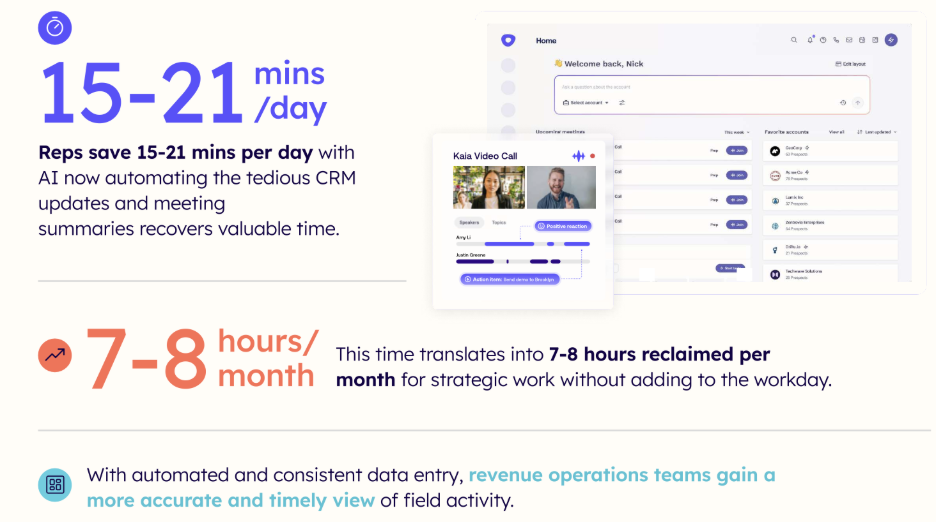
This creates a foundation for consistent execution:
When every interaction is captured and analyzed, execution becomes repeatable — driving more predictable pipeline outcomes and reducing revenue risk.
The value of AI agents comes from how teams reinvest the time they reclaim into revenue-generating activities
The report shows that sellers can reclaim hours each week across research, prep, and administrative work.
That time is reinvested into:
This is the shift: AI agents don’t just make work faster — they increase pipeline generation, improve conversion rates, and expand revenue capacity without adding headcount.
The value of AI agents comes from how teams reinvest the time they reclaim into revenue-generating activities.
The report shows that sellers recover hours each week across research, preparation, and administrative work.
That time is reinvested into:
AI doesn’t just make work faster. It increases the amount of revenue-generating work a team can perform without adding headcount.
Traditional automation follows predefined rules. AI agents operate with context. They can interpret conversations, summarize unstructured data, and dynamically assist sellers based on real-time inputs.
Look for solutions that integrate directly into your existing workflow, provide enterprise-grade security, and unify data across systems. The goal is to eliminate silos, not create new ones.
No. AI agents enhance human sellers by removing administrative burden and providing insights. Relationship building, negotiation, and strategic thinking remain human strengths — and become even more important when supported by AI.
AI agents improve pipeline coverage by enabling reps to engage more accounts, increase conversion rates through faster response times, and drive more consistent revenue execution.